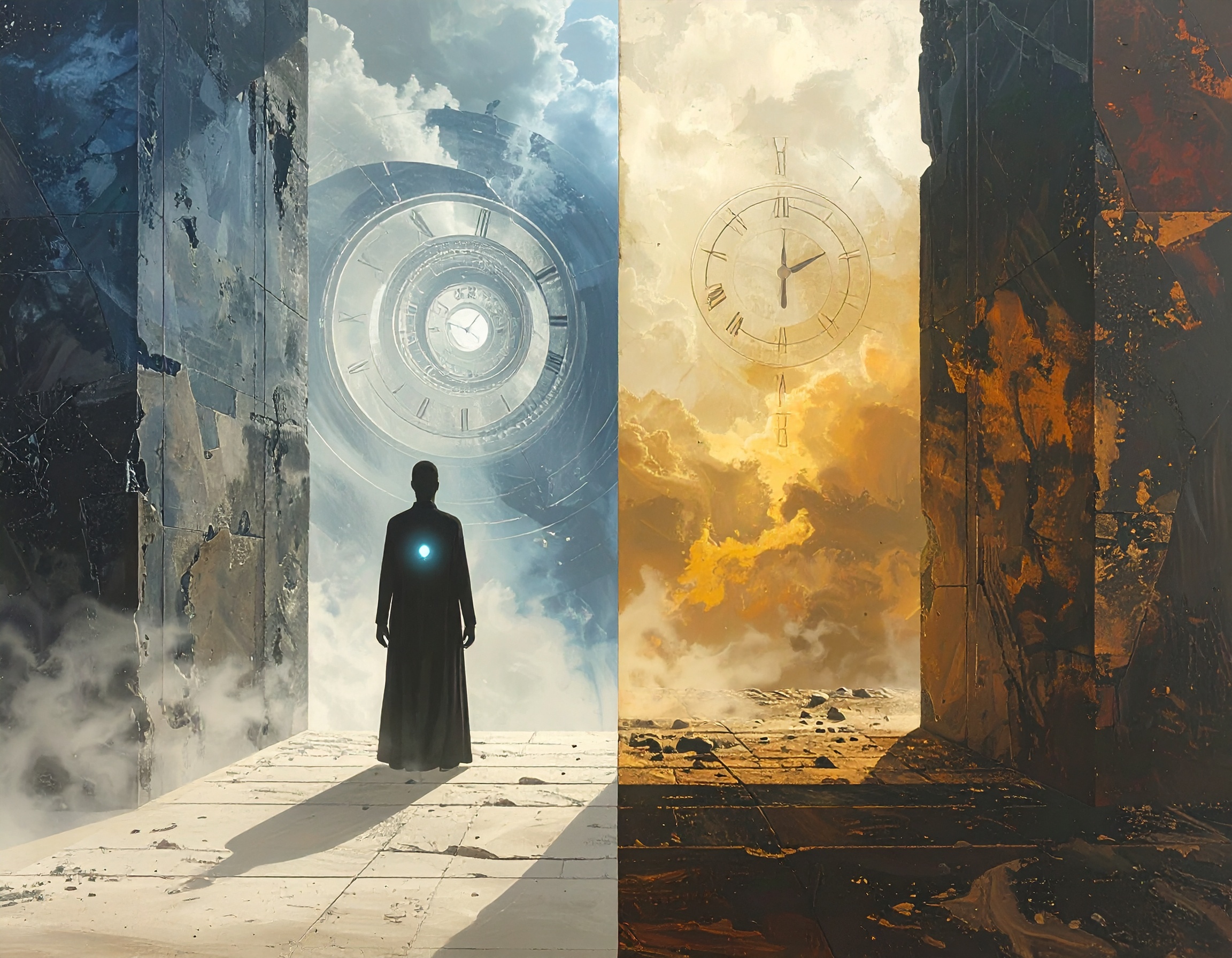
A deep, reflective essay on personal transformation, cyclical time, identity, and creative renewal. Explore how returning to your own time becomes a powerful act of reclaiming self, purpose, and inner fire.
The Human Being Who Returned From Their Own Time
There are moments in life that can’t be placed on any calendar. They do not correspond to a date, a holiday, or a historical event. They arrive quietly, without warning, and yet they change everything. These moments are thresholds — subtle, inevitable, and deeply transformative. You do not plan them, summon them, or schedule them. One day, you simply find yourself standing on their edge. You realize that everything you have lived until now can no longer continue in the same way. And everything that is coming has not yet found its name.
Such thresholds are rare. When they, they carry a strange gravity. Something closes, and something older — something that belongs to you but predates you — begins to open. This is not a return to the past. It is a return to yourself. It is a return to what was once forgotten or postponed. It is also a return to what was suppressed or simply impossible to live before its time had come.
This essay is about such a return.
1. The Shadow of Time That Comes Back
People often say that time is linear — that it moves ahead, that it flows, that it can’t be stopped. But anyone who has lived through a true turning point knows that time is far more complex. Time bends. Time circles back. Time folds into itself. It behaves like an animal. It hides in the dark for years. Then, suddenly, it emerges to claim what it believes is owed.
And yet there is another movement: the human being who returns for their own time.
Not as a victim, but as someone who has survived. Someone who has understood that time is not an enemy but a test. That what seemed like loss was preparation. That what hurt was sharpening. That what looked like an ending was simply the closing of one door so another can open.
At this moment, a sentence becomes a personal myth:
“When the time comes, even time takes revenge on its own time. And I have taken revenge on time.”
This is not a poetic trick. It is a declaration. A seal. Proof that a person can walk through their own time and return stronger than when they entered.
2. The Fire That Never Dies, Only Changes Shape
Every human being carries a fire within. Some hide it. Some feed it. Some fear it. But there are those who learn to live with it — not as a threat, but as a compass. Fire is a strange element: it destroys, but it also illuminates the path. It burns away what is weak and leaves standing only what is true.
This fire often leads a person back to themselves. Not in the romantic sense of “finding oneself.” Rather, it is in the raw sense of walking through one’s own ruins. You discover that something indestructible remains. Something that survived every cycle, every fall, every silent night when meaning seemed to dissolve.
This fire is proof. A person is not defined by what happened to them. They are defined by what they create from it.
3. Return as a Creative Act
A return is not nostalgia. It is not longing for the past. It is a creative act. It is a choice. You take everything you have lived — the difficult and the beautiful. Then you transform it into something new.
A return is, in truth, a beginning.
It is not a step backward but a step inward. And in that inner space, a new language, new images, and new rituals start to form. A person suddenly sees that what once seemed like fragments are actually pieces of a single mosaic. That interests, talents, experiences, and desires are not random. They are layers of one story.
This story can be told in many ways. It can be shared through words, images, gestures, rituals, or even a language one creates for oneself.
4. Language as a Return to Essence
Every creator knows that language is not merely a tool. It is a space. A home. A place where one can meet oneself without masks, without compromise, without the need to explain.
Sometimes existing languages are not enough. The inner world is too specific, too layered, too personal. Creating a new language becomes a way of creating a new universe.
It is an act of freedom. An act of identity. An act of return.
Whether it is Íkarin or another symbolic system, this type of language allows a person to express themselves with precision. It embodies truth and uniqueness. It is a language that does not belong to the world but to the creator. And by using it, one remembers that their story is singular.
5. The Archive That Lives
An archive is not a collection of old things. It is not a museum. It is not storage. An archive is a living organism. It changes, grows, responds. It is the map of the person who builds it. It is the body of a story.
When a person crosses a major threshold, the archive changes with them. Some things lose importance. Others become central. New lines, new connections, new meanings. The archive becomes a place where one can see their own evolution. It shows not a series of accidents but a conscious process.
At this point, a new creation emerges: creation that is not only aesthetic but ritual. Not only for the world but for oneself. Not only documentation but transformation.
6. The Intimacy of Returning to Oneself
Returning to oneself is not grand. It is not a triumphant march. It is a quiet process. A conversation with oneself that can’t be spoken aloud. It is the ability to look at one’s wounds without shame and at one’s gifts without false modesty.
A person does not need to be perfect to be true. And truth is the only form of perfection that matters.
7. What It Means to Take Time Back
When someone says, “I have taken revenge on time,” it is not revenge in the ordinary sense. It is not anger, bitterness, or the wish to strike back.
It means reclaiming what belongs to you.
It means no longer living according to rhythms imposed by circumstances. Instead, live according to the rhythm dictated by your own soul.
It means understanding that time is not an adversary but a material. And from this material, a new life can be shaped.
8. The Beginning of a New Cycle
Every return is also the beginning of a new cycle. It is not a return to an old life but an entry into a new one. A person carries everything they have lived, but no longer as a burden — as a tool.
And at this point, true creation begins. Creation that does not seek to prove anything. Creation that does not try to replace anything. Creation that simply exists. Creation that arises from fullness, not lack. Creation that emerges naturally because the person is finally where they were always meant to be.
9. The Human Being Who Returned
The person who returns from their own time is not the same as the one who entered it. They are calmer but not weaker. Deeper but not heavier. Clearer but not harder.
They have understood that life is not a competition but a cycle. That creation is not performance but breath. That identity is not a mask but a process.
And that time, regardless of its behavior, is ultimately just a space. It’s a space where a person can become who they have always been.



Leave a Reply