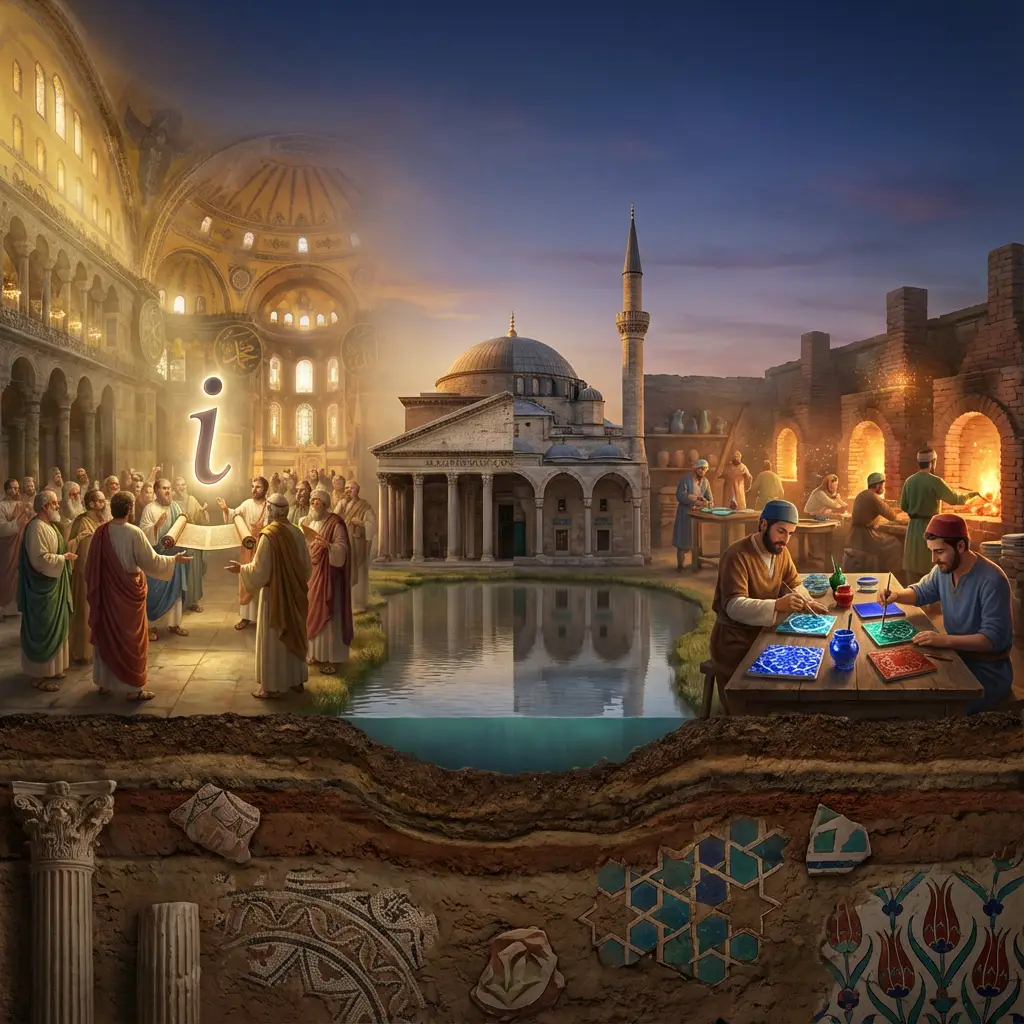
From Christ’s Divinity to Sultan’s Tiles: The Astonishing Dual History of Iznik
1. Introduction: The Small Town That Forged Two Worlds
Tucked away in northwestern Turkey, on the serene shore of a vast lake, lies the tranquil town of Iznik. To a casual visitor, it seems like a quiet district center. It is rich in history, but unassuming in its modern pace. Yet, this unassuming town has twice altered the course of world history. It is a town built on a paradox.
Iznik is globally significant for two entirely different reasons, separated by nearly a thousand years. This single location was the crucible where the foundational doctrines of Christianity were forged in the fires of theological debate. Centuries later, under a different empire and a different faith, it rose again. It became the epicenter of the Ottoman Empire’s most celebrated artistic achievement: its luminous, world-famous ceramics.
Here are five surprising truths that reveal the counterintuitive and deeply layered history of this remarkable city.
2. Five Surprising Truths About Historic Iznik
The Future of Christianity Was Decided by a Single Letter
In 325 AD, when the town was known as Nicaea, Roman Emperor Constantine convened the first-ever ecumenical council. He aimed to unite a church divided by the Arian controversy. This was a bitter dispute over the divine nature of Jesus Christ. The core of the debate was ferociously specific: Was Christ of the same substance as God the Father, or was he merely of a similar substance?
The entire theological argument would shape the future of the faith. It hinged on the difference between two Greek words: homoousios (“of one substance”) and homoiousios (“of a similar substance”). A single letter—the iota (“i”)—distinguished the foundational creed for the vast majority of Christians today. This letter defined the creed.
It Became the Capital of a “Lost” Byzantine Empire-in-Exile
In 1204, the Fourth Crusade did the unthinkable: Western European and Venetian forces sacked Constantinople, shattering the Byzantine Empire. The Byzantine aristocracy fled the fallen capital and established several successor states to continue the fight. The most powerful and best-positioned of these was the state founded at Nicaea.
From 1204 to 1261, this “Empire of Nicaea” served as the Byzantine government-in-exile. It was more than a mere successor state; it acted as the keeper of the Roman flame. And preserved the legal, cultural, and imperial traditions of a civilization that stretched back over a millennium. Also preserved imperial traditions, titles, and the singular goal of restoration. This government-in-exile was ultimately successful. In 1261, forces under the command of Michael VIII Palaiologos, the emperor of Nicaea, recaptured Constantinople. They restored the Byzantine Empire, ensuring its survival for another two centuries.
A Christian Ruling on Holy Images Was Made in What is Now a Mosque
Nicaea hosted not one, but two critical ecumenical councils. In 787 AD, the Seventh Ecumenical Council took place in the city’s great church, the Hagia Sophia. The council aimed to resolve the Iconoclast controversy. This was a century-long, violent debate over the use of religious images, or icons.
The council restored the veneration of icons. It delivered a ruling that the honor paid to an image passes to the person it shows. This decree ended the official destruction of religious art. It remains central to Catholic and Orthodox theology. It is also recognized by Anglican and other major Protestant traditions. In a profound twist of history, the Ottomans converted the Hagia Sophia of Nicaea into a mosque. This was the building where this foundational Christian ruling was made. The ruling occurred after their conquest of the city in 1331. It remains a mosque today.
Its World-Famous Ceramics Were Misidentified for Centuries
Iznik’s second great claim to fame is its unparalleled ceramic and tile production. This craftsmanship peaked in the 16th century under the Ottoman Empire. These brilliant wares were the signature of imperial power. They covered the walls of the Topkapi Palace and mosques commissioned by figures like Suleyman the Magnificent. This includes the famous Rustem Pasha Mosque, which is a veritable museum of Iznik tilework. As European collectors began acquiring these masterpieces in the 19th century, they had no idea where they were made. This led to a series of misattributions based on where the pieces were found or their supposed style.
- “Rhodian” ware: This name refers to pottery with a vibrant, sealing-wax red color. Collectors named it this way because they acquired most of their examples on the island of Rhodes.
- ‘Damascus’ ware: Pieces have a distinct pastel palette of sage green and pale purple. People once thought they had originated in Damascus, Syria. This belief was incorrect.
- ‘Abraham of Kutahya ware’: All early blue-and-white pottery was attributed to the town of Kutahya. This attribution was based on a single, inscribed ewer from 1510. This ewer mentioned a man by that name.
It wasn’t until the 1930s that art historians finally pieced the puzzle together. They realized that these distinct and magnificent styles all came from the workshops of a single town: Iznik.
The Art Was So Perfect, Its Own Technology Helped Destroy It
The technical superiority of Iznik ceramics was unmatched. Potters created a quartz-based artificial ceramic known as fritware, which produced a hard, brilliant white body. This was covered in a clear, lead-alkaline-tin glaze that made the colors beneath shine with exceptional clarity. But the industry collapsed in the 17th century, and not just because of lost imperial funding or economic inflation.
The very materials of its genius were its poison. The fritware body had high-quartz content that produced breathable silica dust. The brilliant lead-alkaline-tin glaze also released toxic vapors in the kilns. A surprising and tragic factor was that the materials themselves were inherently hazardous to the artisans.
The cumulative and adverse health effects include breathing silica dust from the body and lead vapors from the glazes. Additionally, the endemic malaria of Iznik’s lake basin posed significant health risks. There was also a profound change in the Ottoman economy…
The technological perfection of the craft gave the world such beauty. This perfection was intertwined with the systemic collapse of the community that had mastered it.
3. Conclusion: A City Written in Layers
Iznik’s history is rooted in profound transformations. These shifts are often paradoxical. Here, in the same soil, a debate over Christ’s divinity laid the bedrock for one of the world’s great religions. Centuries later, that ground gave forth the clay that would become the defining artistic expression of a great empire. The city’s identity is written in these layers—Roman, Byzantine, Seljuk, and Ottoman—each leaving an indelible mark.
The original workshops fell silent for 300 years. Yet, a modern revival has brought the town’s artistic legacy back to life. Artisans are once again producing the brilliant tiles that made Iznik a household name in the art world.
How many other places in the world have so quietly shaped history, and what stories do their layers hold?


Leave a Reply