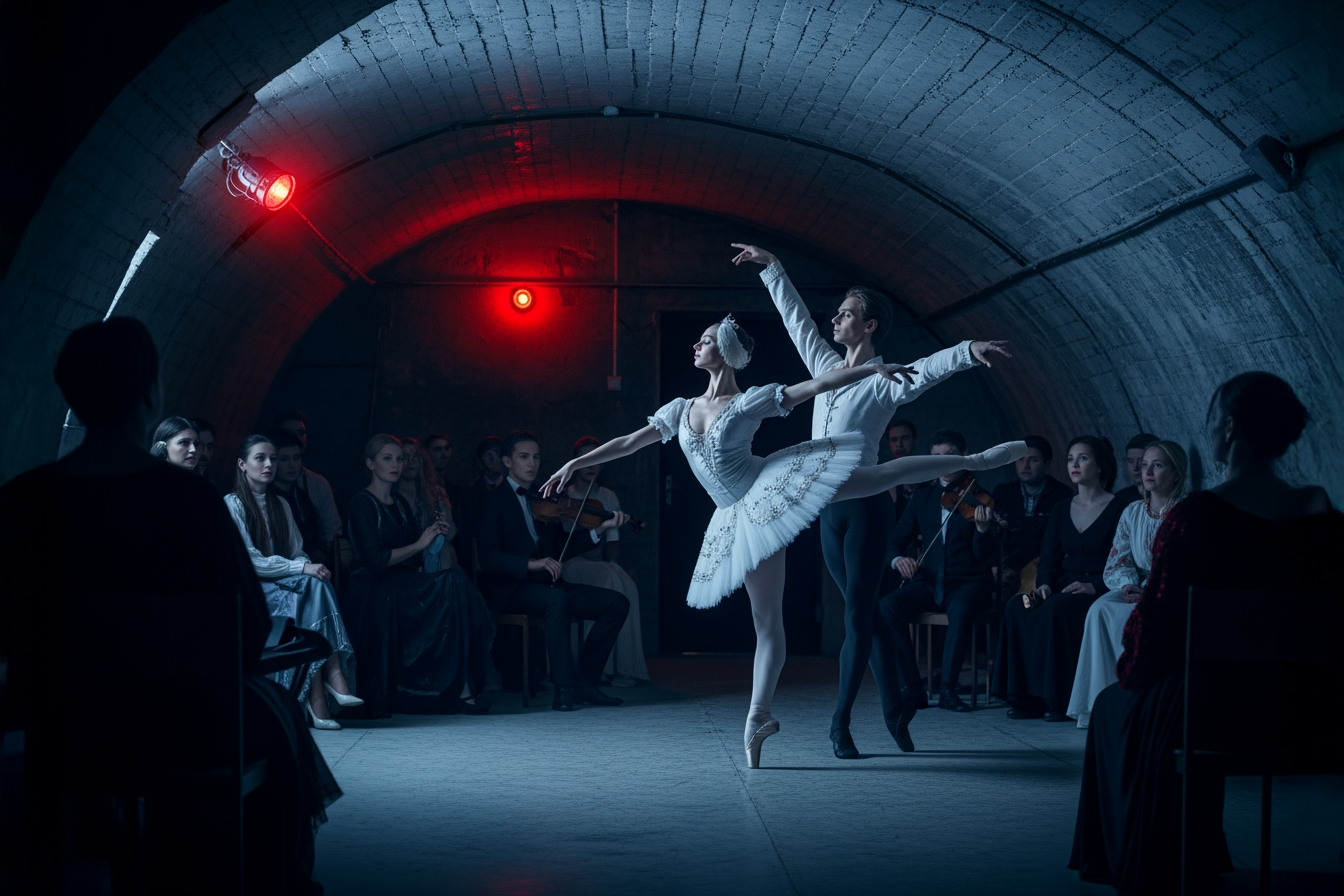
The Ukrainian National Ballet performs in bomb shelters, reshapes its repertoire, and loses artists to the front. A powerful story of cultural resistance in wartime.
Table of contents:
- Sirens, Exiled Ballets and Artists in the Trenches: A Portrait of Resistance by the Ukrainian National Ballet
- Art Under Fire: Performances in a Bomb Shelter
- Cultural Decolonization: Ballets Removed from the Repertoire
- From Artist to Soldier: A Broken Chain of Artistic Transmission
- A Changing Mission: Art as “Obligation,” Not “Honor”
- Artistic Heritage in the Shadow of War: Kovtun’s Innovative Choreography
- Conclusion
Sirens, Exiled Ballets and Artists in the Trenches: A Portrait of Resistance by the Ukrainian National Ballet
When one thinks of ballet, usually grace and delicate beauty come to mind. It also provides a brief escape from the anxieties of daily life. Dancers glide in tulle. Audiences marvel at magnificent sets and enchanting music. Yet this idyllic image has been shattered by the brutal reality of war for the Ukrainian National Ballet. For them, the stage has transformed into a front line. It is no longer merely a space for art. National identity is being redefined here, shaped by sacrifice and a conscious act of defiance. This company is not simply surviving. Amidst the war, it is actively reinventing its artistic purpose. It is transforming its repertoire and redefining the very reason for its existence. In this article, we explore key aspects of how the Ukrainian National Ballet is rebuilding its artistic identity. This transformation happens in the face of an existential threat.
Art Under Fire: Performances in a Bomb Shelter
At the Taras Shevchenko National Academic Opera and Ballet Theatre in Kyiv, art has not stopped. It continues intertwined with the harsh realities of war. Performances are staged before a limited audience, constrained by the 400‑person capacity of the theatre’s bomb shelter. This alone reveals how art becomes a source of comfort. It is a search for normalcy, even in the most difficult conditions.
Even more astonishing is that performances are often interrupted by air-raid sirens. When the sirens sound, dancers, orchestra members, and the audience must descend together into the shelter. Once the danger passes, they return to the stage. It is as if nothing happened. The performance resumes exactly where it left off. Principal dancer and Ukrainian People’s Artist Mykyta Sukhorukov describes this tragic routine. He explains that people now react quite calmly. They are accustomed to the sound of sirens. At first everyone panicked and ran to safety, but now fewer people go to the shelters.
This is living proof that art can be a form of resistance. It serves as a beacon of hope even in the darkest moments.


Cultural Decolonization: Ballets Removed from the Repertoire
The war has profoundly reshaped the artistic identity of the Ukrainian National Ballet. This is not just a simple boycott. It is a deliberate and radical step toward asserting artistic sovereignty. It signifies stepping out of the shadow of Russian cultural heritage. During international tours like Nadiya Ukraine, the company made a conscious decision. They reshaped their repertoire through a meticulous cultural surgery. It is an intellectual and artistic campaign aimed at de‑imperializing the ballet canon.
“There is not a single Russian composer or Russian choreographer in the program. It is forbidden. Tchaikovsky’s ballets have been exiled… Everything related to Russia has been cut out.”
Sukhorukov’s words reveal the decisiveness of this stance. Yet this is not a crude purge. Classics like Don Quixote stay in the repertoire. This is because its composer, Ludwig Minkus, was Austrian by origin. He was active in the Russian Empire. Such distinctions show that the company is not merely making a political statement. It is carefully disentangling itself from Russian cultural hegemony. At the same time, it is presenting Ukraine’s own artistic identity to the world. The struggle to redefine Ukrainian culture on the global stage carries a human cost. This cost is embodied in the stories of artists like Oleksandr Shapoval.
From Artist to Soldier: A Broken Chain of Artistic Transmission
The most painful impact of war on cultural life is the loss of human beings. Oleksandr Shapoval, a ballet dancer who performed at the Ukrainian National Opera for 28 years and held the title of Honored Artist of Ukraine, became a symbol of this tragedy. In the 2018 recording of The Nutcracker, we saw him as the “Spanish Doll.” In 2022, he volunteered to defend his country, trained as a mortar operator, and was killed by mortar fire on September 12, 2022.
His death is not merely the loss of one artist. It is a deep wound to the fragile world of ballet. This world relies on personal attention and the passing of knowledge from master to apprentice. Shapoval was not only a dancer but a repository of knowledge, a mentor, a bearer of an artistic lineage. Ballerina Yuliia Moskalenko honors his sacrifice with these words: “He was a true hero.” He was not only on stage, but also in real life.”
A Changing Mission: Art as “Obligation,” Not “Honor”
The war has fundamentally transformed the purpose of the Ukrainian National Ballet. For its dancers, performing is not just an artistic expression. It is an existential struggle and a cultural duty. Tours like Nadiya Ukraine now serve a strategic purpose. They turn art into a tool of international diplomacy. These tours also serve as a means of raising funds for national survival.
Sukhorukov summarizes this transformation powerfully:
“Before February 23, 2022, politics and art were separate. Now they are not. I dance for the Ukrainian National Ballet. I symbolize my country. This is a political stance. It used to be an honor; now it is a necessity. It stands for something very important.”
These words reveal the weight now resting on the shoulders of the artists. Every performance has become a declaration of Ukraine’s resistance and cultural identity. Dance has turned into a powerful instrument of cultural diplomacy, amplifying Ukraine’s voice on the international stage.
Artistic Heritage in the Shadow of War: Kovtun’s Innovative Choreography
The Ukrainian National Ballet’s struggle today is about more than just survival. It also involves preserving a rich and dynamic artistic heritage. They do not keep a static museum of classical ballet. Instead, they uphold a bold and innovative tradition. This tradition is distinctly Ukrainian and focuses on reinterpretation. One of the most important figures in this tradition is the legendary Ukrainian choreographer Valeriy Kovtun.
Kovtun’s interpretations of The Nutcracker and Swan Lake are not mere productions — they are psychologically rich and daring reimaginings. In his Nutcracker, Clara is danced by a prima ballerina from beginning to end. This transforms the story into a journey of coming‑of‑age. Another bold choice is casting a female dancer in the role of Clara’s brother Fritz. This decision pushes the boundaries of traditional gender roles. This psychological depth and audacity are central to the company’s unique cultural identity. This is the very identity it now defends both on stage and symbolically on the battlefield.
Conclusion
The Ukrainian National Ballet’s story includes performances in bomb shelters. It also involves removing Russian classics from the repertoire. This story is a vivid testament to how art can redefine a nation’s identity. The death of a hero on the front line also contributes to this transformation of art into a “necessity.” These dancers carry not only their steps onto the stage but also the soul and resilience of their nation. In the darkest times, even a tutu or a pirouette can become a powerful symbol of hope and resistance.
Similar posts:


Leave a Reply