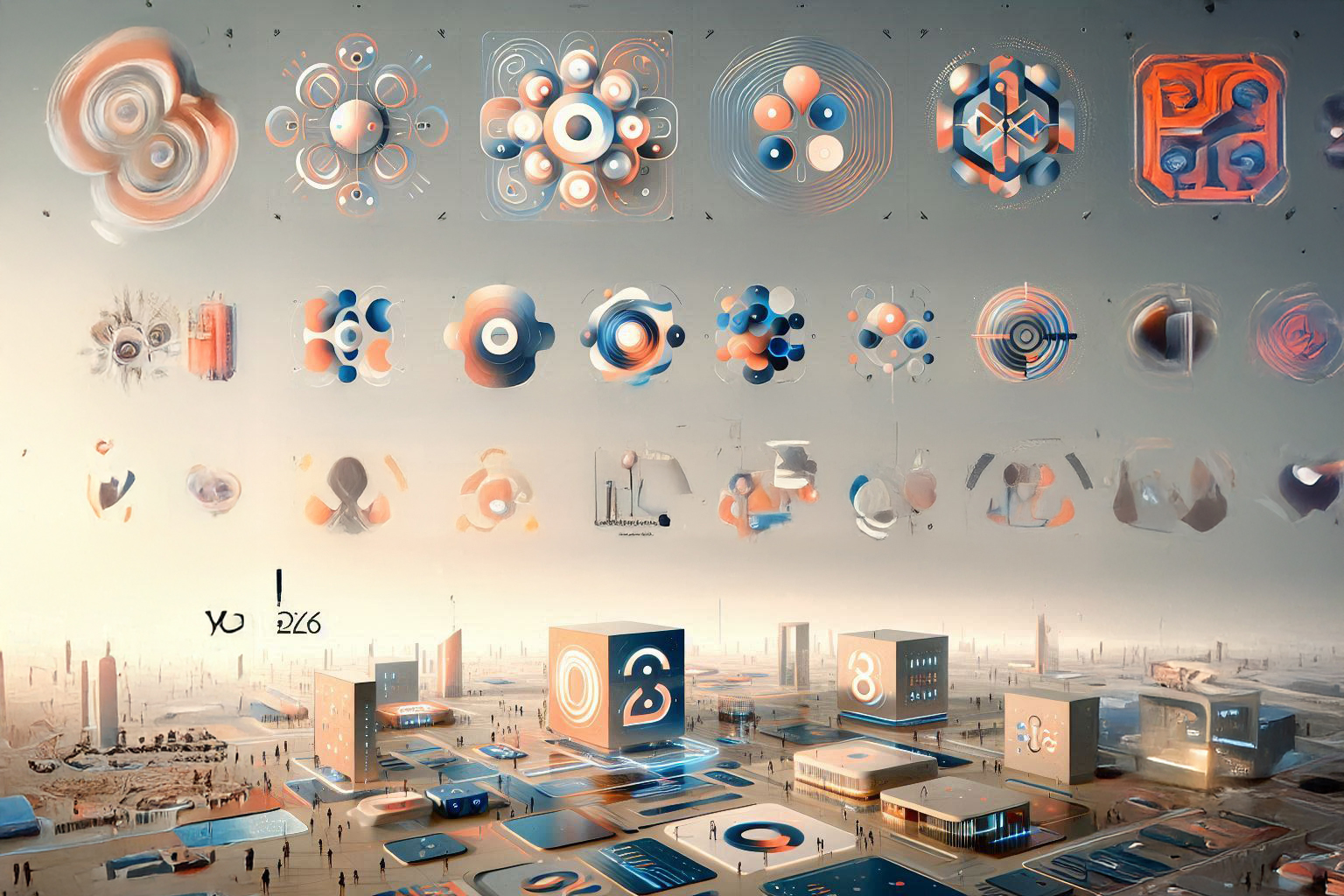
Discover five major graphic design trends shaping 2026 — from handcrafted aesthetics and AI‑revived crafts to expressive typography and living brand identities. Humanity becomes the new innovation.
5 Graphic Trends for 2026 That Will Surprise You: Why We’re Returning to the Human Touch
There is a moment almost everyone working in visual culture experiences today. You scroll through social media. And open your favorite apps. You glance at billboards or product packaging. Everything feels suspiciously smooth. Perfect shapes, flawless gradients, sterile compositions. It’s as if the design world has switched into “precision manufacturing mode.” Aesthetics are produced by algorithms now. They are no longer shaped by human hands. As we look ahead to the future, we are exploring the upcoming 5 Graphic Trends for 2026. It is precisely in this moment that something new begins to emerge. There is a longing for the return of the human touch.
The year 2026 will see a decisive shift away from synthetic uniformity. There will be a move toward the rediscovery of imperfection as beauty. This is not nostalgia, nor a rejection of technology. It is a natural counter-movement. It responds to the oversaturation of digital perfection that surrounds us but rarely moves us. Designers, studios, and brands are searching for ways to bring emotion, texture, and authenticity back into visual communication. And this longing for humanity is becoming the most important innovation of our time.
Below are five trends that will shape the visual world in 2026. They are not just aesthetic directions. They are cultural signals. These signals reveal how our relationship with technology, brands, and ourselves is evolving.
1. Craft as Resistance: The Return of the Hand
After years dominated by digital tools, designers are turning back to physical materials. Ink, clay, paper, textiles, and wood are gaining attention again. They serve as a deliberate counterpoint to AI‑generated aesthetics. This trend is not sentimental. It is strategic.
In an era when algorithms can produce a “perfect” image in seconds, handmade work becomes a luxury. It becomes proof of authenticity. It becomes a signature. And that is why more and more brands are investing in physical processes that can’t be easily replicated.
Hand‑blown glass, hand‑stitched embroidery, real sets instead of CGI — these elements create visuals with depth, weight, and narrative. Imperfection becomes an aesthetic value. More importantly, it becomes an emotional signal. In a world where everything can be copied, the human trace becomes the most precious element.


2. The Paradox of Our Time: AI Learns Craft Too
While humans escape digital perfection by returning to analog techniques, technology moves in the opposite direction. Generative AI is learning traditional crafts — in ways that would have seemed absurd just a few years ago. Woodcut, stone carving, calligraphy, Gothic typography, filigree — all of these are becoming part of the machine’s visual vocabulary.
But this paradox is not a threat. It is an opportunity. AI does not steal craft from humans — it archives it, expands it, and makes it accessible. It allows designers to experiment with techniques that would otherwise need years of study. It opens the door to hybrid styles that merge old and new, physical and digital, intuitive and algorithmic.
A new form of collaboration emerges. Humans bring sensitivity, intuition, and context. Machines offer speed, variation, and can revive forgotten visual traditions. The result is not imitation, but a new visual magic.
3. The Big Return of Brand Mascots: Technology Needs a Face
After years of minimalist logos and sterile identities, mascots are returning — and with surprising force. Brands are realizing that in a digital environment increasingly mediated by AI agents, people need reminders of human presence. They need something with a face, an expression, a mood.
A mascot is not just a cute character. It is a bridge between technology and the human being. It is a way to give an abstract system a personality. And that is why mascots are becoming essential elements of modern brand identities.
Brands use mascots in several ways. They serve as guides inside apps. Mascots act as visual metaphors for brand values. They work as playful elements that soften communication. Additionally, mascots act as emotional anchors in an increasingly impersonal digital world.
Mascots are no longer just marketing tools — they are cultural phenomena. In a time when technology speaks our language, we also want it to have a face.


4. Typography as the Main Character: Letters That Speak
In 2026, typography fully steps out of the background and becomes a protagonist. It is no longer just a carrier of text — it is a carrier of personality. Type becomes a design element capable of expressing mood, tone, attitude, and brand values.
Hand‑drawn letterforms, expressive serifs, responsive typographic systems, variable fonts — all of these form a new language of visual communication. Letters become images. And images become messages.
Typography today can be playful, dramatic, intimate, rebellious, poetic. It can be the voice of a brand in a world where visual identity must adapt to hundreds of formats. And most importantly: it can bring humanity back into digital space. Every stroke, every curve, every rhythm of a typeface carries emotion.
5. Multisensory Identities: Brands That Feel Alive
The final major trend of 2026 concerns the very nature of visual identity. Brands are no longer static. They are not logos designed once and left unchanged for a decade. They are living organisms.
Motion design, dynamic gradients, 3D elements, generative visual systems — these create identities that react, breathe, and evolve. Brands adapt to context, platform, audience, and moment. Just like people.
This shift is logical. We live in an environment where visual content is constantly in motion. Our attention is dynamic. Our expectations are high. And so identity must become an experience, not a static symbol.
Multisensory identities work with movement, sound, depth, and light. They create atmosphere. They create worlds that people can enter. And that is why they feel so powerful.
Conclusion: Humanity as the Ultimate Innovation
When we look at all these trends, one theme connects them: the desire for genuine connection. For something not only visually perfect but emotionally true. Technology surrounds us more than ever, yet it pushes us to search for what is unmistakably human.
The year 2026 will be a year of more personal, tactile, and sensitive design. It is not a return to the past, but a search for balance. A way to use technology without losing ourselves. A willingness to show imperfection as value.
And the most important question for a brand today is: What human feeling do you want to evoke? How do you want your audience to feel?
Because in a world where everything can be created in seconds, emotion is what determines what we remember.



Leave a Reply