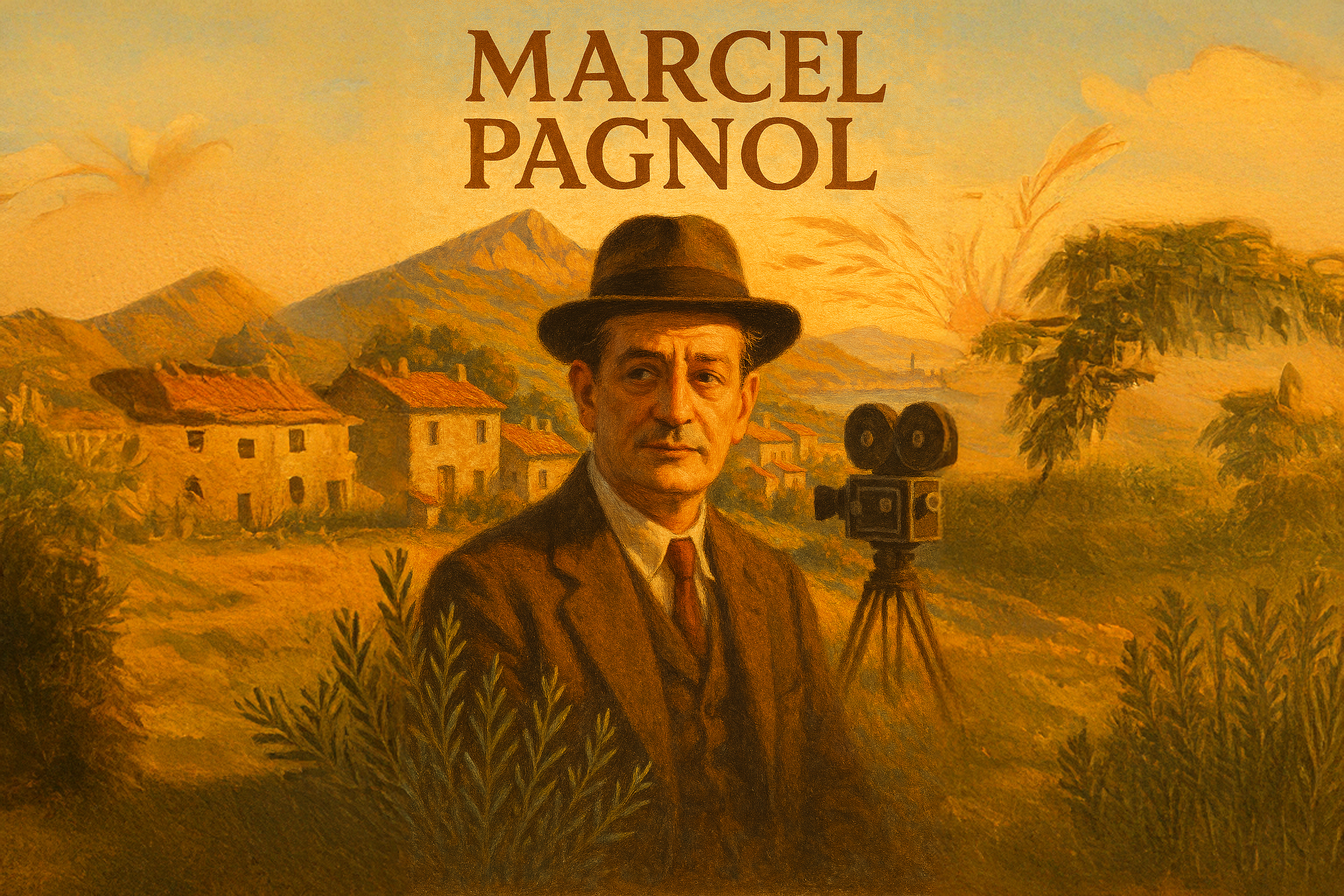
Explore the extraordinary life of Marcel Pagnol — from teacher to cinematic legend who reshaped French culture, humor, and Mediterranean humanism.
From the Teacher’s Desk to Immortality: Five Faces of Marcel Pagnol That Changed the World
There are lives that unfold with such symbolic precision that one hesitates to attribute them to mere coincidence. Marcel Pagnol’s life is one of them. The Five Faces of Marcel Pagnol That Changed the World offer a fascinating lens through which we can appreciate his enduring legacy. He was born on February 28, 1895, in the Provençal town of Aubagne. The limestone massif of Garlaban casts long shadows there and the air carries the scent of rosemary. He entered the world at a moment he would later describe as cosmically aligned with the birth of cinema itself. According to his own mythology, he lovingly cultivated the idea of being born when the Lumière brothers captured the arrival of a train at La Ciotat. He created this narrative with care. Whether or not this is literally true matters less than the fact that Pagnol embraced it as destiny.
Film and Pagnol: two children of the same day, the same century, the same cultural rupture. This dual birth—half literary, half cinematic—became the axis around which his entire creative life revolved.
Pagnol was not merely a storyteller. He designed a Mediterranean humanism. This bridged the gap between Parisian intellectualism and the earthy wisdom of the southern people. He believed in the power of words. He also understood that film can become their most perfect vessel. Above all, he was a creator. He never betrayed the olfactory memory of his childhood hills. These included the rosemary, the dust, the cicadas, and the sunlit silence of Provence.
These five faces represent five roles. He embodied these roles throughout his life. They form the mosaic of a man who reshaped French culture. He also left an indelible mark on world cinema.

1. The Man Who Was Born on the Same Day as Film
Pagnol’s fascination with cinema was never about technology. It was about the human voice. At a time when avant‑garde filmmakers worshipped the “pure image,” they considered sound a vulgar intrusion. Pagnol saw in the talking film a revelation. For him, cinema was a “Fixed Theater.” It was a space where text is preserved forever. The nuances of speech, tone, and breath were captured with a fidelity impossible on the stage.
His decision in 1927 was not an act of youthful recklessness. He chose to leave his secure position as an English teacher at the prestigious Lycée Condorcet. It was a leap of faith. He believed that the talking film required the supremacy of the author over the technician. The camera should serve the word, not the other way around.
This conviction made him a theoretical pioneer. Long before the term “auteur cinema” became fashionable, Pagnol had already articulated its foundations. He understood that cinema democratizes drama. It made drama accessible to those who would never set foot in a Parisian theater.
For Pagnol, sound was not a threat to cinema—it was its salvation.
2. The Independent Rebel Who Built a Mediterranean Hollywood
After clashing with the rigid structures of Paramount, Pagnol made a radical decision: he would build his own film empire. And he would build it not in Paris, but in Marseille—far from the cultural and industrial center of French cinema.
Les Films Marcel Pagnol became a vertically integrated studio system: laboratories, distribution networks, and even a chain of cinemas. This independence was not merely a business strategy. It was a cultural stance. Pagnol rejected the artificiality of studio sets, the standardized Parisian French, and the hierarchical machinery of big studios.
He chose authenticity.
He chose sunlight over spotlights.
He chose the voices of Marseille over the polished diction of the capital.
The result was the legendary Marseille Trilogy—Marius, Fanny, César—a work that elevated local stories into universal myths. Alice Waters named her iconic California restaurant Chez Panisse after one of Pagnol’s characters. This is proof of how far his Mediterranean world traveled.
Pagnol’s Provence was not a postcard. It was a living, breathing universe.
3. The Humorist Who Turned One Third into Four
Pagnol’s humor is rooted in the Mediterranean art of creative exaggeration. It is a humor of rhythm, gesture, and emotional truth rather than logic. The cocktail scene in Marius is famous. César instructs his son to mix a drink using four different “thirds.” This scene is a perfect example.
“One small third of curaçao. A slightly larger third of lemon. A good third of Picon. And finally, a big third of water.”
Marius protests that four thirds can’t exist. César dismisses him with the irrefutable logic of the Marseille docks:
“It depends on the size of the third!”
This humor works because Pagnol wrote dialogue that was alive—dialogue that demanded a body, a voice, a presence. And in Raimu, he found the perfect interpreter. Orson Welles called Raimu the greatest actor in the world. Pagnol knew how to write for him with surgical precision.
Through humor, Pagnol revealed the soul of Provence: generous, emotional, contradictory, but always profoundly human.
4. The Son Who Spent His Life Searching for His Mother
Beneath Pagnol’s sunlit world lies a deep well of melancholy. His mother Augustine died when he was fifteen, and her absence became the emotional core of his work. In My Mother’s Castle and My Father’s Glory, she is not a historical figure. Instead, she is an idealized presence—fragile, luminous, and almost sacred.
For Pagnol, she embodied the “lost paradise” of childhood.
A paradise of summer days in the hills of Garlaban. There were secret paths. It was the quiet happiness of a family that would soon be shattered.
In 1941, Pagnol purchased the Château de la Buzine to build his dream “City of Cinema.” First, he discovered with horror that it was the same “castle of fear.” Then, with triumph, he realized his mother had dreaded passing it during their childhood walks.
This revelation closed a symbolic circle.
Buying the castle became an act of revenge against childhood fears. It was also a gesture of love toward the mother he had lost too soon.
5. The Quiet Resister Who Fought War with Carnations
During the German occupation, Pagnol refused to sell his studios to the Nazi‑controlled Continental Films. To prevent their seizure, he orchestrated a strategic “collapse” and transferred them to Gaumont.
But his most ingenious act of resistance was the protection of his film crew. Pagnol bought an estate in La Gaude when his technicians were threatened with forced labor in Germany. He registered them as “carnation growers.” As agricultural workers, they were exempt from deportation.
This was not the resistance of grand gestures.
It was the resistance of a man who valued human lives over ideological purity.
After the liberation, he replaced Marshal Pétain’s speech in The Well‑Digger’s Daughter with a speech by Charles de Gaulle. This act confirmed his loyalty to free France. It also showed his pragmatism. For Pagnol, survival came first. Art and politics were always in service of humanity.
Conclusion: A Dance of Life and Death Under the Provençal Sun
In 1946, Marcel Pagnol was elected to the Académie française. He became the first “Immortal” from the world of cinema. It was not just a personal triumph. It was a cultural milestone: the moment when film finally sat beside literature as its equal.
Pagnol’s legacy teaches us that true art does not need elaborate tricks. It requires sincerity, warmth, and the courage to listen to ordinary lives. In his world, a bar stool can carry more emotional weight than a tombstone. As André Bazin once remarked, it is saturated with memory.
And so we return to the question that Pagnol’s work whispers to us:
If you had to find your own lost paradise today, in what landscape or memory would it be hiding?



Leave a Reply