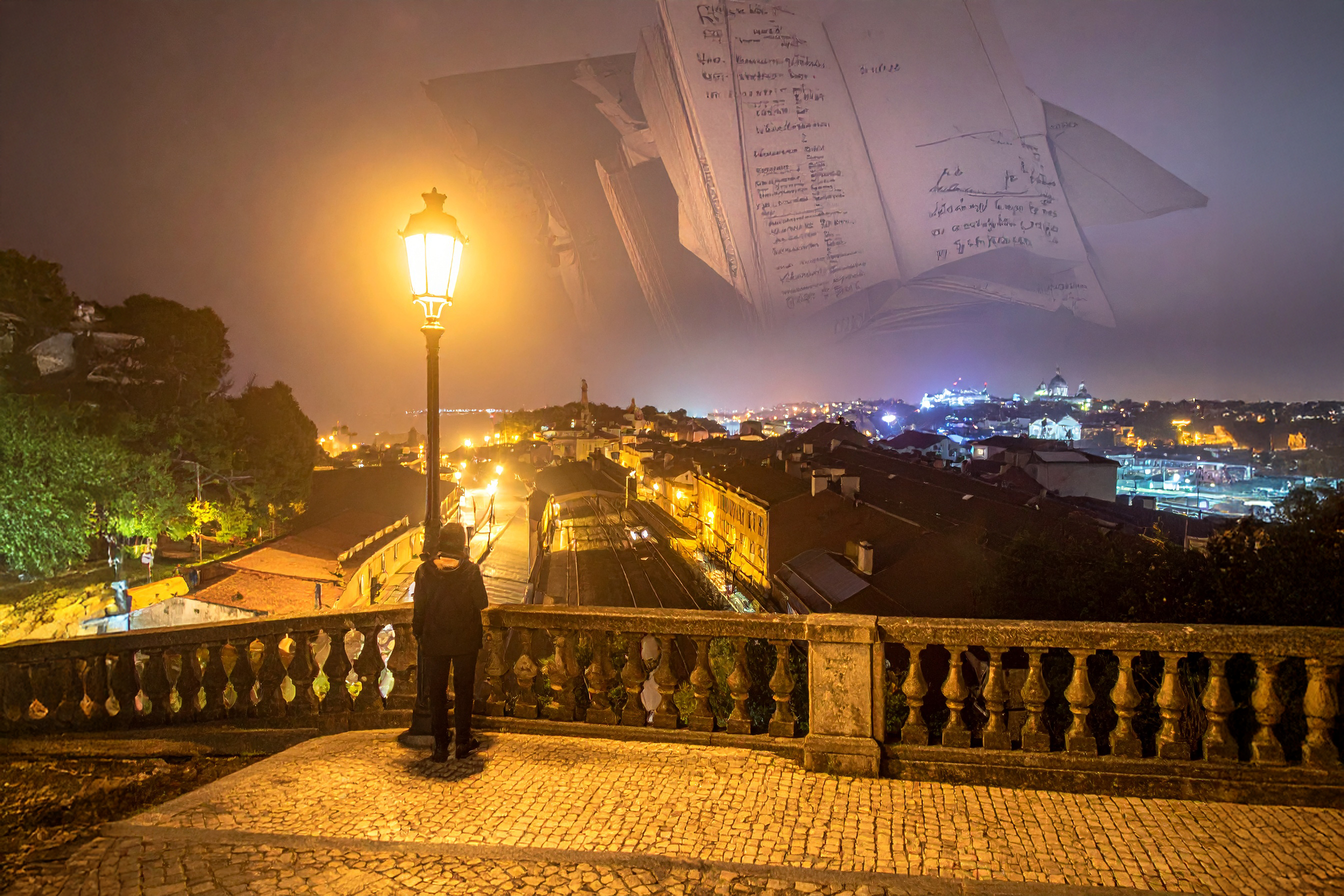
An essay exploring how Pascal Mercier’s Night Train to Lisbon becomes a threshold to Fernando Pessoa’s work and to a deeper inner journey. Literature as a space of memory, identity, and quiet renewal.
Night Train to Lisbon and the Quiet Door to Fernando Pessoa
An essay about a journey that begins not on a platform, but inside a human being
There are books we read and forget, and then there are books that read us. Books that do not simply tell a story but open a threshold — something between a doorway and a mirror. Night Train to Lisbon by Pascal Mercier belongs to this second category. It is not merely a novel about a teacher who abandons his life on a sudden impulse. It is a meditation on what happens when a person touches the edge of an unspoken longing. Sometimes a single sentence, a single tone, a single image is enough to shift the axis of one’s inner world.
For me, it was not only the novel but also the film adaptation. Both opened a deeper path. It was a path leading to Fernando Pessoa. To an author who is not one person but an entire inner city. To a poet who dissolved the idea of a single identity and replaced it with a constellation of voices. To a writer who understood that the self is not a fixed point but a trembling horizon. Through Mercier, I found Pessoa. And through Pessoa, I found a new way of reading myself.

1. A book as an impulse, not an answer
Mercier’s novel is unusual because it does not close anything. It does not offer conclusions. Instead, it creates movement. It unsettles gently, like a hand placed on the shoulder of someone who has been asleep too long. Raimund Gregorius is not a hero in the traditional sense. He is a man who pauses on a bridge and realizes that his life has become too narrow. And then he does something most people never dare to do: he listens to the quiet voice inside.
Reading Night Train to Lisbon, I felt as if I were watching someone relearn how to breathe. And at the same time, I sensed that the movement was not only his. It belonged to anyone who has ever felt they were living a life that did not fully belong to them. Mercier writes about a courage that is not dramatic but intimate. A courage that whispers rather than shouts. A courage that changes direction even when the destination is unknown.
And in that quiet space, Pessoa began.
2. Pessoa as an echo that arrives later
When one finishes Mercier’s novel, a strange emptiness remains. Not a void, but a space. And into that space steps Fernando Pessoa. Not as an answer, but as another question.
Pessoa is not an author one simply reads. He is an experience. A labyrinth. A city of voices. His Book of Disquiet is not a novel but a map of inner weather. Fragmented, melancholic, luminous in its own muted way. When I opened it for the first time, I felt like I was discovering something familiar. It was something I had always known but never articulated.
Mercier’s fictional Amadeu de Prado carries the spiritual DNA of Pessoa. Both are fractured. Both are searching. Both look at the world through delicate cracks. Both believe that life can be lived differently — more slowly, more truthfully, more inwardly.
3. Lisbon as an outer and inner city
Lisbon in Night Train to Lisbon is more than a backdrop. It is a city vibrating between past and now, between light and shadow. A city with the melancholy of the ocean and the softness of southern light. Reading Mercier, one feels that Lisbon is not a place but a state of mind.
Pessoa transformed Lisbon into a metaphysical territory. A city that exists not only on a map but inside the reader. A city that can be read like a poem. A city that is both home and exile.
That is why both authors resonated so deeply with me. I, too, live between places — between Silesia, Czechia, and Istanbul. I know what it means to feel at home in several places. Yet, I do not fully belong to any of them. Pessoa called this “the scattered self.” Mercier called it “the life that waits.” I call it simply: return.
4. The quiet courage to change direction
What unites Mercier and Pessoa is a quiet form of bravery. Not the kind that seeks attention, but the kind that unfolds inwardly. Pessoa had the courage to be many people at once. Mercier’s protagonist had the courage to leave a life that no longer fit him.
And through them, I found the courage to open doors I had long ignored.
Sometimes a single sentence is enough to shift a life. For me, it was Pessoa’s line:
“I am nothing. I shall never be anything. I can’t wish to be anything. Apart from that, I have in me all the dreams of the world.”
Suddenly everything moved. Not dramatically, but subtly. Like waking in the middle of the night and realizing you can hear your own breath.
5. Literature as a threshold
Looking back, I see that Night Train to Lisbon was not just a book. It was a threshold. And Pessoa was not just an author. He was a space. Together, they led me to what I now call my archive — a living organism that grows, shifts, and breathes.
Literature has the strange ability to open doors we did not know existed. Sometimes those doors lead to another writer. Sometimes to another city. And sometimes — to another version of ourselves.
6. What remains after reading
Why did Mercier lead me to Pessoa? I see several layers:
- both write from a place of introspection rather than drama
- both treat identity as fluid
- both see life as a text that can be rewritten
- both treat the city as a living being
- both open space rather than close narrative
And most importantly: both remind us that it is never too late to change direction. That there are trains leaving even at night.
7. The final quiet
When I close my eyes, I see three images:
Raimund Gregorius standing on a bridge.
Pessoa sitting in a Lisbon café.
And myself, reading their words in the silence that surrounds me.Literature is not an escape. It is a return. A return to oneself, to the places that shaped us, to the voices we have long ignored. Night Train to Lisbon taught me to see differently. Pessoa taught me to listen differently. Together, they reminded me that life can be lived as an open, shifting, unfinished text.
That is why this journey touched me so deeply. Because it was never only about a book. Or an author. It was about the moment when a single impulse becomes a path. This path leads back to one’s own center.
We all have our night train. And we all have our Pessoa. Sometimes all it takes is opening the right book at the right moment.


Leave a Reply