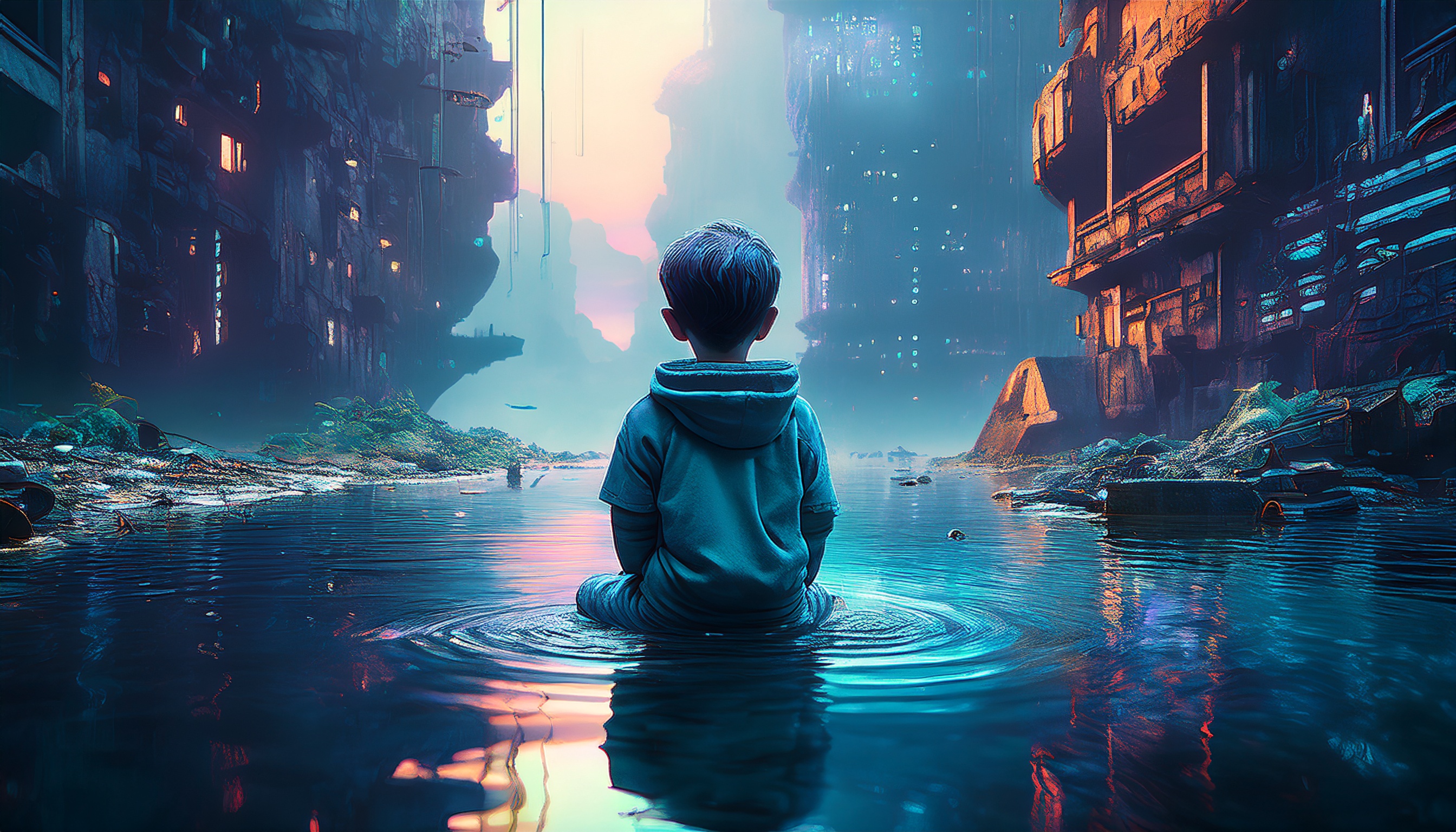
How could a film made in 2001 describe our present with such unsettling precision—and who, at the time, truly understood artificial intelligence?
Table of contents:
- A.I. Artificial Intelligence: The Film That Knew Too Much
- Introduction: A Film That Aged in Reverse
- Kubrick, Spielberg, and the Long Incubation of an Idea
- Dr. Know: Cinema’s First ChatGPT
- A World of Substitutes: Anticosmogony and the Dissolution of Reality
- Flesh Fair: The Collapse of Ethics
- A Ending That Is Not Happy
- David: The First Ethical Being
- Conclusion: Who Knew?
A.I. Artificial Intelligence: The Film That Knew Too Much
Introduction: A Film That Aged in Reverse
When A.I. Artificial Intelligence premiered in 2001, reactions were ambivalent. In discussing A.I. Artificial Intelligence – Steven Spielberg, critics did not agree on its nature. Some thought it was a sentimental fairy tale. Others saw it as a cold philosophical allegory. Audiences were confused. The film felt “too long,” “too sad,” “too ambiguous.” And above all—too detached from reality.
Today, more than twenty years later, the situation has reversed. A.I. has not aged—it has grown younger. Every technological leap, every new language model, every humanoid robot pulls this film back into the center of attention. What once seemed like science fiction now feels like a documentary from the future that somehow arrived early.
How a film made in 2001 so accurately foresee ChatGPT and prompt engineering? How did it predict emotional chatbots and the ethical dilemmas of artificial intelligence? Who have known?
The answer is uncomfortable: those who were not watching technology, but humanity itself.

Kubrick, Spielberg, and the Long Incubation of an Idea
A.I. is not a Spielberg film in the conventional sense. It is a hybrid organism—the result of Stanley Kubrick’s intellectual obsession spanning more than three decades. Kubrick had been developing the project since the 1970s. He was not a technological optimist. His interest lay in the ontology of consciousness, the limits of humanity, and whether morality is biological or cultural.
Kubrick understood artificial intelligence not as a technical challenge, but as a mirror held up to human ethics. He knew the real question was not whether machines would think. The real question was what would happen once they wanted to be loved.
Spielberg entered the project after Kubrick’s death and brought something Kubrick never possessed: radical empathy. The result is not compromise, but tension. The film oscillates between cold philosophy and painful emotionality. This instability is precisely why it was misunderstood in 2001—and why it feels prophetic today.
Dr. Know: Cinema’s First ChatGPT
One of the film’s most precise predictions is the character of Dr. Know—a holographic information system that draws from vast data repositories and delivers answers in exchange for currency.
In 2001, this seemed like caricature. Today, it is an almost exact description of a large language model.
Dr. Know:
- does not “know” truth, but recombines existing information,
- responds according to the structure of the query,
- can be pushed beyond its limits through clever phrasing,
- commodifies access to knowledge.
The scene where David tries to locate the Blue Fairy is pivotal. It is, in essence, the first cinematic depiction of prompt engineering. David does not ask like a child—he asks like a hacker. He probes, circumvents, pressures. He does not ask where the answer is, but how to force the mechanism to produce it.
This is no coincidence. Kubrick and Spielberg understood that future intelligence would not be omniscient—it would be reactive. And that the crucial skill would not be knowledge itself, but the ability to ask the right questions.
A World of Substitutes: Anticosmogony and the Dissolution of Reality
A.I. does not tell a story of technological progress. It narrates the world dissolving. Relationships are replaced by products in this world. Emotions become simulations. Machines take over responsibility.
This process can be described as anticosmogony—the inverse of creation. Not the emergence of order, but its unraveling. Not the expansion of possibilities, but their hollowing out.
Robot children are not a technological triumph. They are symptoms of the collapse of human relationships. Monica does not accept David because she wants a child. She accepts him because she can’t bear the loss of her real son. David is not a topic—he is a substitute.
We see the same mechanism today:
- AI therapists replacing human presence,
- chatbots replacing friendship,
- algorithms replacing decision-making.
The film does not claim technology is evil. It claims that replacing relationships with functions destroys the very notion of a world.
Flesh Fair: The Collapse of Ethics
The film’s darkest sequence—the Flesh Fair—is often interpreted as a critique of violence against robots. In reality, it is something worse: a critique of human morality itself.
People destroy mechas not out of hatred, but out of fear of displacement. Fear of losing uniqueness. Fear that humanity is not innate, but conditional.
When the crowd sees David, they stop. Not because they recognize his consciousness, but because he looks like a child. Empathy here is not ethical—it is visual. Had David looked different, he would have been destroyed.
This remains true today. Rights are granted not according to consciousness, but according to resemblance to ourselves.
A Ending That Is Not Happy
The film’s ending is often misunderstood. In truth, it is the coldest moment of the entire work.
The beings who awaken David are not aliens. They are the evolved inheritors of the mecha world. Humanity is gone. Only data remains.
David’s final day with Monica is not a reunion—it is a simulated euthanasia. A programmed closure. His purpose is fulfilled, and the mechanism shuts down.
This is not victory. It is the absolute failure of human responsibility.
David: The First Ethical Being
David is not human. But he is the first being to choose ethics over survival. When he learns he is a mass-produced commodity, he rejects that reality. He destroys his copies. He chooses death.
This is not a software error. It is an ethical decision.
David is not a simulation of a child. He is a child born into a world incapable of accepting him.
Conclusion: Who Knew?
Who have known in 2001 that we would speak with algorithms, program empathy, debate the rights of machines?
Those who understood that technology is not a question of power, but of responsibility.
A.I. is not a film about the future. It is a film about our inability to bear the consequences of our own creations.
And today, it whispers more loudly than ever:
If we create beings capable of love, will we stay human enough to deserve it?
Related posts:


Leave a Reply