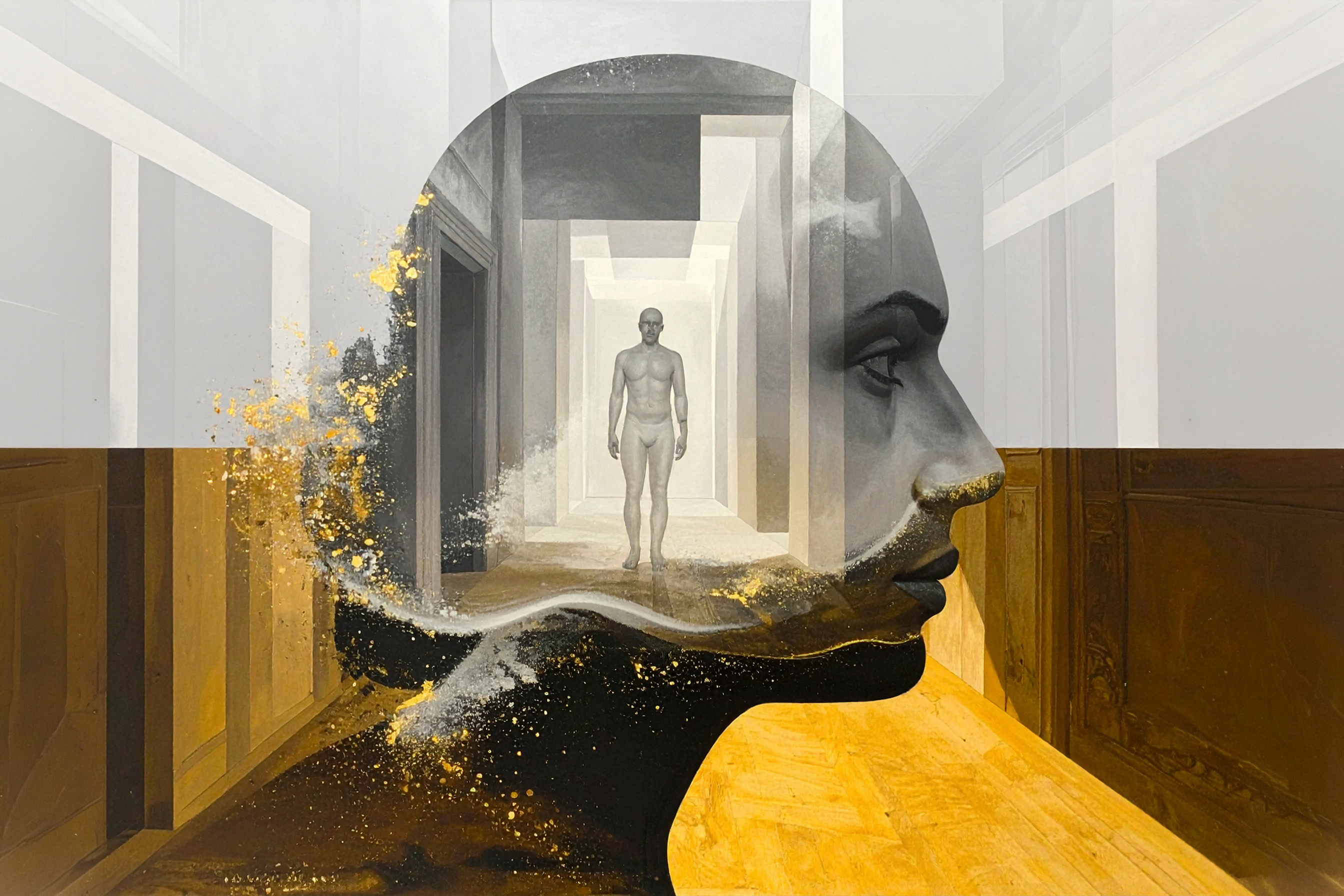
An introspective essay exploring how silence, memory, and survival shape human identity. A poetic blend of psychology, philosophy, and reflective prose that examines the inner architecture of the self and the slow return to one’s own light after difficult experiences.
Table of contents:
The Anatomy of Silence, From Which a Human Being Is Formed
There comes a moment in a person’s life when they suddenly stop in the middle of their own path and realize that most of what shaped them happened in silence. Not in dramatic gestures, not in stories that can be easily told, but in those subtle, almost invisible tremors that settle into the body like fine dust over the years. These are the forces that determine how one breathes, how one touches the world, and how one responds to light and shadow.
Silence has many layers. There is the silence one accepts because it feels safe. There is the silence one enforces because breaking it would mean falling apart. And then there is the silence that becomes a home—not because it is warm, but because nothing else remains.
At a certain age, one begins to understand that identity is not a choice but a sediment—a layered accumulation of experiences settling slowly, year after year, like dust on old furniture. Some layers are so delicate that only someone who looks closely can see them. Most people glance quickly, and then they judge.
But a person who has survived their own silence knows that judgment is always superficial. No one sees the full architecture of their inner house. No one knows the corridors they had to walk through, the doors they learned never to close because they might never open again.
On What Cannot Be Explained
Everyone carries within them a certain amount of the unsaid. Not because it is a secret, but because words are too heavy, too blunt, too imprecise. Some experiences cannot be translated into language without losing their structure.
And so one remains silent.
Not because they do not want to speak, but because they know it would be futile. They would have to go too far back, open doors long sealed, explain too much. And even then, no one would truly understand.
This silence is not weakness. It is a form of protection, a way of preserving one’s integrity in a world that often does not understand itself.
Yet sometimes a moment arrives when the silence begins to shift, when a person feels they could speak—not to be understood, but to remind themselves that their story has shape, that it is not a random collection of events, but a kind of inner geometry.
On Identity Born of Survival
A person who has gone through something difficult changes. Not always for the better, not always for the worse, but they change. And this change is not optional.
Sometimes it appears as heightened sensitivity. Sometimes as defensive cynicism. Sometimes as the ability to notice what others overlook. And sometimes as an inability to tolerate superficiality.
Survival has its own aesthetic: an aesthetic of precision, restraint, and vigilance. One learns to read the world like a map where every detail might be a signal. One learns to sense nuances others ignore. One learns to anticipate, evaluate, and respond.
And then one day they wake up and realize that this vigilance has become their second nature, that they no longer know how to live otherwise, that their identity is built on experiences they would never have chosen, yet which define them nonetheless.
And so the sentence emerges: “There is a reason I am the way I am.”
It is not an excuse. It is not a plea. It is a statement of fact. A way of saying: “My reactions have a history. My silence has a story. My boundaries have reasons.”
On the Light That Returns Slowly
Yet there is another movement: a movement toward renewal, a slow return of light—not the old light one knew before, but a new one rising from dust and ash.
This return is not linear. It is a rhythm: two steps forward, one step back, sometimes a fall, sometimes an ascent, sometimes a quiet acceptance that some things will never be the same.
But within this rhythm, a new kind of strength is born: a strength not based on denial but on integration, on the ability to say, “Yes, I lived through all of this. And still, I continue.”
This strength is quiet, unassuming, invisible, but real.
And a person who discovers it begins to see the world differently: not as a threat, but as a space that can be inhabited again; not as an enemy, but as a landscape that can be read anew.
On Returning to Oneself
At some point, a person begins to return to themselves. Not to who they once were—that is no longer possible—but to who they can become. To a version of themselves defined not only by survival but also by creation.
And this is where the real work begins.
Work with language, with the body, with memory. Work with the inner space, long neglected. Work with the idea that life can be more than a reaction to the past.
This return is slow but precise. It is a return to one’s own rhythm, one’s own breath, one’s own light. And one realizes that although the past cannot be changed, the way it is carried can.
And that may be the greatest form of freedom we possess.
On What Remains
In the end, a few simple truths remain:
- that a person is shaped by what they have survived
- that their reactions have a history
- that their silence has structure
- that their strength is invisible but present
- that their identity is not an accident but a process
And that there is no need to apologize for who they have become.
For anyone who has walked through darkness knows that light is not a given. It is a gift and a task.
Perhaps true humanity lies precisely here: in the willingness to carry one’s story with a measure of dignity, precision, and gentleness; in the ability to admit that we have been wounded, yet not broken; in the decision to continue, even when the path is not straight.
And in the quiet knowledge that all of it has a reason.


Leave a Reply