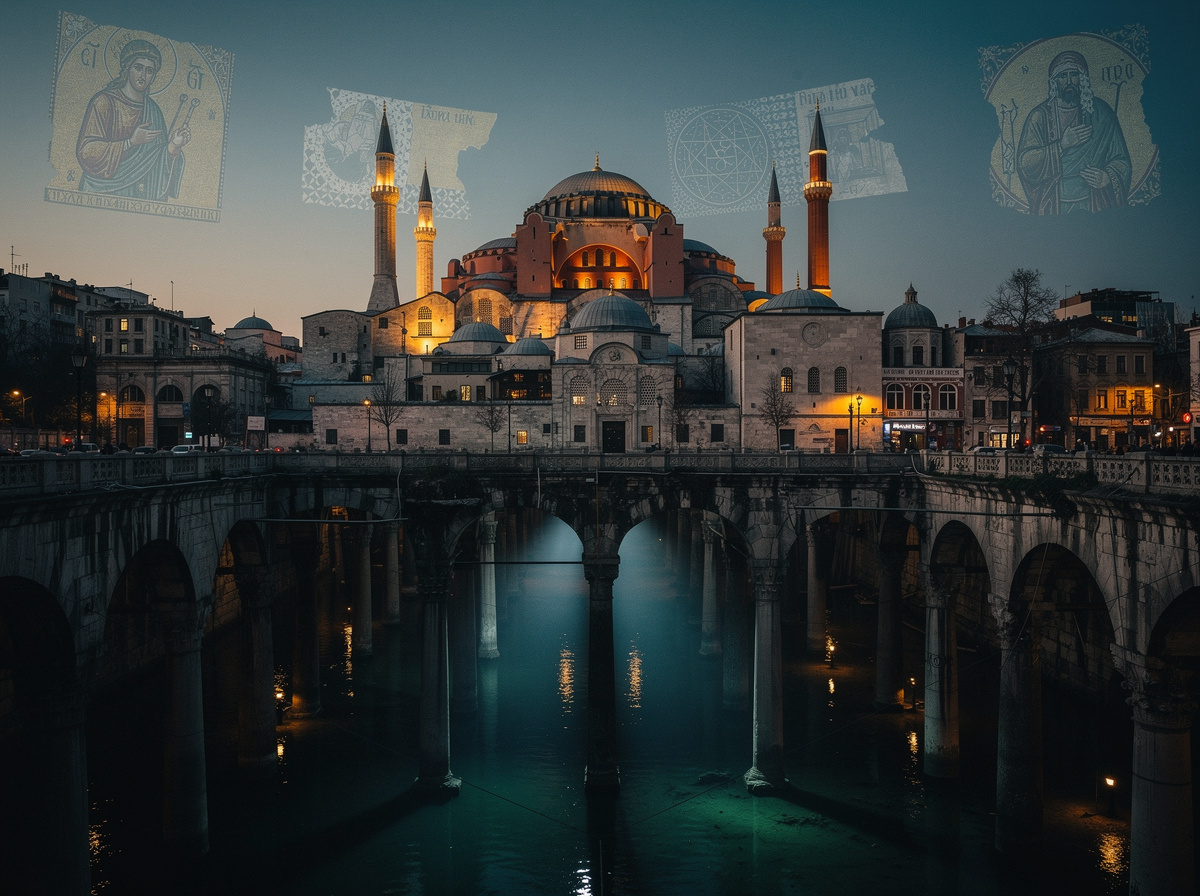
A deep literary-philosophical essay on Laurence O’Bryan’s “The Istanbul Puzzle”, exploring Istanbul’s layered history, psychology, symbolism, and the nature of the conspiracy thriller.
Table of contents:
Istanbul as a Mirror of Depths: An Essay on Laurence O’Bryan’s The Istanbul Puzzle
Some cities tell their stories plainly, as if reciting a well‑rehearsed chronicle. Others must be read like a palimpsest — layer by layer, shadow by shadow, with patience, intuition, and a willingness to listen to what is not said. Istanbul belongs to the latter. It is a city that whispers rather than declares, that reveals itself only to those who accept that revelation is never complete.
Laurence O’Bryan’s “The Istanbul Puzzle” captures precisely this quality: the tremor of ambiguity, the vibration of history beneath the pavement, the sense that the visible city is only a thin membrane stretched over something older, darker, and infinitely more complex.
This novel does not attempt to redefine the thriller genre. Instead, it uses the city itself—its underground cavities, its sacred tensions, its historical fractures—as the engine of the narrative. And that, in its quiet way, is far more interesting.

The Story: Moving Through a Labyrinth
The novel opens with a brutal murder: the beheading of archaeologist Alek Zegliwski near Hagia Sophia. The image is shocking, but it is also symbolic—a threshold, an invitation to descend into the labyrinth beneath the surface of the city and the surface of the self.
Sean Ryan, Alek’s colleague, arrives in Istanbul not as a hero but as a wounded man. His journey is driven less by duty than by a need to understand, to restore coherence to a world that has fractured. He is joined by Isabel Sharp, a British diplomat whose rationality and political instinct counterbalance Sean’s emotional volatility.
Their investigation quickly becomes something larger than a search for a killer. It becomes a race against time, a confrontation with hidden mosaics, secretive organizations, and the looming threat of a biological catastrophe. O’Bryan uses the familiar tools of the conspiracy thriller—short chapters, sharp transitions, constant forward motion—yet he allows Istanbul to breathe, to shape the rhythm of the narrative. The city becomes a third protagonist, unpredictable and magnetic.
Hagia Sophia and the Subterranean City: Between Fact and Fiction
In this novel, Hagia Sophia is not a backdrop. It is a consciousness, a symbolic field where epochs overlap like layers of pigment on an ancient icon. Basilica, mosque, museum, mosque again—each transformation has left a residue, a trace, a question.
O’Bryan draws on three historically grounded elements:
- mosaics hidden for centuries,
- substructures that remain only partially explored,
- the architectural tension between sacredness and power.
These elements are real, though the novel expands and dramatizes them, bending them toward narrative necessity. The result is not documentary accuracy but emotional truth—and that truth resonates.
The underground Istanbul—cisterns, drainage tunnels, forgotten passages—is one of the novel’s most atmospheric dimensions. The Basilica Cistern, with its forest of columns reflected in still water, is already a mythic space. O’Bryan deepens it, connects it, mythologizes it further. He creates a realm where the reader feels both small and exposed, as if walking along the border between history and dream.
The Psychology of the Characters: Pain as a Compass
Sean Ryan is defined by loss. His journey to Istanbul is not only an attempt to understand Alek’s death but also a search for meaning in his own life. Every step he takes through the city is mirrored by a step into his own interior darkness. This makes him fragile, but also profoundly human.
Isabel Sharp stands at the opposite pole: order, logic, diplomatic restraint. Her presence stabilizes the narrative while introducing tension—for Sean and Isabel embody two different ways of navigating the world. He is intuitive, emotional, impulsive. She is analytical, measured, strategic. Their dynamic is a subtle interplay between instinct and discipline.
This psychological duality gives the novel a depth that many thrillers lack. The action is not merely external; it is mirrored by an inner movement, a slow excavation of grief, fear, and the desire for coherence.
The Conspiracy Thriller: Why the Genre Endures
The conspiracy thriller is a modern mythology. It offers the reader a world in which nothing is accidental, where symbols carry hidden meanings, and history is a coded message waiting to be deciphered. O’Bryan uses this mythology with awareness and restraint:
- a symbolic murder,
- historical artifacts as keys,
- sacred architecture as a map,
- a global threat,
- personal trauma woven into a larger narrative.
Compared with Dan Brown, O’Bryan is less theological and more contemporary. His puzzle does not challenge the foundations of religion; it exposes the fragility of the modern world — its biological vulnerabilities, its political manipulations, its dependence on information that can be distorted or concealed. This makes the novel feel grounded, even when it leans into speculation.
Reception: Between Fascination and Critique
International readers praise the novel’s atmosphere above all else. Istanbul emerges as vivid, sensuous, and charged with tension. The scenes in underground tunnels are frequently cited as the most memorable.
Criticism tends to focus on two points:
- the occasional reliance on archetypal character patterns,
- the repetition of certain narrative beats.
But this is typical of the genre. A thriller is not a psychological laboratory; it is a machine designed to generate momentum.
In Turkey, the reception is more nuanced. On one hand, there is pride in seeing Istanbul at the center of an international novel. On the other, there is sensitivity to how the city is portrayed — whether it is exoticized, simplified, or filtered through a Western gaze. O’Bryan does not always avoid these pitfalls, yet his respect and fascination for the city are unmistakable.
Final Verdict: Why This Book Matters
The Istanbul Puzzle is not a literary revolution, but it is an invitation—to a city that is itself a novel, composed of light and shadow, water and stone, memory and forgetting.
Reading this book is not merely solving a mystery; it is descending into the city’s layers, into history’s sediment, into the quiet chambers of one’s own psyche. You hear the echo of footsteps in subterranean corridors. Feel the cool breath of stone. You sense the glimmer of mosaics that waited centuries to be seen again.
This is a novel not about answers but about the courage to look beneath the surface, to step into the hidden, to meet what waits in the depths—in the city and in oneself.



Leave a Reply