Table of contents:
Author and Context: Milan Kundera
- Milan Kundera (1929–2023) – Czech-born novelist, essayist, and dramatist, later living in France.
- The novel was first published in 1984 in French, then translated into Czech and other languages.
- It was banned in communist Czechoslovakia and circulated only in exile editions until 1989.
Literary Characteristics
- Genre: Philosophical and psychological novel
- Movement: Postmodernism, late 20th century
- Form: Prose, blending narrative with essayistic reflection
- Narrative style: Omniscient narrator who often interrupts the story with philosophical commentary
Themes and Motifs
- Central theme: The paradox of lightness versus weight in human existence.
- Philosophical foundation: Inspired by Nietzsche’s idea of eternal return. If life repeats infinitely, every choice carries immense weight; if it happens only once, it is unbearably light.
- Motifs:
- Love and fidelity versus freedom and eroticism
- Political oppression and personal responsibility
- The danger of kitsch (false sentimentality)
- Exile, identity, and memory
Structure
- Milan Kundera’s The Unbearable Lightness of Being is divided into seven parts, each focusing on different characters and perspectives.
- Polyphonic composition: Alternating viewpoints of Tomáš, Tereza, Sabina, and Franz.
- Essayistic digressions: Kundera inserts reflections on politics, art, and philosophy, making the novel part narrative, part meditation.
Characters
- Tomáš – A surgeon, torn between erotic freedom and responsibility. Embodies lightness.
- Tereza – Sensitive, loyal, shaped by childhood trauma. Embodies weight.
- Sabina – An artist, rejecting kitsch and commitment, living in perpetual betrayal. Represents radical lightness.
- Franz – A professor, idealist, politically engaged. Stands for naive weight.
- Karenin (the dog) – Symbol of unconditional love and loyalty, contrasting human frailty.
Lightness vs. Weight
- Lightness – Freedom, detachment, pleasure, but also emptiness.
- Weight – Responsibility, suffering, commitment, but also meaning.
- Kundera shows that neither is purely positive: both can be destructive, both can be redemptive.
The Concept of Kitsch
- Defined as the denial of unpleasant aspects of existence (death, suffering, filth).
- Political kitsch (communist ideology) and personal kitsch (romantic illusions) are equally dangerous.
- Sabina’s rejection of kitsch is her rebellion against falsity.
Historical Context
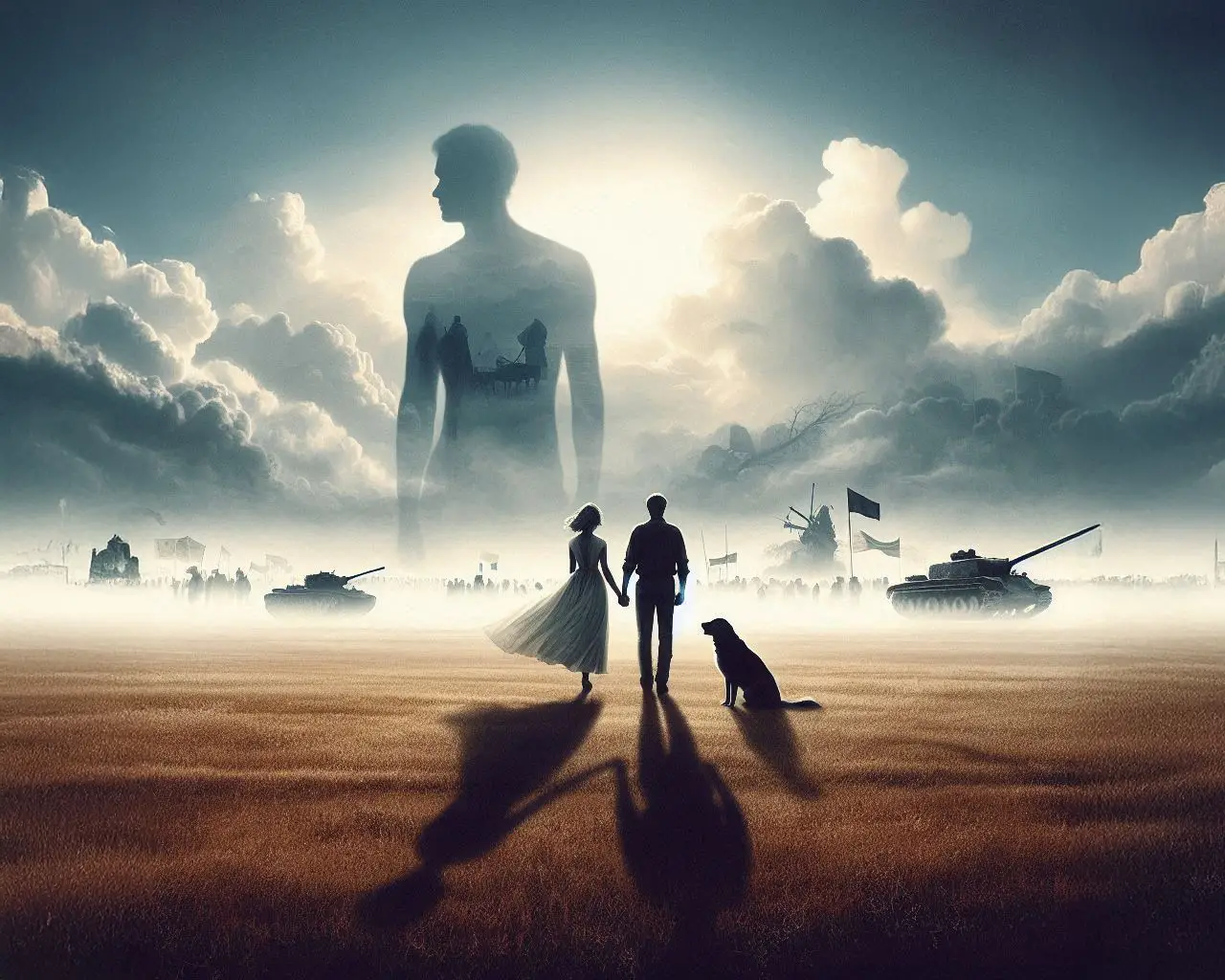
- Set against the backdrop of Prague Spring (1968) and the Soviet invasion of Czechoslovakia.
- Personal lives are intertwined with political events. Tomáš loses his career for a political essay. Tereza photographs the invasion. Franz joins protests.
- The novel illustrates how history penetrates intimacy.
Symbolism
- Dog Karenin – Pure love, loyalty, and reconciliation with mortality.
- Photography – Tereza’s effort to capture truth, but also the burden of witnessing history.
- Journeys and exile – Symbolize the search for authenticity and belonging.
Significance
- One of the most translated Czech novels worldwide.
- Combines existential philosophy with political critique and intimate storytelling.
- Challenges readers to think about whether life’s lightness liberates us. Does it leave us empty? They also think about whether weight gives meaning or crushes us.
For many, Milan Kundera’s The Unbearable Lightness of Being is inseparable from Philip Kaufman’s acclaimed 1988 film adaptation. The film stars Daniel Day-Lewis and Juliette Binoche. It was a critical and public success. It is beloved for its sensual portrayal of love struggling against the crushing weight of history.
But what if this popular understanding, shaped by the film, misses the point entirely? Both the film and the Milan Kundera novel on which it is based are often misunderstood. The book’s true purpose is far more radical and philosophically complex than a simple love story set against political turmoil. It is an exploration of existence itself, a challenge to the very idea of what a novel should be.
Here are four surprising truths. They are drawn from Kundera’s own philosophy of the novel. These truths will change how you see this modern classic.
1. It’s Not a Political Novel (And Reading It That Way Is a “Bad Reading”)
The setting of the 1968 Prague Spring and the subsequent Soviet invasion was powerful. However, Milan Kundera explicitly rejected political interpretations of his work. His primary aim was never political commentary. He saw the novelist’s role not as a denouncer of regimes, but as an “explorer of existence.”
When asked by an interviewer why he was offended by political readings of his novels, Kundera’s response was blunt and unequivocal:
“Because it is a bad reading. Everything you think is important in the book you’ve written is ignored. Such a reading sees only one aspect: the denunciation of a communist regime.”
This is a startling claim. The historical context of the novel is so potent. There is an artistic and intellectual ferment, and hope is crushed by tanks. Naturally, readers see it as a political statement. Yet for the author himself, this focus obscures the novel’s real project. It reduces a deep investigation of the human condition to a mere “denunciation.” To interpret the book mainly as a political work is to overlook the essence of Kundera’s intentions. If the novel’s purpose is not political denunciation, what is it? For Kundera, it starts with embracing uncertainty radically. He refuses to give the answers that political readings demand.
2. Novels Shouldn’t Give Answers—They Should Offer Possibilities
In a world that craves moral clarity and definitive answers, Kundera’s novels offer something far more unsettling: uncertainty. He believed that traditional nineteenth-century novels often sought to give clear resolutions and causal explanations. Unlike these novels, the modern novel’s true power lies in its ability to hold multiple, contradictory truths at once.
His philosophy on this is direct and uncompromising: “The novel doesn’t answer questions: it offers possibilities.”
Kundera admired early novelists like Cervantes. He also admired 18th-century masters like Laurence Sterne and Denis Diderot. They forced the reader to confront “a welter of contradictory truths” without providing a single, absolute one. He believed the novelist must embrace what he called “the wisdom of uncertainty.” This is the reason his novels can feel so ambiguous. It is also why his narrator often steps back from making final judgments. They are intentionally designed not as a neat summary of life’s answers. Instead, they serve as a space to explore its most complex and unresolvable questions.
3. The Characters Aren’t Supposed to Be ‘Real People’
A common measure of a great novel is how “real” its characters feel. We want to believe they can step off the page. Kundera, yet, had a radically different, non-psychological approach. His characters are not meant to be imitations of real people; they are embodiments of existential problems.
He explained his method of character creation in a way that fundamentally challenges the reader’s assumptions about realism:
“It would be senseless for the author to try to convince the reader that his characters once actually lived. They were not born of a mother’s womb. And emerged from a stimulating phrase or two. They also arose from a basic situation.”
Kundera saw his characters as his “own unrealized possibilities,” with each one crossing a “border that I myself have circumvented.” This reframes our entire understanding of the novel’s famous foursome. They are living investigations into the book’s great themes. Each is defined by their unique “existential code.” These are the key words that define their essential problem. Tomas is not a character who simply is ‘lightness.’ He is the novel’s primary investigation into the very meaning of lightness. This investigation is often contradictory and explores the consequences of lightness. Likewise, Tereza is an exploration of weight defined by “body, soul, vertigo.” Sabina is an exploration of betrayal. Franz is an exploration of the seductive trap of “kitsch.”
4. The Authorial Interruptions Are the Whole Point
Many first-time readers of The Unbearable Lightness of Being are struck by how often the narrator interrupts the story. The plot is constantly paused for essayistic digressions on philosophy, history, music theory, or the meaning of a particular word. But what seem like a flaw or a distraction is, in fact, Kundera’s central artistic technique.
He explicitly constructed his novels on two parallel levels. One level is the story itself. The other is the thematic explorations that run “within” and “by” the story. This technique was not born in a vacuum. It is a deliberate revival and modernization of what Kundera called “novelistic meditation.” Kundera admired this style in predecessors like Sterne. Their characters were often forgotten for pages in favor of the narrator’s digressive explorations. Kundera’s ultimate ambition was to achieve a perfect synthesis of profound thought and effortless prose. As he put it, his aim was “To bring together the extreme gravity of the question… and the extreme lightness of the form.”
The story of Tomas and Tereza, then, is not the painting itself. It is the intricate frame upon which Kundera stretches the canvas of his philosophical meditation. The plot provides the human situations. However, the book’s true purpose as an “exploration of existence” is most fully realized in the narrator’s reflections.
Conclusion: A New Way of Reading
These core principles help us understand that The Unbearable Lightness of Being is more than just a story. It is a passionate argument for what a novel can and should be. Ultimately, Kundera’s masterpiece argues that a novel’s true power is realized only when it rejects political answers. It also avoids demanding moral clarity. Instead, it uses experimental characters and a digressive form. This creates a space for profound, unresolved questions. It is a celebration of what he called “the wisdom of uncertainty.”
Kundera’s vision is captured perfectly in his declaration of the novel’s purpose, a statement that serves as a guide to his entire body of work:
The novel is not the author’s confession. It is an investigation of human life in the trap the world has become.
It makes you wonder. How many other great works have we only understood on the surface? The author’s true, more radical experiment may lay waiting to be discovered just beneath.
Similar posts:


Leave a Reply