4 Surprising Truths About the Councils That Forged Christianity
Discover how politics, rivalries, and power struggles shaped the early Church councils.
Introduction: Beyond the Stained Glass
We imagine the great councils of the early Church as scenes of solemn, spiritual gravity. The First Council of Nicaea is often at the forefront of these imaginations. We envision assemblies of ancient, bearded bishops. They debate profound theological mysteries in hushed, sacred halls. It’s an image of divine order, where the foundational doctrines of Christianity were carefully and peacefully clarified for all time.
The historical reality, yet, was far messier. The events that defined Christian orthodoxy were not tidy seminars but a series of politically charged deeply human conflicts. They were shaped as much by imperial ambition, bitter personal rivalries, and calculated power plays as by pious devotion. This article will reveal four of the most surprising truths about these foundational events. It will uncover a history forged in the crucible of conflict.
1. The Emperor Who Called the Council of Nicaea Was a Politician First, a Pious Believer Second
Constantine’s Imperial Calculation
Emperor Constantine I. The man convened the first-ever ecumenical council at Nicaea in 325 AD. He is often remembered as the first Christian emperor. But his primary motivation was rooted in statecraft, not scripture. After unifying the vast Roman Empire under his sole rule, Constantine needed a unifying ideology to hold it together. He recognized the rapidly growing Christian faith as a potential social glue. It served as a Pax Christiana (Christian Peace). Nonetheless, its internal divisions posed a direct threat to imperial stability.
His goal in calling the bishops to Nicaea was not to settle a theological debate for its own sake. Instead, he aimed to enforce religious uniformity as a matter of state security. As historical analysis confirms, his intervention was about achieving political harmony.
Constantine’s engagement in the ecclesiastical sphere was motivated primarily by his political need for religious uniformity (homoiotes). He was not driven solely by theological dedication.
The most stunning proof of his political pragmatism is a fact often lost to history. Constantine remained unbaptized for his entire reign, only undergoing the rite on his deathbed. More surprising still, Bishop Eusebius of Nicomedia performed the ceremony. He was a leader of the Arian faction, the very theological movement that the Council of Nicaea had officially condemned. This counter-intuitive detail is crucial. It reveals that from the very beginning, the line between imperial politics and Christian doctrine was not just blurry. It was deliberately intertwined.
2. The “Victorious” Nicene Creed Was a Historic Failure in the Short Term
A Declaration of War, Not Peace
The Council of Nicaea’s greatest achievement was the Nicene Creed. This statement of faith now serves as a cornerstone for billions of Christians worldwide. It is seen as the decisive moment when orthodox doctrine triumphed. Yet, in the decades that followed, the council was anything but a success. Instead of uniting the Church, it triggered a brutal, multi-generational civil war known as the Arian Resurgence.
The council’s decisions were instantly and violently contested. A powerful network of Arian-sympathizing bishops hunted down defenders of the Nicene Creed. They deposed and exiled these defenders. These bishops had the emperor’s ear. Key proponents of Nicaea, like Eustathius of Antioch and Marcellus of Ancyra, were quickly removed from their posts.
The prime example of this backlash is the life of Athanasius of Alexandria, the creed’s most ferocious champion. For his refusal to compromise on the council’s definition of Christ, he was hounded for nearly half a century. Over the course of his 45-year episcopate, he was forced into exile a staggering five times. The opposition was so total and relentless that the historian Rufinus of Aquileia would later write of him:
“For the whole world conspired to persecute him”
The “defining moment” of Christian orthodoxy was not a clean victory. It was the opening shot in a political and theological war. This conflict would continue for over 50 years. It demonstrated that the creed’s survival was far from guaranteed.
3. The Word That Defined Orthodoxy Was a Controversial, Non-Biblical Afterthought
The Unpopular Bedrock of Faith
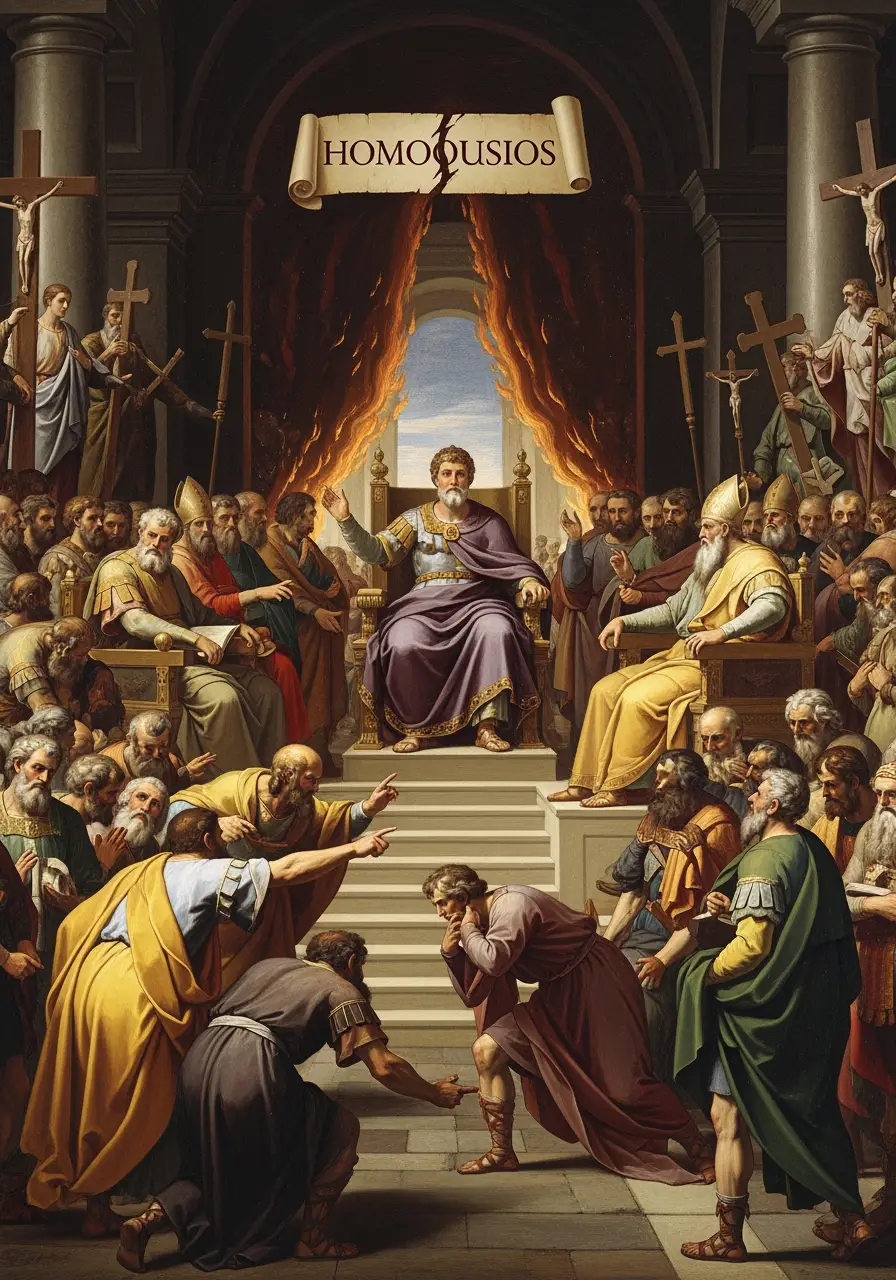
The entire theological debate at Nicaea hinged on a single, critical word: homoousios. A Greek term meaning “of the same substance.” It was inserted into the creed to declare that the Son was not a created being. Arius claimed otherwise. Nevertheless, the creed affirmed that the Son was fully and eternally God, just like the Father. Today, it is the bedrock of Trinitarian theology. But at the time, it was a deeply controversial, non-biblical, and highly political term.
Two facts made many of the bishops at Nicaea deeply uncomfortable with the word. First, it did not anywhere in scripture. This made them wary of adding a philosophical term to a statement of faith. Second, many Eastern bishops were concerned. They feared it sounded too much like Sabellianism. This heresy was condemned. It taught that the Father, Son, and Spirit were merely different “modes” of a single being. It did not recognize them as distinct persons.
Even Athanasius, the word’s greatest defender, had a complicated relationship with it. He never used *homoousios* in his writings before the council. He waited 27 years after Nicaea, until around 352 AD, to start defending it robustly in his work. The most revealing detail comes from Athanasius himself. He later admitted that the council was on the verge of agreeing to a compromise creed. This creed would only use biblical phrases. The term *homoousios* was deliberately inserted at the last moment for one specific reason. It was the single word the Arians could not reinterpret or twist. It was a theological lock designed to make their position impossible to hold. This is profoundly significant. The central word of orthodox Christian faith was a politically motivated term. It was initially unpopular and non-biblical. Even its greatest champion was slow to fully embrace it.
4. The Councils Called to Unify the Church Often Caused Permanent Divorces
Blueprints for Schism
Nicaea set the precedent. It was just the first of many councils called to settle theological disputes. These councils aimed to unify the Church. These later councils did not produce a single, monolithic body. Instead, they often had the opposite effect. They triggered permanent schisms and created the distinct families of Christian churches that exist to this day. Two examples stand out:
The Council of Ephesus (431 AD)
This council’s primary debate was over the title of the Virgin Mary. The faction led by Nestorius, Patriarch of Constantinople, argued that Mary should be called Christotokos (“Bearer of Christ”). They believed she gave birth only to Jesus’s human nature. The council condemned him, declaring Mary to be Theotokos (“Bearer of God”). Nestorius’s followers refused to accept the decision. They were excommunicated. This led to the formation of the Nestorian Church, also known as the Church of the East. It flourished for centuries across Persia, India, and China.
The Council of Chalcedon (451 AD)
The council was convened to address a crucial issue. It aimed to settle the question of Christ’s nature once and for all. It declared that Christ had two distinct natures—one human, one divine—united in a single person. A huge number of Christians rejected this definition. Rejection came particularly from believers in Egypt and Syria. They believed it came dangerously close to Nestorius’s error by over-separating Christ’s humanity and divinity. This disagreement caused one of the most significant splits in Christian history. It gave rise to the family of churches known today as the Oriental Orthodox. This includes the Coptic, Armenian, Syriac, and Ethiopian churches.
The great irony of the conciliar movement is that its quest for perfect unity often resulted in permanent division. The councils did not create one body. Instead, they became the mechanism that inadvertently fractured Christianity. This led to the global family of distinct traditions we see today.
Conclusion: A Messy, Human History
The story of the early Church councils is not one of serene revelations delivered from on high. Foundational doctrines were forged in the chaotic fires. These fires consisted of human ambition, political necessity, and fierce intellectual struggle. The core tenets of a global faith were established. They came from bitter conflict, strategic maneuvering, and painful compromise. This process left a legacy of both division and unity.
This messy, complicated history leaves us with a compelling question. What does it teach us about the enduring relationship between faith and power? How does it relate to humanity’s relentless quest for absolute certainty?


Leave a Reply