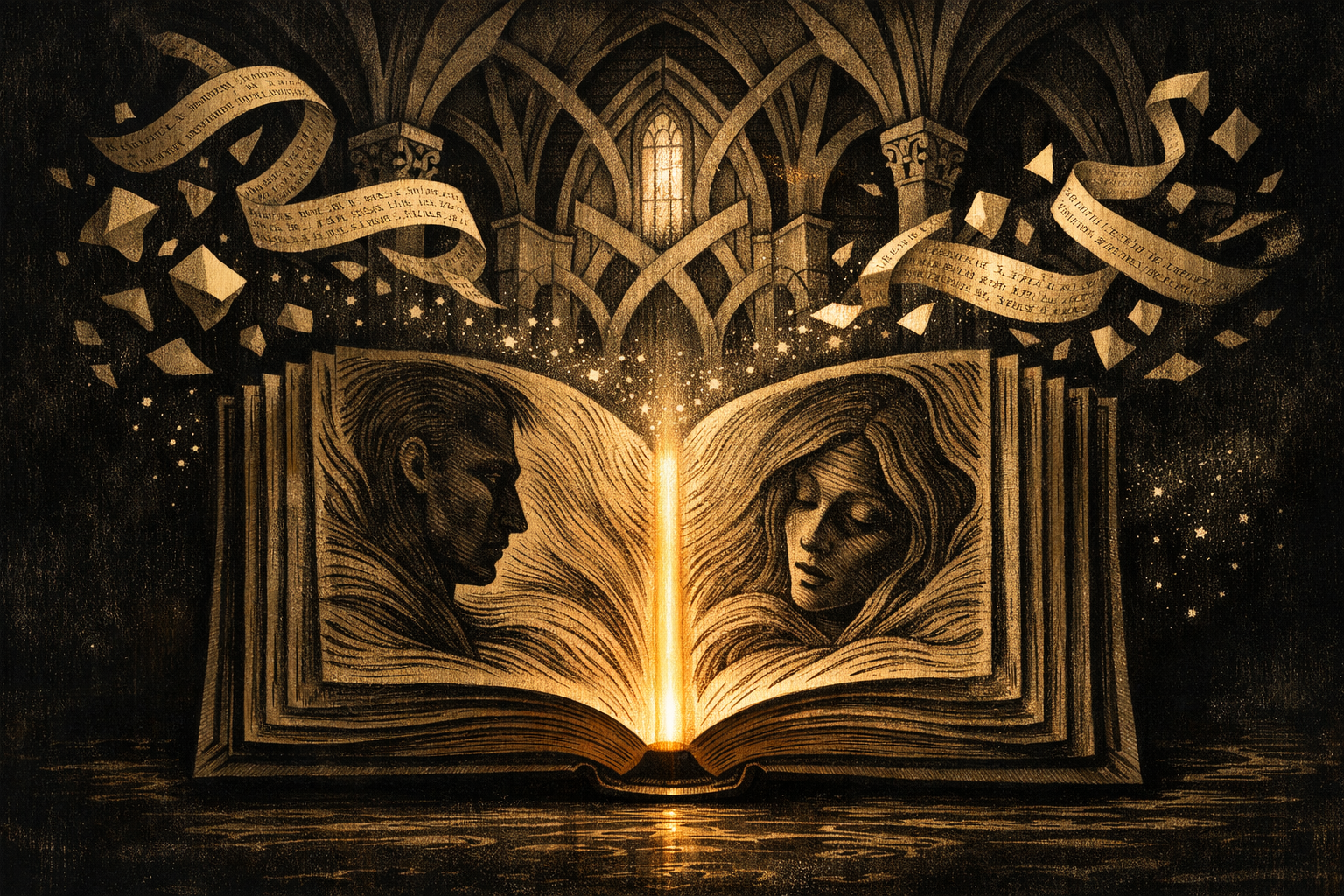
An essay exploring the book as a portrait of the soul, the art of Fritz Eichenberg and Gertrude Stein, the tension between compassion and cruelty, and the alchemy between text and image. “A book has never been merely a volume of printed sheets.”
Table of contents:
- Introduction: The Chiaroscuro of the Human Interior and the Paper Archive
- Engraving of Conscience: Fritz Eichenberg and the Geometry of Human Compassion
- The Salon of Oblivion and Eternity: Gertrude Stein and the Echoes of Her Afterlife
- The Pendulum of Cruelty and Tenderness: The Moral Chiaroscuro of Human Nature
- The Alchemy of Ink and Burin: When the Word Becomes the Body of the Image
- Conclusion: The Timelessness of Human Stories and Their Visual Interpretation
Introduction: The Chiaroscuro of the Human Interior and the Paper Archive
A book has never been merely a volume of printed sheets; it is a physical space where the dust of human existence settles, a ritual vessel that preserves the echoes of our deepest crises and silent triumphs. When we open an old print, we do not merely read characters; we touch the materiality of time. In this silent dialogue between author, illustrator, and reader, an alliance is born that transcends the boundaries of centuries. It is a space where the word meets the image, where human identity is born and dies, suspended between the light of reason and the shadows of our own cruelty.
This essay attempts to examine these threshold spaces. We will enter the workshop of Fritz Eichenberg, whose burin cut into wood with the same relentless justice with which Dostoevsky dissected the human soul. Visit the Paris salon of Gertrude Stein on the rue de Fleurus, that strange panopticon of modernism that to this day refuses to yield to the dust of oblivion. We will explore how boundless sympathy collides with cold cruelty in art, and how a new, third dimension of human experience is born from the tension between text and its visual accompaniment. Let us step onto this threshold, where ink smells of blood and paper of silence.
Engraving of Conscience: Fritz Eichenberg and the Geometry of Human Compassion
To enter the world of Fritz Eichenberg’s wood engravings is to undergo a bath in chiaroscuro. This German-American artist, who fled the Nazi darkness and found refuge in the quiet spirituality of the Quakers, did not project mere illustrations onto paper. His works were a seismographic record of human suffering and the unquenchable desire for justice. Eichenberg’s burin did not glide lightly over the surface of the wooden block; every cut was an ethical act, a ritual carving of light out of absolute darkness.
Eichenberg was a natural interpreter of the great monologues of the human conscience. When he illustrated Dostoevsky’s “The Brothers Karamazov” or “Crime and Punishment,” it was not a mere accompaniment to the plot. His Raskolnikov is not just a literary character; he is the embodiment of existential dread, a man caught in the geometric trap of his own theories, where the shadows on the wall of his garret room have the weight of lead. Eichenberg understood that the human face is an archive of lived catastrophes. Every wrinkle he etched into the face of Father Zosima or the wretched Marmeladov is a topography of compassion.
His Quaker faith was manifested not in dogmatic gestures, but in a deep, quiet humanism. In his depictions of the poor, the outcast, and the imprisoned, there is a sacred solemnity that recalls the baroque chiaroscuro of Rembrandt or the mystical geometry of Santini’s buildings, where light does not enter from anywhere outside, but is born from the internal tension of the matter itself. Eichenberg shows us that human connection is not a given; it is a hard-won territory in a landscape otherwise prone to coldness and indifference. His lines are strong, uncompromising, and yet full of trembling. It is an art that does not seek admiration, but the transformation of the viewer. It demands that we look into the face of the sufferer and recognize in it our own portrait.
The Salon of Oblivion and Eternity: Gertrude Stein and the Echoes of Her Afterlife
While Eichenberg sought truth in the depth of the cut and the weight of the shadow, Gertrude Stein in Paris, on the rue de Fleurus, was reshaping the very structure of time and speech. She was a woman who became a monument in her own lifetime, yet her true significance emerges only in what biographer Francesca Wade calls her “afterlife.” Stein was not merely a collector of paintings and a patron of the avant-garde; she was the architect of a new way of perceiving.
Her literary style—that famous layering of words, repetitions that were not mere duplication but an attempt to capture the present moment in its constant movement—recalls the work of a weaver. “A rose is a rose is a rose,” she wrote, and with this seemingly simple gesture, she stripped the word down to its ritual core. Stein rejected linear narrative because she knew that the human mind does not work that way. Our consciousness is a palimpsest, a constant rewriting of what has already been written, a layering of memories in which the past constantly seeps into the present.
The afterlife of Gertrude Stein, as reconstructed by Francesca Wade in her award-winning book, shows how this woman became a myth, and at the same time, how this myth obscured her real human vulnerability. Stein, who lived on the threshold between two worlds as a Jewish intellectual in occupied France, carried deep contradictions within herself. Her salon was a meeting place, but also a fortress in which she protected herself from the chaos of the outside world. Her legacy lives today not in academic analyses, but in how she taught subsequent generations of artists not to fear the empty space between words. The silence she left behind is not a vacuum, but a resonating chamber in which the voices of Hemingway, Picasso, and all those who sought confirmation of their own existence in her salon still echo.
The Pendulum of Cruelty and Tenderness: The Moral Chiaroscuro of Human Nature
Art, if it is to be true, must not avoid the dark corners of the human heart. Human nature is not a monolith; it is a battlefield where deep sympathy constantly collides with cold, even refined cruelty. Great creators—both illustrators and writers—are those who follow this pendulum with scientific precision and, at the same time, with poetic emotion.
Consider, for example, how artists depict moral dilemmas. The true art of humanity does not lie in moralizing, in pointing fingers at the guilty. It lies in the courage to show how close the executioner and the victim are to one another. In Eichenberg’s prints for Dostoevsky, we see this polarity a second before its explosion. Raskolnikov, holding the axe over the old pawnbroker’s head, is depicted not with hatred, but with a terrifying understanding of a human weakness that has gone mad. It is the moment when sympathy turns into cruelty, and cruelty gives birth to deep, cleansing remorse.
We find this moral chiaroscuro also in authors who at first glance seem cold and analytical. Gertrude Stein, in her portraits of friends and acquaintances, often used a method that could be called aesthetic autopsy. Her gaze was like an X-ray; she discarded the layers of social politeness to reveal the raw, sometimes grotesque core of the personality. Is there a certain cruelty in this? Undoubtedly. But it is the cruelty of a surgeon who must make a cut to save the patient from illusion. The artist of sympathy and cruelty knows that without shadow, light would be blinding and flat. Only in contrast, in that tense space between the embrace and the blow, is the true plasticity of human character revealed.
The Alchemy of Ink and Burin: When the Word Becomes the Body of the Image
The relationship between the text and its visual interpretation is one of the oldest rituals of book culture. Illustration should never be a mere handmaiden to the text, its passive reflection. If this is the case, the book dies from a lack of air. Real collaboration between writer and artist is an alchemical process in which one medium dissolves into the other so that something completely new can emerge—a third space where eyes and mind meet.
When we look at Eichenberg’s work for classical works of world literature, we see how the graphic medium gives physical weight to the word. Dostoevsky’s text is full of feverish monologues, inner voices, and psychological tension. Eichenberg materializes this tension. His woodcut is not an illustration of a scene; it is its spatial equivalent. Here, the black plane of ink acts like a silence that swallows words, while the white lines are screams that cut through this silence.
We can understand this dialogue between writing and image as a rite of passage. The reader, leafing through the book, transitions from the linear time of reading to the simultaneous time of seeing. This moment of transition—when the word turns into an image and the image reinterprets the word—is where depth is born. It is like looking into a mirror that does not reflect our face, but our interior. The text gives us the story, the image gives us its weight, its haptic dimension. Without this synergy, books would be merely an archive of dead thoughts; with it, they become living organisms that breathe with our every glance.
Conclusion: The Timelessness of Human Stories and Their Visual Interpretation
At the end of all our journeys, after turning hundreds of pages and exploring countless shadows in print, we return to the simplest thing: the human story. Man is a creature who tells stories to survive. Our stories are fragile threads that we stretch over the abyss of oblivion, and artists like Fritz Eichenberg or Gertrude Stein are those who weave these threads into strong ropes.
The visual interpretation of literature is not merely decorative art; it is an archaeology of the human spirit. It shows us that even as technology, scenery, and language change, our basic anxieties and desires remain the same. The desire for connection, the fear of loneliness, the tension between justice and mercy—these are all constants that we find in old woodcuts just as we do in avant-garde poems.
The book as a portrait of the soul remains open. Every new generation writes its own marginalia into it; every new reader relives that silent miracle when a world full of colors, shadows, and human warmth is born from black characters on white paper. In this infinite layering of memory lies our only true immortality. And perhaps there—in the quiet presence of the book on our table—we find the answer to the question of who we actually are: we are travelers on the way to the light who are not afraid to explore the shadows.
Similar posts:


Leave a Reply