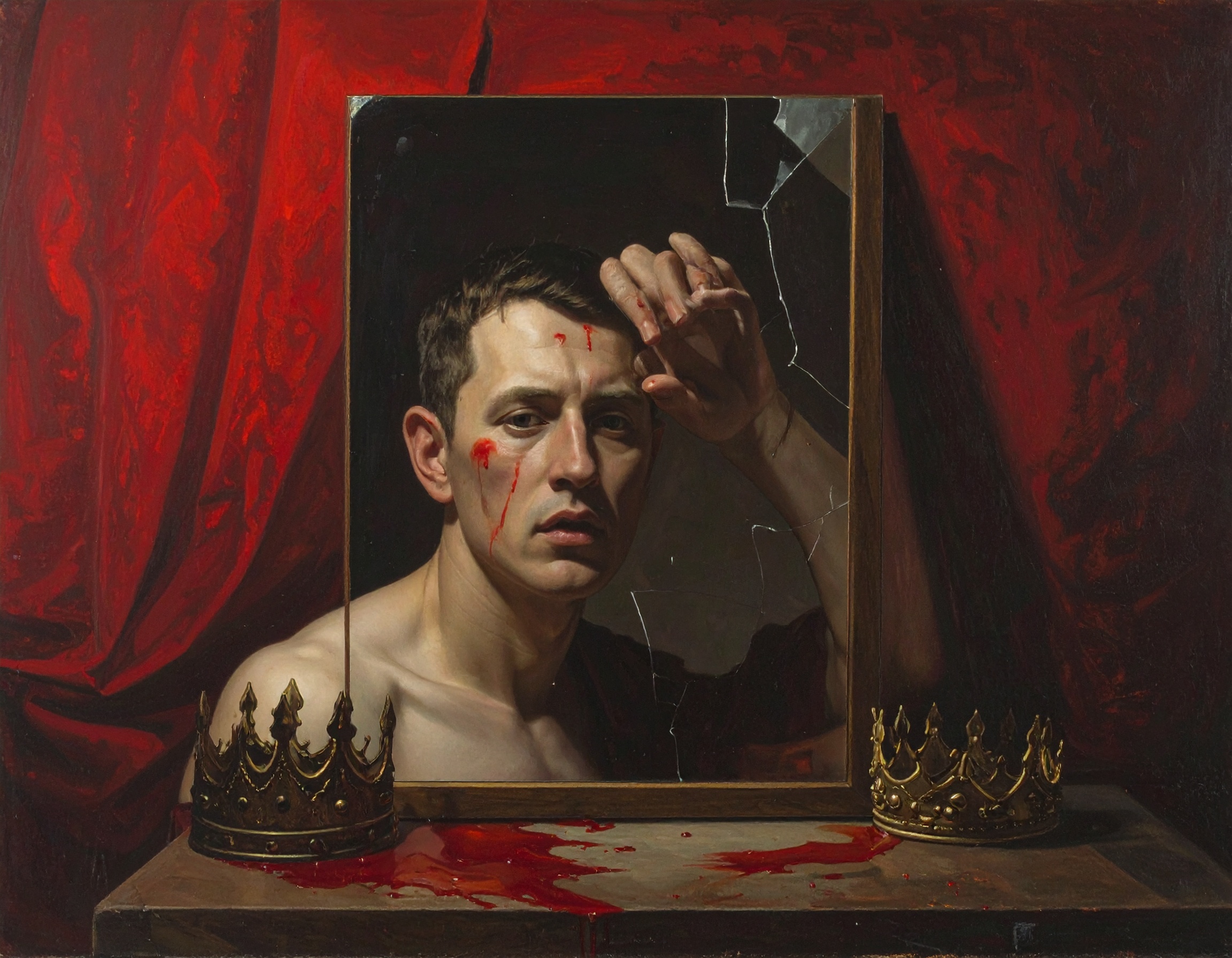
An essay exploring how art reveals the psychology of power: guilt, fear, authority, and human fragility hidden in portraits of tyrants. From Repin’s haunting painting to modern political imagery, art becomes a mirror that power cannot fully control or escape.
Table of contents:
- The Tyrant, the Artist, and the Mirror of the Soul: How Art Reveals the Psychology of Power
- I. Repin’s Terrible Moment: When Power Sees Itself Without a Mask
- II. How Power Chooses to Be Seen: From Icons to Modern Political Portraits
- III. The Psychology of Power: Who Are You When No One Is Watching?
- IV. Art as the Witness That Can’t Be Silenced
- V. Conclusion: Power and the Fear of Its Own Reflection
The Tyrant, the Artist, and the Mirror of the Soul: How Art Reveals the Psychology of Power
There are moments in history that do not survive in chronicles but in gestures. A single trembling hand shows vulnerability. An intense gaze widens in realization. A single streak of red cuts through a dark canvas like a confession. Art has always been more than representation; it is a form of psychological archaeology. It excavates what power tries to bury. It reveals what rulers try to silence. Preserves what human beings, in their fragility, would prefer to forget.
Power speaks in decrees, but it also speaks in images. And images, unlike decrees, do not fade. They linger, they haunt. They return.
This essay is an exploration of that return. It is a meditation on how art becomes a mirror. In this mirror, the psychology of power is exposed, whether power wishes it or not. It is a journey through the faces of tyrants. It is also a journey through the hands of artists. Through the eyes of viewers, even centuries later, they still feel the pulse. It is the pulse of a moment that should have disappeared.
I. Repin’s Terrible Moment: When Power Sees Itself Without a Mask
Ilya Repin’s Ivan the Terrible and His Son Ivan is not merely a painting; it is a psychological event. To stand before it is to witness the exact second when power collapses inward. It is the moment when the architecture of authority fractures. It reveals the trembling human beneath.
In the dim interior of the scene, the tsar cradles the dying body of his son. The red of the blood is the only vivid color, a violent interruption in the muted palette. Ivan’s eyes are wide, almost animalistic, filled not with rage but with horror — the horror of recognition. This is the moment when the tyrant sees himself clearly for the first time.
Guilt as a Color That Can’t Be Washed Away
Repin uses red not simply as a symbol of violence but as the visual language of guilt. It spreads across the canvas like a stain that refuses to disappear. The viewer can’t look away from it. The tsar can’t look away from it. It is the color of consequence.
In this painting, guilt is not abstract. It is physical, heavy, and irreversible. It is the point at which power becomes aware of its own shadow.
The Father and the Tyrant in One Body
What makes the painting devastating is not the political dimension but the intimate one. Repin does not show a ruler; he shows a father. In that collision, authority meets affection. Dominance meets vulnerability. The entire psychology of tyranny is revealed.
Tyranny begins not with ideology but with psychology. It begins with the belief that one is entitled to act without consequence. It begins with the illusion that no one is watching.
Repin’s painting is the moment that illusion shatters.
II. How Power Chooses to Be Seen: From Icons to Modern Political Portraits
Power has always needed an image. Because to be seen is to exist. And to control how one is seen is to control the narrative of one’s existence.
Historical Strategies of Representation
Across centuries, rulers have shaped their own images with meticulous care:
- Medieval icons presented rulers as divine intermediaries, untouched by human weakness.
- Renaissance portraits emphasized the body as a symbol of rationality, order, and legitimacy.
- Baroque compositions used theatricality and grandeur to overwhelm the viewer with the spectacle of authority.
- Nineteenth‑century portraiture introduced psychological nuance, though still carefully curated to keep dignity and control.
Each portrait is a negotiation between truth and intention. Each is a crafted fiction.
The Modern Face of Power
Today’s political portraits are more subtle but no less strategic. Instead of crowns, we see flags, instead of thrones, we see desks. Instead of divine light, we see soft studio illumination designed to evoke trust, stability, and competence.
The modern leader must be human — but not too human. Approachable — but not vulnerable. Strong — but not threatening.
The choreography is precise: a slight smile, a controlled posture, a background that whispers authority without shouting it.
Yet even in these carefully constructed images, there are cracks. A shadow that falls strangely. A smile that strains. A gaze that reveals exhaustion or fear.
It is in these cracks that the truth of power hides.
III. The Psychology of Power: Who Are You When No One Is Watching?
One of the most revealing questions in psychology is deceptively simple: Who would you be if no one were watching?
Power often answers this question in troubling ways. For power is not merely the ability to act — it is the ability to act without being seen.
The Erosion of Empathy
Psychological research suggests that:
- A lack of external accountability weakens empathy.
- A sense of exceptionalism distorts identity.
- Isolation fosters narcissism.
- And power without witnesses becomes power without limits.
Tyranny does not emerge suddenly. It grows in increments:
- a privilege unchallenged,
- a lie unpunished,
- a decision without consequence.
These small permissions accumulate until the person no longer recognizes the boundary between self and world.
Guilt as the Return of the Witness
Guilt appears only when the internal witness awakens — when the individual sees themselves from the outside. When the mirror is held up. When the image becomes unbearable.
Repin’s Ivan is caught in this exact moment. This is the moment when the tyrant becomes human again. The human can’t bear what he sees.
IV. Art as the Witness That Can’t Be Silenced
Art has one advantage over power: it endures. Rulers fall. Regimes collapse. But the image remains.
Portraits that were meant to glorify become, over time, indictments. Images that were meant to inspire awe start to reveal insecurity, fear, or vanity.
The Painting Lives Beyond Its Creator
An artist is obedient, intimidated, or fascinated by power. But once the work is created, it belongs to no one. It becomes a witness — silent, patient, incorruptible.
The Viewer as Interpreter
Every viewer becomes a co‑author of the image. We project our own fears, hopes, and interpretations onto the canvas, we read what the ruler tried to hide. We see what the artist not have consciously intended.
This is why art is dangerous to power: it opens a space that can’t be controlled.
V. Conclusion: Power and the Fear of Its Own Reflection
The history of art reveals a simple truth: power is obsessed with its own image — and terrified of it.
Repin’s painting reminds us that no authority is absolute. That every tyrant is, in the end, a human being confronted with the consequences of their actions. That guilt is the shadow of power. And that art is the mirror in which that shadow becomes visible.
Art teaches us that the psychology of power is not merely a political question but a human one. It asks us to consider our own relationship to control, to responsibility, to the gaze of others.
And it leaves us with a question that echoes across centuries:
Who are you when no one is watching — and who do you become when you finally see yourself?
Similar posts:
Inspiration:
- Aeon | Great art explained: Ivan the Terrible and His Son Ivan on 16 November 1581
- Aeon | The presence of power
- Psychology Today | Who Would You Be if No One Was Watching?


Leave a Reply