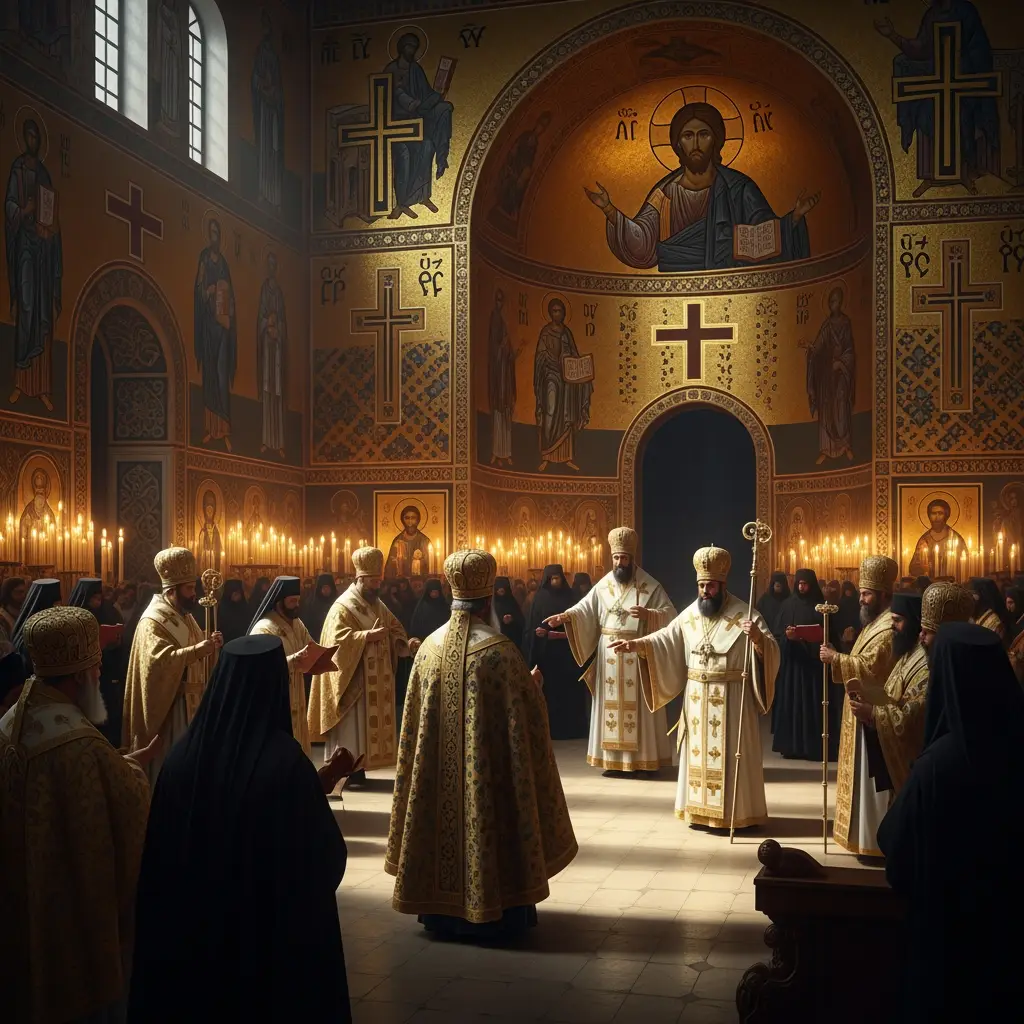
Discover the history of the Second Council of Nicaea (787), which resolved the iconoclastic dispute and affirmed the role of icons in Christian tradition.
Table of contents:
Icons, an Empress, and a Mistranslation: 5 Shocking Truths About the Council That Defined Christian Art
Introduction: More Than Just a Meeting
Walk into an Eastern Orthodox church. Enter a Catholic cathedral or a museum of medieval art. You will inevitably meet them: icons. These solemn, stylized images of Christ, the Virgin Mary, and the saints gaze out from walls, panels, and mosaics. Many assume they have always been an accepted part of Christian devotion. Their origins are lost in the early church’s pious mists. But the story behind these images is no quiet theological debate. It is a dramatic saga of imperial power and political coups. There was a war between rival councils. Additionally, an international misunderstanding nearly fractured Christendom.
A conflict was at the heart of this storm. It was as much about power as it was about piety. This was a quintessential struggle over who held ultimate authority: the emperor or the church. The focal point of this tension was the Second Council of Nicaea, convened in 787. This assembly was called to settle the “Iconoclast Controversy.” It was a century-long, empire-wide war. The debate was over whether religious images were holy aids to worship or forbidden idols. But the council’s proceedings and its aftermath were far from a simple resolution.
The history of the official definition of Christian art is filled with surprising twists. These twists reveal the complex interplay of faith, politics, and human ambition. Here are five shocking truths about the council that shaped the images we see today.
An Empress Ran the Show (and It Got Brutal)
A woman of extraordinary political skill and ruthlessness convened the council to restore holy images. She was not a pope or a patriarch. Her name was Empress Irene. Following the death of her husband, Emperor Leo IV, in 780, Irene became regent for her ten-year-old son, Constantine VI. An iconophile (a supporter of icons), she was determined to reverse decades of official, state-sponsored iconoclasm.
Her path was anything but smooth, forcing her to assert the full power of the throne. The first try to hold the council in Constantinople in 786 faced violent disruption. Iconoclast-sympathizing soldiers still loyal to the old regime were responsible. Unfazed, Irene executed a brilliant political maneuver. She strategically dealt with the mutinous troops in Constantinople by replacing them with loyal soldiers from other regions. With her military power base secured, she successfully reconvened the council a year later in the city of Nicaea.
This fact is stunning because it frames the entire controversy within the context of Byzantine imperial power, where the ruler was seen as God’s regent on Earth. The resolution to one of the church’s most profound theological crises depended directly on calculated political and military force, a clash between divinely ordained visions for the empire. The triumph of icons was won not by debate alone, but by an empress’s command of the army. Irene’s ambition, however, had a tragic postscript. Years later, to secure her own power, she staged a coup against her son. She had him imprisoned and, in the very room where he was born, had him blinded to ensure he could never rule again, becoming the first woman to rule the Byzantine Empire in her own right.
The Council Was Actually a “Rematch”
The Second Council of Nicaea wasn’t the first assembly to rule on the question of icons. It was, in fact, a high-stakes rematch against a rival council that had already claimed ultimate authority. In 754, the iconoclast Emperor Constantine V convened a massive council of 338 bishops at the palace of Hieria. This assembly forcefully condemned the creation and veneration of religious images, declaring the practice to be “idolatrous and pagan.”
The Council of Hieria made its most audacious move in its final declaration. It proclaimed itself to be the “Seventh Ecumenical Council.” In the eyes of the emperor and a significant portion of the Eastern church, the case was closed. The highest possible authority had spoken, and icons were heresy.
The primary task of Nicaea II in 787 was not simply to discuss icons. Its main aim was to systematically dismantle the authority of its predecessor. One entire session was devoted to reading the decrees of Hieria and refuting them, line by line. Nicaea II aimed to overturn the 754 council. Its goal was to claim the title of the true Seventh Ecumenical Council for itself. This was a theological and political showdown. It was a clear case of Caesaropapism. Two competing imperial visions for the Church came into conflict. Constantine V’s vision clashed with Empress Irene’s. Each used the mechanism of a council to claim infallible authority.
It All Hinged on Two Greek Words
The central accusation of the iconoclasts was simple and powerful: honoring images violated the Second Commandment’s prohibition against worshipping idols. To them, bowing before a painting of Christ was no different than bowing before a golden calf. The bishops at Nicaea II solved this theological problem with a brilliant linguistic distinction. They precisely clarified the difference between two types of honor. This was done using two Greek words.
- Latreia (λατρεία): This term was defined as “true adoration” or worship. The council decreed that latreia is owed to God alone. It is a grave sin to offer it to any created thing, including an icon.
- Proskynesis (προσκύνησις): This term was defined as “honorary veneration.” This gesture is one of reverence and respect. It is like bowing to a king or honoring the holy Gospels. This veneration is given to icons, the cross, and other sacred objects without committing idolatry.
To explain how this worked in practice, the council articulated a crucial principle of transmission. The honor given to the physical object does not stop there but passes through it to the person it symbolizes, as the council’s final decree states:
Indeed, the honor paid to an image traverses it. It reaches the model. He who venerates the image venerates the person represented in that image.
This distinction was the theological masterstroke of the council. It created a framework that allowed believers to use physical objects in their devotion while steering them clear of idolatry. It affirmed that although the wood and paint of an icon are mere matter, the person they represent is holy. Venerating that image is a way of honoring that person.
The West Rejected the Council—Partly Due to a Mistranslation
One can assume that a council approved by the Pope would be universally accepted, at least in the West. In a shocking turn of events, the most powerful ruler in Western Europe rejected the decrees of Nicaea II. This ruler was Charlemagne, King of the Franks. The reason reveals the precarious nature of international communication and the rising political tensions of the 8th century.
A “very faulty” Latin translation of the council’s Greek acts was sent to the Frankish court. This translation completely neglected to capture the subtle but essential distinction between proskynesis (veneration) and latreia (worship). It rendered both Greek words into the single Latin term adoratio (adoration). Reading this, Charlemagne and his theologians were horrified. They believed the council in Nicaea was instructing Christians to offer images the same adoration. This adoration was usually reserved for the Holy Trinity.
In response, the Franks produced a lengthy and severe critique known as the Libri Carolini (“The Books of Charles”). The critique was based not only on a bad translation. It also stemmed from a confused understanding. It ignorantly conflated the sayings of the icon-supporting Nicaea II with those of the icon-destroying Council of Hieria from 754. At the Council of Frankfurt in 794, Charlemagne’s theologians formalized their rejection, condemning Nicaea II’s decrees as heretical. For Charlemagne, an aspiring emperor, this theological dispute was a perfect chance to assert his authority against the Byzantines. It helped him discredit Greek authority. This marked a major early episode in the growing cultural and political divergence between East and West.
Victory Wasn’t Instant or Final
Despite the definitive rulings at Nicaea in 787, the Iconoclast Controversy was far from over. The council’s victory was temporary, and its decrees would be overturned before being finally restored. This messy aftermath challenges the clean, linear way we often think about how church doctrine is established.
In 815, a new emperor, Leo V, interpreted military defeats against the Bulgars as signs of divine judgment. He concluded that these losses showed God’s displeasure with icons. He initiated a “Second Iconoclasm.” Once again, he banned religious images throughout the empire. This action powerfully illustrated how Byzantine theology was tied to the state’s military fortunes. For nearly three more decades, the church was thrown back into turmoil, with iconophiles once again facing persecution.
The final and definitive end to the Iconoclast Controversy came in 843. This was a full 56 years after the Second Council of Nicaea. The restoration of icons was finally secured by another empress, Theodora, acting as regent for her young son. This event is celebrated in the Eastern Orthodox Church to this day. It is known as the “Triumph of Orthodoxy.” This annual feast occurs on the first Sunday of Lent. This long, contested history shows that major doctrinal definitions are often not the end of a debate. Instead, they mark a crucial turn in a struggle. This struggle can last for generations.
Conclusion: Faith, Art, and Power
The story of the Second Council of Nicaea shows the deep connection between the history of Christian art and raw political power. It reflects the constant tension between emperors and the Church and profound theological reflection. The icons that adorn churches today are not just tranquil objects of devotion. They survived a turbulent and fiercely contested history. They carry the legacy of ruthless empresses and rival councils. Theologians under immense pressure hammered out subtle yet powerful distinctions.
This history reminds us that the sacred objects we see are the product of a dramatic human story. This history leaves us with a compelling question. How does this complex history change our perception of the relationship? It explores the link between sacred art, religious authority, and the human hands that shape it?
Similar posts:

Leave a Reply