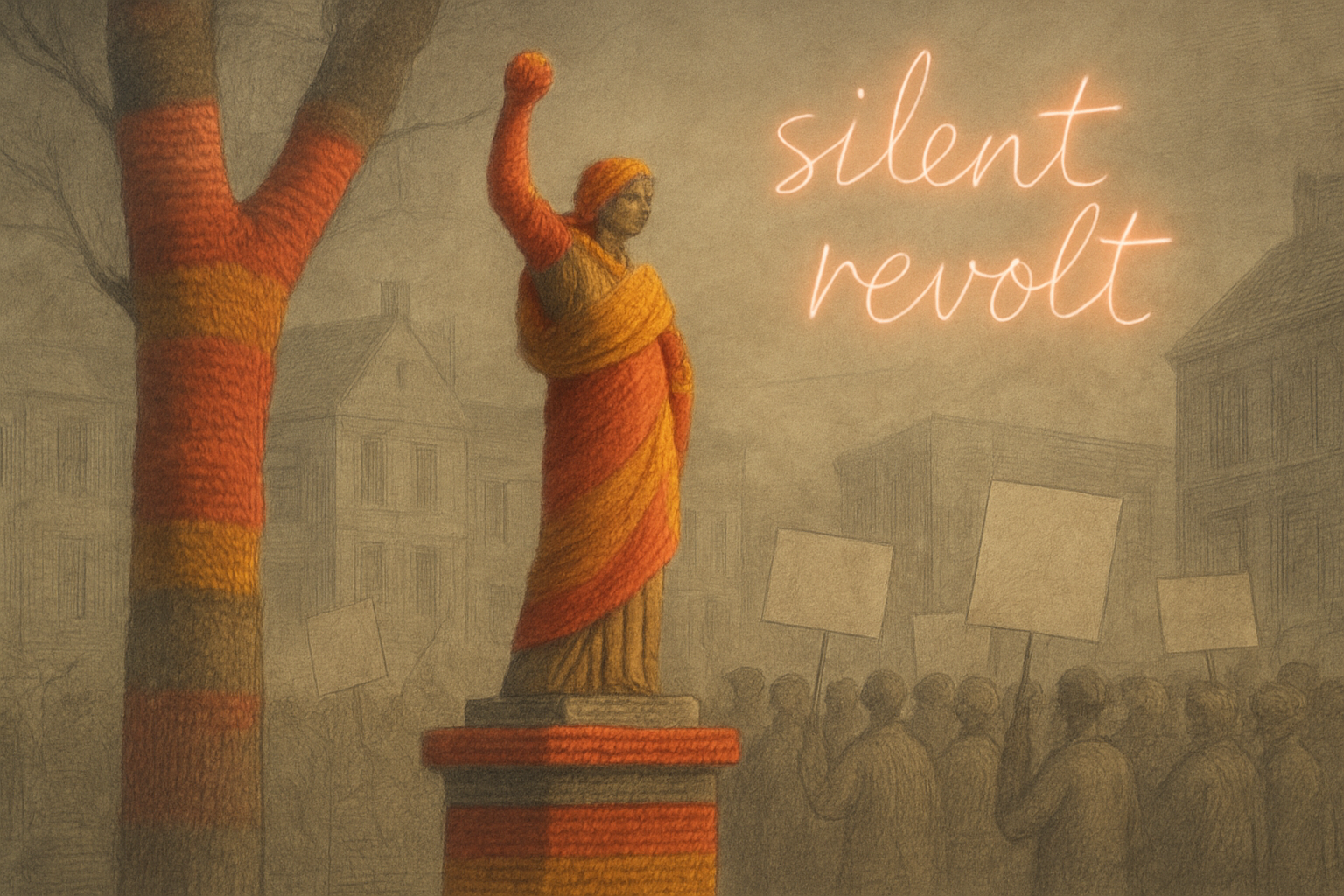
An essay exploring art as both silent and loud protest — from colonial-era visual resistance to contemporary public interventions, the soft subversion of yarn bombing, and the radical intimacy of Tracey Emin. A reflection on how artistic expression challenges power, norms, and cultural silence.
Table of contents:
- Art as Silent (and Loud) Protest: From Colonial Unrest to Yarn Bombing and Tracey Emin
- Colonial-Era Roots: When Images Became a Shield and a Sword
- The Street as a Stage: Public Space and the Evolution of Protest Art
- Yarn Bombing: Soft Materials, Hard Messages
- Tracey Emin: When the Personal Becomes Political
- Boundary-Breaking as a Generational Voice
- The Continuum of Protest: Silent, Loud, and Everything Between
- Digital Age Activism: New Platforms, New Challenges
- Why Protest Art Still Matters
- Conclusion: The Future of Artistic Resistance
Art as Silent (and Loud) Protest: From Colonial Unrest to Yarn Bombing and Tracey Emin
Art has always been more than ornamentation. Across centuries, it has served as a mirror of society. It has been a weapon of dissent. Art became a language of resistance when spoken words were censored, punished, or simply insufficient. From the coded satire of colonial-era printmakers, protest art has evolved to the soft subversions of yarn bombing. Tracey Emin’s raw confessional power also contributes to it. This art form creates a continuous thread of defiance woven through history.
Colonial-Era Roots: When Images Became a Shield and a Sword
In colonial societies, where political speech was tightly controlled, art became a strategic refuge for dissent. Visual culture—prints, caricatures, symbolic rituals—allowed communities to express opposition without directly confronting imperial authority.
The Rise of Visual Satire
Caricatures and engravings circulated widely in colonial America, mocking trade monopolies, taxation policies, and the British Crown. Their power lay in their accessibility: even those who not read understood a biting image.
- Satirical prints exposed corruption and exploitation.
- Allegorical scenes encoded political messages in mythological or moral narratives.
- Public rituals—burning effigies, destroying imported goods—became performative protests with aesthetic and political force.
These early forms of protest art established a template: use imagery to say what cannot be said aloud.


The Street as a Stage: Public Space and the Evolution of Protest Art
As cities expanded, public space became a contested arena. Walls, bridges, and plazas turned into canvases for dissent. Graffiti, murals, and guerrilla performances challenged the neutrality of urban landscapes.
Why Public Art Became Political
Public art disrupts the everyday. It forces passersby—willing or not—into a moment of reflection.
- It bypasses institutional gatekeepers.
- It democratizes access to political expression.
- It transforms the city into a living archive of resistance.
This shift from printed satire to street intervention paved the way for more intimate, tactile forms of activism.


Yarn Bombing: Soft Materials, Hard Messages
Yarn bombing emerged in the early 2000s. It is often described as “soft graffiti.” This form of art is a playful yet pointed public intervention. Instead of spray paint, it uses knitted or crocheted textiles to wrap trees, benches, statues, and street signs.
The Politics of Softness
At first glance, yarn bombing appears whimsical. But beneath its colorful surfaces lies a sharp critique of urban alienation, gender norms, and the commodification of public space.
- It reclaims traditionally “feminine” craft as a tool of activism.
- It introduces care, warmth, and slowness into fast, impersonal cityscapes.
- It challenges the idea that protest must be aggressive to be effective.
Yarn bombing’s power lies in its paradox: gentle materials delivering uncompromising messages.
Community, Craft, and Resistance
Unlike solitary graffiti writers, yarn bombers often work collectively. The act of knitting together becomes a form of solidarity, a ritual of shared resistance.
- Craft becomes community.
- Community becomes visibility.
- Visibility becomes political.
This “aesthetics of care” stands in stark contrast to the harsher tones of traditional protest. It offers a new model of activism rooted in tenderness.


Tracey Emin: When the Personal Becomes Political
If yarn bombing signifies collective softness, Tracey Emin embodies the opposite: radical vulnerability. Her work—spanning neon text, installations, drawings, and autobiographical confession—pushes the boundaries of what society deems acceptable to reveal.
Confession as Confrontation
Emin’s art is not polite. It is raw, intimate, and often uncomfortable. But discomfort is precisely the point.
- She exposes trauma, sexuality, shame, and desire.
- She challenges patriarchal expectations of female silence.
- She transforms private pain into public critique.
Her iconic works—My Bed, Everyone I Have Ever Slept With, her neon declarations—serve as emotional protests. They oppose cultural norms that police women’s bodies and voices.

Boundary-Breaking as a Generational Voice
Emin’s influence extends beyond her own oeuvre. She opened the door for a generation of artists who use personal narrative as political resistance.
- Autobiography becomes activism.
- Vulnerability becomes a weapon.
- The body becomes a site of protest.
Her work reminds us that protest is not always external; sometimes it is the act of refusing to hide.

The Continuum of Protest: Silent, Loud, and Everything Between
Across centuries, protest art has taken many forms—some subtle, some explosive. Yet all share a common purpose: to disrupt the status quo.
The Spectrum of Resistance
- Colonial satire whispered dissent through metaphor.
- Street art shouted it across concrete walls.
- Yarn bombing wrapped it in softness.
- Tracey Emin carved it into neon confession.
This continuum reveals that protest is not a single gesture. It is a multiplicity of strategies. Each strategy is shaped by its cultural moment.

Digital Age Activism: New Platforms, New Challenges
In the 21st century, protest art has migrated into digital spaces. Social media, online galleries, and virtual performances amplify visibility but also introduce new tensions.
Amplification and Ephemerality
Digital platforms allow protest art to reach global audiences instantly. Yet this speed can dilute depth.
- Viral images spread quickly but fade just as fast.
- Algorithms shape what is seen and what is buried.
- Authenticity competes with performative activism.

The challenge for contemporary protest artists is to keep substance within acceleration.
Hybrid Forms of Resistance
Today’s most impactful protest art often blends physical and digital elements:
- Yarn bombing documented and shared online.
- Performance art livestreamed to global audiences.
- Neon texts photographed, remixed, and reinterpreted.
The boundaries between medium, message, and audience dissolve.

Why Protest Art Still Matters
In an era of polarization, misinformation, and rapid change, protest art remains essential. It offers something political discourse often lacks: emotional truth.
What Art Can Do That Politics Cannot
- It slows us down.
- It makes us feel before we think.
- It creates space for ambiguity, nuance, and reflection.
- It invites participation rather than demanding allegiance.
Protest art does not simply react to the world; it reshapes the imagination of what the world will be.
Conclusion: The Future of Artistic Resistance
From colonial engravings to yarn-wrapped trees and neon-lit confessions, protest art continues to evolve. Its forms shift, but its purpose endures: to challenge, to reveal, to resist.
The question is not whether art can protest—it always has.
Which forms of protest resonate most deeply today? Is it the quiet, communal gestures of yarn bombing? Or is it the raw, confrontational honesty of artists like Tracey Emin?
Both speak to different facets of our moment. Both are necessary. Both remind us that resistance is not a single voice but a polyphony of creative defiance.

Inspiration:
- JSTOR Daily (“When Profit Met Protest in Colonial New York”, “Knit One, Bomb Two: A Primer on Yarn Bombing”)
- Artsy News (“6 Boundary-Breaking Artworks in Tracey Emin’s Major London Show”)



Leave a Reply