4 Surprising James Baldwin Ideas We’re Still Catching Up
Discover four surprising James Baldwin ideas—from America’s willful “innocence” to his influence on feminism—that remain urgently relevant today.
Surprising James Baldwin Ideas We’re Still Catching Up To
It is, to borrow a phrase, a Baldwinian moment. In recent years, James Baldwin has been resurrected in the American consciousness. His searing words offer a powerful lens through which to understand movements like Black Lives Matter. His work has found new audiences through documentaries like Raoul Peck’s I Am Not Your Negro. It has been cited as a key influence for a new generation of writers and activists.
Yet for all his newfound relevance, Baldwin is often reduced to his most quotable moments. We share the soundbites, but we often miss the symphony. While he is celebrated for his righteous anger, he is also known for his eloquent critiques of racism. His most profound, counter-intuitive, and challenging ideas often stay buried beneath the surface. To truly understand Baldwin’s enduring power, we must move beyond the familiar quotes. We should explore four of his most surprising takeaways. These ideas reveal the deeper and more demanding layers of his thought.
America’s Deadliest Sin Isn’t Hatred, but Willful “Innocence”
Baldwin reframes the most corrosive force in American life not as overt hatred. Instead, he sees it as something far more insidious: a cultivated and “culpable” innocence. For Baldwin, this is not a simple lack of knowledge; it is a willful blindness. It reflects a deliberate refusal to face the brutal history. It also demonstrates a concerted refusal to acknowledge the ongoing reality of racial domination in America.
This idea is radical. It recasts racism not merely as an issue of malicious acts by a few “bad people.” Instead, it views racism as a corrupting national habit of self-delusion. Baldwin believed this self-delusion required ignoring a fundamental truth. He articulated this truth throughout his work: “History is literally here in all that we do.” The “innocence” he diagnosed was the nation’s determined effort to ignore this ever-existing history. This ignorance allows a comforting myth of exceptionalism to persist, despite its corrupting nature. By diagnosing this willful ignorance as the nation’s core spiritual sickness, Baldwin challenges the very foundation of American identity.
As scholar George Shulman explains, this concept is central to Baldwin’s critique:
…what he calls “innocence” of domination is a willful form of bad faith. It is culpable and uses the existentialist idiom of his formative years. It depicts a willful not-seeing and disclaiming of responsibility. This fundamentally corrupts American life…
Black and White Americans Are Trapped in a “Lover’s Quarrel”
American discourse often frames racial conflict as a clash between two separate and opposing groups. Baldwin, nevertheless, presented a startlingly different metaphor. He argued that Black and white Americans are not separate peoples. Instead, they are bound together in a painful, intimate, and inescapable relationship—a “lover’s war.” He insisted that their identities were forged in the same crucible of American history. One cannot be understood without the other.
Baldwin’s rhetorical strategy is to collapse the distance between Black and white interlocutors. He asserted that the so-called “Negro problem” was, in fact, a white problem. This issue stemmed from a crisis of white identity and a deep-seated “nameless fear.” Baldwin used this phrase to describe the terror at the heart of white identity. He saw it as the true engine of racism. His use of an ambiguous, shifting “we” often traps the white reader in this quarrel. This approach makes the abstract concept of a shared destiny a tangible, textual experience. The struggle for Black liberation is not a plea for separation. It is a demand to “achieve our country” together. This forces a painful but necessary reckoning.
In his own words, this shared struggle is the nation’s only hope:
if we—and now i mean the relatively conscious whites and the relatively conscious blacks, who must, like lovers, insist on, or create, the consciousness of the others—do not falter in our duty now, we may be, handful that we are, to end the racial nightmare, and achieve our country, and change the history of the world.
True “Freedom” Is Something Most People Don’t Actually Want
In Baldwin’s political thought, “liberty” and “freedom” are not the same thing. Scholar Nicholas Buccola analyzed Baldwin’s views. Baldwin saw “liberty” as a political possibility. This included the rights to vote, to assemble, and to be free from interference. “Freedom,” nevertheless, was something else entirely: a terrifying, deeply personal state of being that exists “beyond politics.”
For Baldwin, true freedom is liberation from one’s own delusions. It is a painful, uncomfortable process. This process involves stripping away the myths we tell ourselves about our history, our society, and our own identities. This idea is radical and profoundly challenging. It casts freedom not as a political status to be granted; instead, it is a Socratic responsibility to be undertaken. It is a terrifying internal battle against one’s own cherished myths. Baldwin believed it is a state so difficult to bear. Most people, if they were honest, would admit they don’t actually want it.
He articulated this stark vision in a 1962 essay:
i have met only a very few people—and most of these were not Americans—who had any real desire to be free. Freedom is hard to bear. it can be objected that i am speaking of political freedom in spiritual terms, but the political institutions of any nation are always menaced and ultimately controlled by the spiritual state of that nation.
Baldwin’s Essays Provided a Blueprint for the Women’s Liberation Movement
Baldwin’s intellectual legacy includes surprising aspects. One is his influence on a movement he is not often linked to: Second Wave feminism. Scholar Brian Norman explains that Baldwin’s early essays provided a powerful model. Many prominent activists in the women’s liberation movement were influenced by this model.
The core connection was his method of “personal politics.” Baldwin skillfully used his autobiographical experience. The specific pains and humiliations of his life were the starting point. He created a systemic critique of power. This model was compelling. It offered a choice. It challenged the rigid masculinism also rising within both the New Left and Black Power movements of the era. And provided a different grammar for liberation. In Baldwin’s work, feminists found a framework. They understood how “given” realities like racism—and by analogy, sexism—were not natural or inevitable. These were social constructions that can be analyzed, deconstructed, and ultimately changed.
Feminist writer and activist Adrienne Rich powerfully illustrated this influence:
Reading James Baldwin’s early essays in the fifties had stirred me deeply. They gave me the sense that apparently “given” situations like racism be analyzed and described. This understanding lead to action and change.
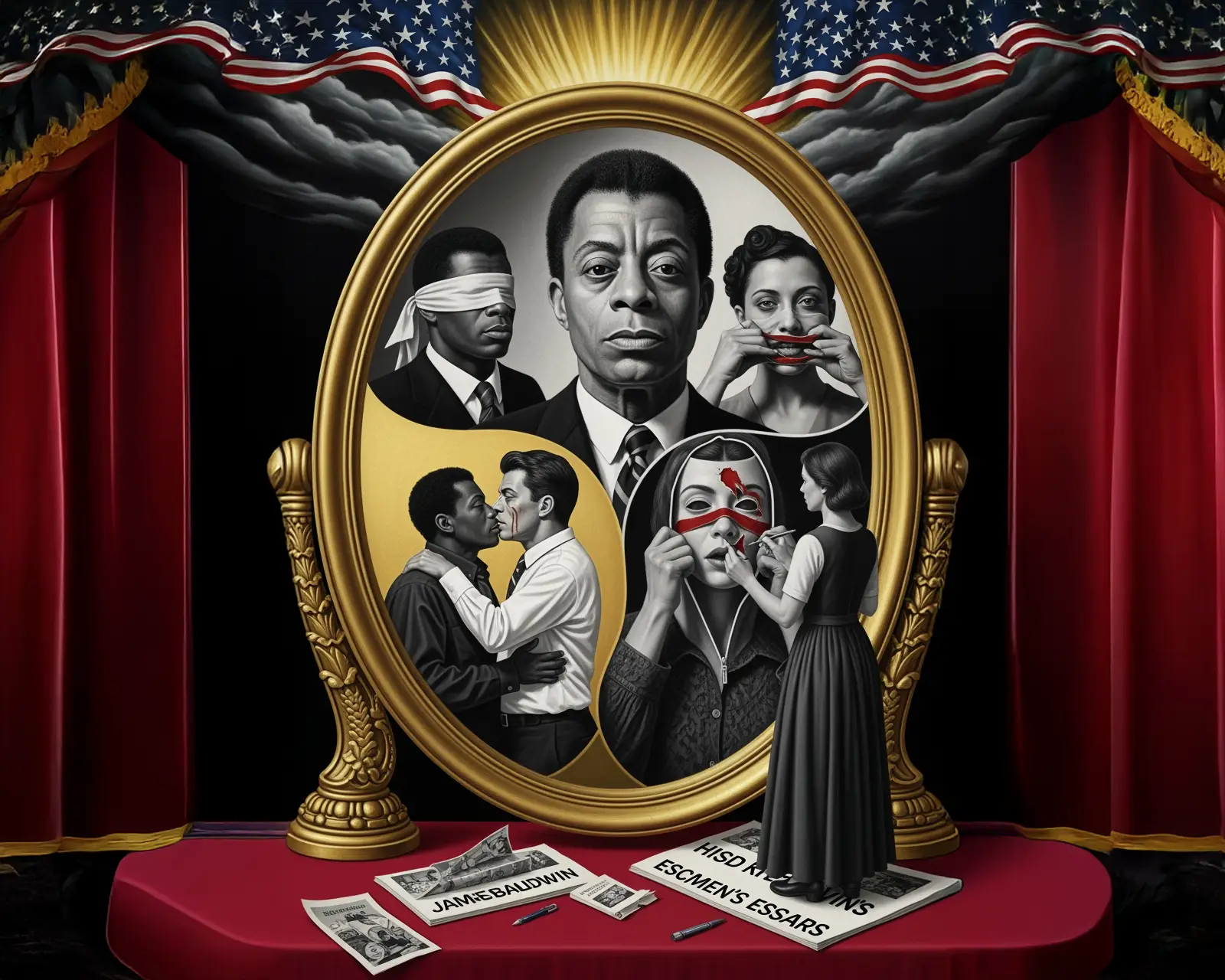
The Man in the Mirror
These four ideas are not merely opinions; they are surgical interventions into the American psyche. Baldwin’s diagnosis of “innocence” recasts racism as a collective cognitive disorder. His metaphor of a “lover’s quarrel” is a rhetorical intervention designed to force a reckoning with our shared, tangled destiny. His Socratic definition of “freedom” turns the quest for liberation inward, making it a terrifying personal responsibility. And his influence on feminism reveals an intellectual framework so powerful it can cross identitarian lines to empower other struggles.
Baldwin’s work serves as a “most disagreeable mirror,” as scholar Lawrie Balfour put it. It forces society to see the ugly truths it desperately tries to ignore. After seeing our collective reflection, the question changes. It isn’t what Baldwin can teach us. It’s about what we are truly prepared to face.




Leave a Reply