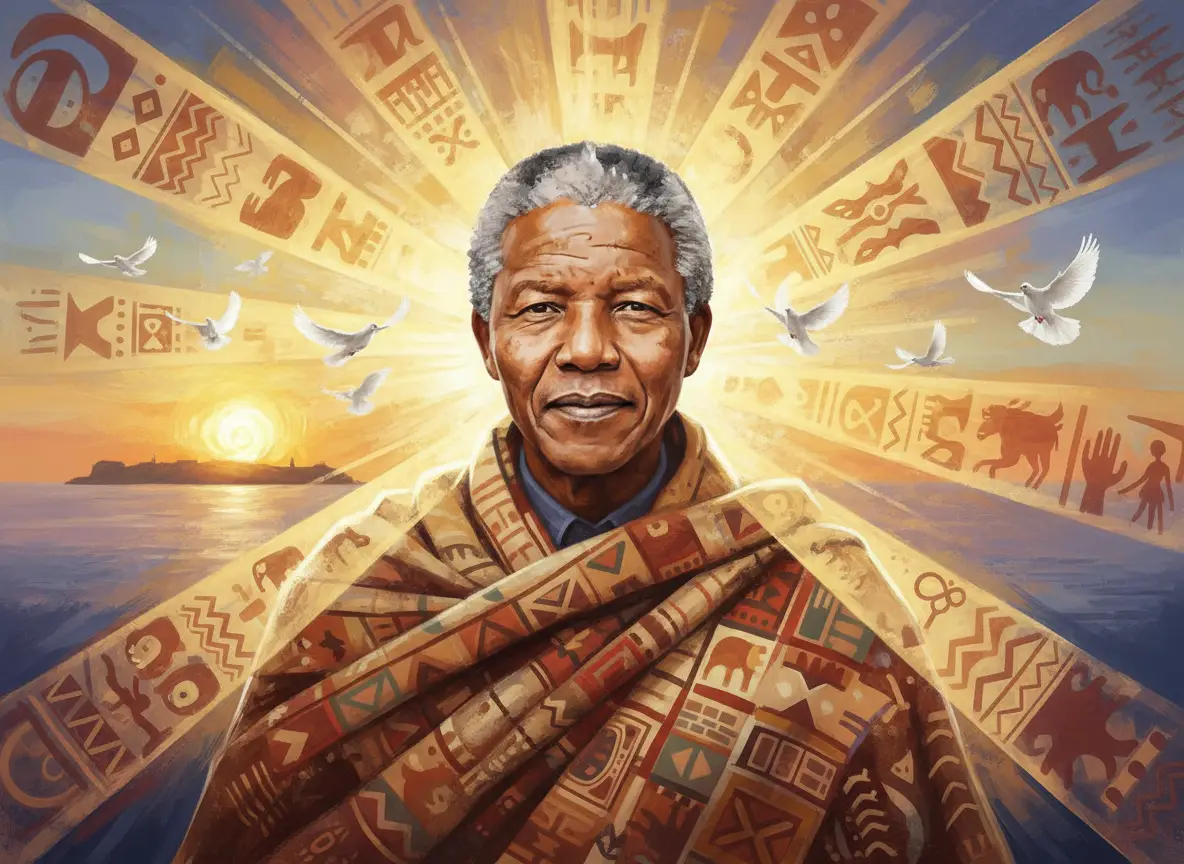
Essay on Nelson Mandela – his fight against apartheid, 27 years in prison, and his vision of reconciliation.
Nelson Mandela (July 18, 1918 – December 5, 2013) – The Path to Freedom and Reconciliation
Childhood
Nelson Rolihlahla Mandela was born in 1918 in the small village of Mvezo. He became one of the greatest symbols of human courage and resilience, embodying “Nelson Mandela – The Path to Freedom”. His life story reflects the history of South Africa. It also serves as a universal archetype of the struggle for dignity and justice. Mandela grew up amidst the traditions of the Xhosa people and the harsh reality of colonial oppression. From an early age, he learned the power of words, law, and resistance. This knowledge led him to become a lawyer. His office became a refuge for those seeking justice, forming part of Nelson Mandela’s path to freedom.
The ANC and the Fight Against Apartheid
Mandela’s journey into politics was not inevitable, but it was shaped by the injustices he observed daily. Joining the African National Congress (ANC), he quickly rose to prominence as one of its most influential leaders. At first, he believed in nonviolent resistance, inspired by Mahatma Gandhi‘s philosophy. Yet the brutality of apartheid—a system designed to strip the majority of their rights and humanity—forced him to reconsider. In 1961, he helped form Umkhonto we Sizwe, the armed wing of the ANC. This decision was controversial, yet it was a significant step in “Nelson Mandela – The Path to Freedom”. Mandela was not a detached dreamer. He was a man navigating the tension between principle and necessity. Through these experiences, he embarked on his long journey, which would eventually become the path to freedom for his nation.
27 Years of Imprisonment on Robben Island
The defining chapter of his life unfolded behind prison walls. Twenty-seven years on Robben Island became a symbol of endurance. Mandela did not emerge broken; instead, his imprisonment transformed him from activist to icon. In the harsh conditions of confinement, he cultivated patience and discipline. He developed the ability to lead even without direct contact with the outside world. His presence became larger than life, and his name a rallying cry for freedom across continents. These years were pivotal in Nelson Mandela’s journey on the path to freedom.
Presidency and the Nobel Peace Prize
When Mandela was released in 1990, the world held its breath. Would he seek revenge? Would decades of suffering harden him into bitterness? Instead, he chose reconciliation. His speeches were not filled with anger but with a vision of unity. In 1994, he became South Africa’s first black president, elected in the country’s first free elections. His government focused on dismantling the legacy of apartheid, fighting poverty, and building bridges between communities. The Nobel Peace Prize he received in 1993 was not just recognition of his struggle. It also acknowledged his ability to transform personal pain into a universal message of hope. Mandela’s presidency was a pivotal point. It solidified the freedom he tirelessly pursued and underscored “Nelson Mandela – The Path to Freedom”.
Mandela was not flawless. His political decisions were sometimes criticized, and his personal life was marked by complex relationships. Yet it is precisely this humanity that makes his story so powerful. A leader does not need perfection to become a symbol. It is enough to combine courage with vision. This combination offers people hope. Mandela embodied the paradox of strength and humility, showing that true leadership lies in the ability to forgive without forgetting.
Mandela as a Universal Symbol of Human Rights
Today, Mandela’s legacy transcends South Africa. He remains an inspiration for human rights movements worldwide. He serves as a reminder that freedom is not a gift but the result of persistent struggle. His life challenges us to ask: how much are we willing to sacrifice for justice? And how can reconciliation, rather than revenge, become the foundation of lasting peace? Nelson Mandela – The Path to Freedom demonstrates resilience and reconciliation.
A Legacy Beyond Africa’s Borders
Nelson Mandela’s story is more than history; it is a mirror held up to our own time. In a world still fractured by inequality and division, his example reminds us that courage and compassion can coexist. Reconciliation is not weakness but the highest form of strength. Nelson Mandela – The Path to Freedom was long and painful. Yet, he left behind a legacy that continues to illuminate the way ahead.




Leave a Reply