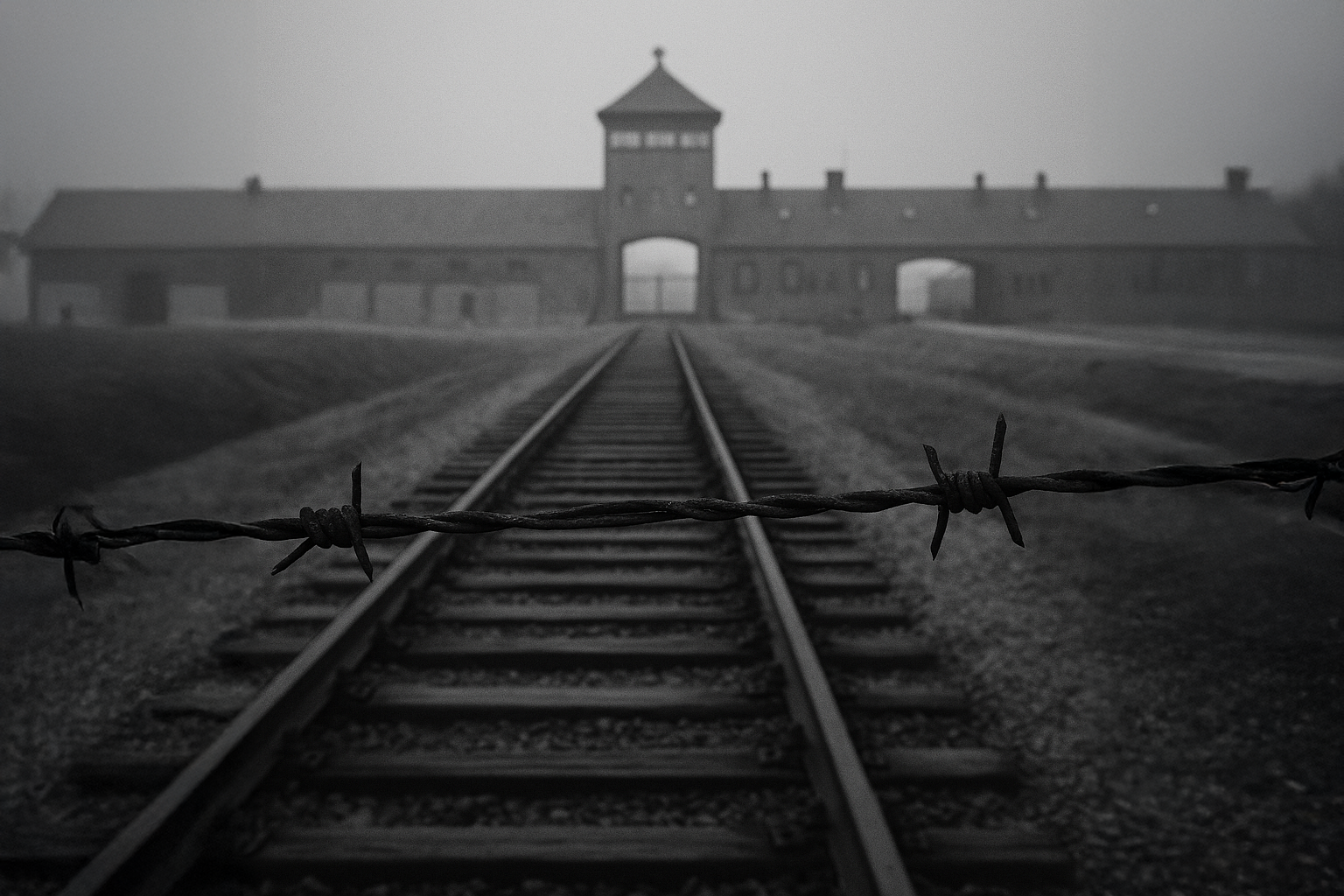
A powerful essay on Auschwitz as a system, on dehumanization, memory, and personal legacy. Why remembrance is essential in an age of rising hatred and division.
Silent Witness: Why Auschwitz Still Speaks and Why We Must Listen
Introduction: When Silence Is Not Emptiness but Warning
We live in an age where information travels faster than ever before. News, images, and stories reach us instantly, yet paradoxically, our collective memory grows weaker. Forgetting is no longer a passive fading of the past. It has become an active erosion. This erosion is accelerated by distraction, oversaturation, and the comforting illusion that history is safely behind us.
“Auschwitz” is a word that should never lose its weight. It is not merely a historical site or a museum. It is the most concrete evidence of how civilization, law, and morality can collapse. This happens when ideology, bureaucracy, and technology merge into a single destructive force.
For me, this topic is not abstract. My family was deported to Auschwitz. Some survived. Some did not. My mother was born shortly before the camp was liberated. She was a fragile spark of life in a place designed for death. Her birth is a reminder that even in the darkest corners of human history, life can insist on existing. But that insistence is not guaranteed. It must be protected.
Writing about Auschwitz is thus not only an act of remembrance. It is an act of responsibility — a refusal to allow silence to become complicity.
1. Auschwitz as a System: When Crime Becomes Structure
In popular imagination, Auschwitz is often reduced to a single gate, a single sign, a single image. But the reality was far more complex. Auschwitz was not one camp. It was a system — a network of more than forty camps functioning as a coordinated organism.
Auschwitz I – the administrative brain
This was the first camp, the headquarters. Here the SS developed and tested the earliest methods of killing. Here decisions were made that determined the fate of hundreds of thousands. It was the laboratory where ideology was transformed into procedure.
Auschwitz II – Birkenau – industrialized death
Birkenau was the epicenter of extermination. Gas chambers, crematoria, selection ramps — all designed for efficiency. Death was not chaotic here; it was organized, scheduled, optimized. It was a process.
Auschwitz III – Monowitz – when industry collaborates with totalitarianism
Monowitz was financed and built by IG Farben. Prisoners were forced into slave labor until they collapsed. Those who could no longer work were sent back to Birkenau to be killed. This partnership between industry and genocide reveals a chilling truth: evil is not only ideological. It can be economic, bureaucratic, and profit-driven.
Auschwitz was not an accident. It was a structure. A system engineered to destroy human beings with the same logic used to run factories.
2. “Canada”: The Paradox of Abundance in the Heart of Catastrophe
Among prisoners, the word “Canada” symbolized abundance. It referred to the warehouses where belongings stolen from deported people were sorted: suitcases, clothes, food, jewelry, children’s toys. For prisoners, it was the only place where one can find extra food or warm clothing.
But this abundance was an illusion — a shadow cast by tragedy.
Every suitcase was a story.
Toy was the echo of a silenced child.
Every coat was the last trace of a life violently interrupted.
The “Canada” warehouses were the center of one of the largest state-sponsored theft operations in history. Valuables were sent to the Reich Bank. Clothing was redistributed. Gold was melted down. The economy of the Third Reich fed on the possessions of the murdered.
“Canada” was not a place of wealth. It was a graveyard of memories.
3. The Human Body as Raw Material: Dehumanization at Its Peak
One of the most haunting exhibits in the Auschwitz-Birkenau State Museum is the two-ton pile of human hair. These were not symbolic artifacts. They were real hair, cut from real people after their deaths — often before their bodies were burned.
The hair was used as industrial material: stuffing for mattresses, textile blends, insulation.
For the Nazis, even the bodies of the dead were resources.
Forensic analysis has found traces of Zyklon B on the hair.
This is silent, irrefutable evidence of what happened in the gas chambers.
Dehumanization did not end with death.
It continued beyond it.
A person was reduced to material.
To product.
To object.
This is the final stage of genocide: the complete erasure of humanity.
4. Liberation: The End of the Camp, but Not the End of Suffering
On January 27, 1945, Soviet soldiers entered Auschwitz. What they found defied comprehension. Thousands of prisoners on the brink of death. Many weighed less than thirty kilograms, did not walk. Many not speak, did not believe they were truly free.
Eyewitness accounts describe a mixture of relief, shock, and overwhelming grief.
Liberation was not a moment of triumph.
It was a confrontation with the full scale of human cruelty.
For survivors, liberation was the beginning of a long journey — a journey of rebuilding bodies, identities, and lives. Trauma does not disappear when the gates open. It lingers, sometimes for decades, sometimes for generations.
My mother’s birth in Auschwitz is part of this story.
Her life began where others’ lives ended.
Her existence is a testament to survival — but also a reminder of the fragility of humanity.
5. Auschwitz as the Foundation of Modern Human Rights
After the war, the world had to ask itself: how can we prevent this from happening again?
The answers became the foundations of modern international law:
- crimes against humanity
- the Genocide Convention
- the Universal Declaration of Human Rights
These documents are not abstract ideals. They are legal responses to the horrors of Auschwitz. They are attempts to give language to the unspeakable and to create mechanisms that prevent its repetition.
The Auschwitz-Birkenau Museum follows a strict principle:
“Conserve, but do not repair.”
The goal is not to create a polished museum.
The goal is to preserve authenticity — to keep the site as a witness, not as a sanitized show.
Every brick, every fence, every ruin is evidence.
6. Why We Must Speak: Memory as an Act of Resistance
Today, hatred, polarization, and dehumanization are rising again.
This is why remembering Auschwitz is not only about the past.
It is about the current — and the future.
Forgetting is dangerous.
It opens the door to distortion.
And distortion opens the door to repetition.
I share my family’s story not to evoke pity, but because personal stories are the most resilient form of memory. They are bridges between generations. They are warnings written in human experience.
My mother was born in Auschwitz.
Her life is proof that even in a place built for death, life can emerge.
But this fragile light must be protected.
Memory is not passive.
It is an act of resistance.
A refusal to let silence erase truth.
Conclusion: Silent Witnesses That Must Not Be Drowned Out
Auschwitz is not only a relic of the past.
It is a question that confronts us today:
How do we protect humanity now?
Memory is a choice.
A commitment.
A responsibility.
When we speak about Auschwitz, we do not reopen wounds.
We protect the world from reopening them.
The silent witnesses of Auschwitz — the ruins, the objects, the stories — continue to speak.
Our task is simple, but essential:
To listen.
And to remember.
To resist forgetting.



Leave a Reply