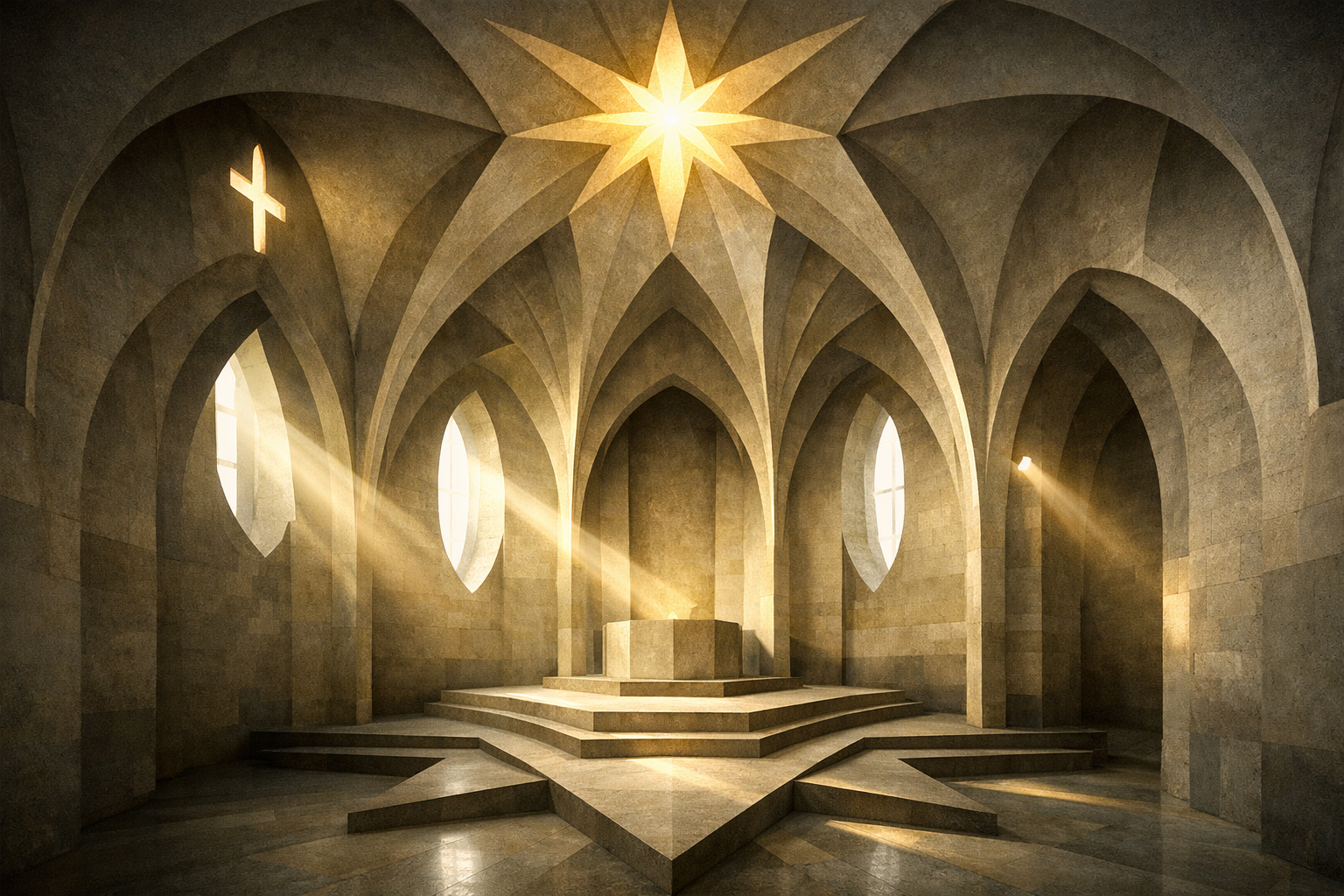
Discover the life, style, and masterpieces of Jan Blažej Santini‑Aichel, the visionary architect who fused Gothic structure with Baroque dynamism. Explore his symbolism, geometry, and iconic works such as the UNESCO‑listed Church of St. John of Nepomuk at Zelená Hora.
Jan Blažej Santini-Aichel: Life and Work of a Baroque Genius
Introduction
Jan Blažej Santini‑Aichel (1677–1723) stands as one of the most remarkable and enigmatic figures of early 18th‑century European architecture. His work, today synonymous with the so‑called Baroque Gothic, fundamentally transformed the face of the Czech landscape. It left a profound mark on the history of art. Santini’s buildings fascinate not only through their formal originality, but also through their deep symbolism, geometric precision, and spiritual dimension.
This report provides a comprehensive scholarly overview of Santini’s life, education, and sources of inspiration. It also covers his architectural style and key works. His significance within both Czech and European architectural contexts is also discussed. Special attention is devoted to his most famous buildings, particularly the Pilgrimage Church of St. John of Nepomuk at Zelená Hora, as well as issues of preservation, restoration, and the contemporary perception of his legacy.
Life and Biography of Jan Blažej Santini‑Aichel
Jan Blažej Santini‑Aichel was born on 3 February 1677 in Prague. He was born into the family of the Italian stonemason Santino Aichel. Santino Aichel was originally from the Ticino region of Switzerland. His mother was Czech, from Plzeň. Santini was baptised in St. Vitus Cathedral, which symbolically foreshadowed his lifelong connection with Gothic architecture and the cultural environment of Prague.
The Aichel family settled in Bohemia around 1650 and quickly established themselves among the leading builders and craftsmen. Jan Blažej was the eldest son. He was born with a physical disability. He was partially paralysed and unable. This prevented him from continuing in his father’s stonemasonry workshop. He still trained as a stonemason. His training was like his brother František’s. At the same time, he studied painting, probably under Kristián Schröder.
Santini’s life was marked not only by health difficulties but also by personal tragedies. His first wife was Veronika Alžběta, the daughter of his teacher Schröder. She bore him four children. Three of these children died in childhood. After her death, he married Antonia Ignatia Chřepická of Modliškovice, with whom he had two more children. Santini passed away on 7 December 1723 in Prague after a long illness. He was buried in the now‑defunct cemetery by the Church of St. John the Baptist in Obora.
Santini was an exceptional architect. He was also a man deeply interested in mathematics and geometry, as well as numerology and mysticism. His personal and professional life was closely connected with leading representatives of monastic orders. This connection enabled him to realize many significant buildings throughout Bohemia and Moravia.
Education and Formative Journeys: Italy, Rome, and European Inspirations
Santini’s education was extraordinarily broad for his time. He not only excelled in stonemasonry and painting but also mastered several languages (Czech, German, Italian, and probably Latin). He had a deep knowledge of architecture, mathematics, and geometry. After completing his apprenticeship, he embarked on the traditional Wanderjahre, a travelling period common in craft training. Between 1696 and 1699 he travelled through Austria and Italy, with Rome being the key destination.
In Rome, Santini encountered the works of Francesco Borromini. Borromini was one of the most radical architects of Roman Baroque. He also encountered Guarino Guarini, who was renowned for his complex geometric ground plans and dramatic spatial concepts. It was here that Santini adopted his father’s name “Santini” into his own. This was seen as a conscious alignment with the Italian tradition. It also embodied the Baroque style. Italian Baroque, especially the works of Borromini and Guarini, inspired him. This inspiration became one of the defining elements of his later architecture.
Santini’s formative experiences, though, were not limited to Italy. Jean Baptiste Mathey, a French architect, significantly influenced him. He attended Mathey’s Prague atelier. Santini partially inherited Mathey’s projects and clientele after Mathey’s death. This combination of Italian, French, and local influences formed the foundation of Santini’s unique style. It defied contemporary conventions. It also inspired later generations of architects.
Professional Career and Main Patrons
Santini began his independent architectural career around 1700. By then, he was already realising his first buildings and earning his own income. He was not a member of any builders’ guild, worked as a designer. He also supervised the execution of his buildings. His career was closely tied from the beginning to important ecclesiastical and aristocratic patrons.
His first key patron was Abbot Wolfgang II. Lochner of the Cistercian monastery in Zbraslav. Lochner entrusted him with the demanding task of designing a new convent. He was also tasked with designing a convent church on the site of destroyed Gothic structures. This commission opened the door to further important clients, especially among the Cistercians and Benedictines. Another significant patron was Abbot Jindřich Snopek of Sedlec near Kutná Hora. Jindřich Snopek commissioned him to restore the ancient Gothic convent church. He also tasked him with modifying it.
Santini gradually gained a reputation as an architect capable of combining historical continuity with modern Baroque expression. He worked for many influential figures. These included Abbot Václav Vejmluva of Žďár nad Sázavou. Another was Count František Ferdinand Kinský, who built the Karlova Koruna chateau. He also worked for other members of the Czech aristocracy. His clientele was exceptionally prestigious. This elite group enabled him to realise nearly one hundred sacred, residential, and economic buildings across Bohemia and Moravia.
Definition and Characteristics of Baroque Gothic
Baroque Gothic is a unique architectural style. It is sometimes also referred to as Gothicizing Baroque. This style emerged in the first third of the 18th century in the Czech lands. Its principal creator and most prominent representative was Jan Blažej Santini‑Aichel.
Baroque Gothic is not a mere eclectic combination of Gothic and Baroque elements. In Santini’s conception, Gothic principles, like rib vaulting, buttressing systems, and verticality, are not simply quoted. They are reinterpreted and transformed through the Baroque language. Gothic forms carry historical continuity and spiritual meaning. They are also embedded within dynamic, geometrically complex Baroque spatial compositions. The result is an architecture full of tension, movement, and mystical light.
Characteristic features of Baroque Gothic include:
- Dynamic fusion of Gothic and Baroque forms:
Gothic ribs undulate in Baroque rhythms. Pointed arches are set into curved walls. Star‑shaped or net vaults are constructed based on intricate geometric schemes. - Work with light:
Light is perceived as an active agent that shapes space and creates a spiritual atmosphere. - Symbolism and numerology:
Ground plans and proportions are based on carefully considered Christian symbolism and numerological systems (numbers 3, 5, 8, 12, etc.). - Geometric precision:
Buildings are often designed according to strict geometric rules, using circles, stars, triangles, and other shapes.
Baroque Gothic flourished in the Czech lands for several reasons. Monastic orders, including the Cistercians and Benedictines, sought to emphasise continuity with medieval tradition. They also aimed to show triumphant Baroque forms while promoting post-Reformation recatholicisation.

Architectural Principles: Geometry, Numerology, Symbolism
Santini’s architecture is renowned for its geometric sophistication, numerological references, and rich symbolism. These elements are not merely decorative; they form the fundamental compositional framework of his buildings.
Geometry
Santini was a master of geometry. His buildings often use circular, star‑shaped, triangular, or elliptical ground plans. For example, the Pilgrimage Church of St. John of Nepomuk at Zelená Hora is built on a five‑pointed star plan. This design is a unique solution in the European context. Geometry here is not arbitrary; it carries deep symbolic meaning.
Numerology
Numerological references are omnipresent in Santini’s work. Numbers such as:
- 3 — the Holy Trinity
- 5 — the Five Wounds of Christ, the five stars of St. John of Nepomuk
- 8 — resurrection
- 12 — the apostles
decide the basic structure and proportions of his buildings.
At Zelená Hora, the number five appears repeatedly. It is clear in the number of chapels, entrances, altars, and in the ground plan itself.
Symbolism
Santini’s buildings are filled with symbolism derived from Christian tradition, as well as cabalistic and mystical teachings. Ground plans, proportions, and architectural details are deliberately designed to express theological and spiritual meanings.
The star at Zelená Hora refers to the legend of the five stars. These stars appeared above the body of St. John of Nepomuk. It also relates to the Five Wounds of Christ.
Santini’s use of geometry and symbolism is sophisticated. His buildings can be understood as a “theological discourse in stone.” Architecture becomes not only a functional or aesthetic object but a medium of spiritual communication.
Influences: Francesco Borromini, Guarini, Mathey, and Others
Santini’s style was shaped by several key influences, which he synthesised in an original way.
Francesco Borromini
The most significant source of inspiration was Francesco Borromini, the Swiss‑Italian architect of the Roman Baroque, whose work was famous for:
- complex ground plans,
- dynamic spatial concepts,
- innovative use of light.
Santini’s knowledge of Borromini’s architecture was so profound that he is considered Borromini’s most important follower outside Italy. The influence is evident in Santini’s centralised plans, concave and convex curves, and dramatic spatial articulation.
Prostorová dynamika
Guarino Guarini
Another major influence was Guarino Guarini. He was an Italian architect and theorist. He was known for his complex geometric schemes and symbolic architectural concepts. Santini adopted Guarini’s fascination with mathematical constructions and symbolic ground plans.
Jean Baptiste Mathey
The French architect Jean Baptiste Mathey worked in Prague, and the young Santini attended his atelier. After Mathey’s death, Santini inherited some of his projects and clientele, which contributed to his rapid professional rise. Mathey’s influence is visible especially in Santini’s early works, where French elegance and a refined sense of proportion commonly occur.
Other influences
Santini was also influenced by the local Gothic tradition, particularly the work of Peter Parler, the builder of St. Vitus Cathedral in Prague. He had a deep knowledge of medieval architecture. This enabled him to reinterpret Gothic elements in a Baroque context. He did so in an entirely original way.
Analysis of Key Works
Pilgrimage Church of St. John of Nepomuk at Zelená Hora (Žďár nad Sázavou)

The Pilgrimage Church of St. John of Nepomuk at Zelená Hora is considered Santini’s masterpiece and the purest embodiment of Baroque Gothic. The construction of the building took place between 1719 and 1722. It was initiated by Abbot Václav Vejmluva. This happened shortly after the canonisation of St. John of Nepomuk.

The church is built on a five‑pointed star ground plan. This design refers to the legend of the five stars that appeared above the saint’s body. The entire composition is based on the symbolism of the number five. It features five entrances, five altar niches, five triangular chapels, and five oval chapels. The geometry of the building is extraordinarily sophisticated, with all proportions derived from circles and their multiples.
The architecture combines Gothic elements (pointed arches, rib vaults, buttressing systems) with Baroque dynamism and a dramatic treatment of light. Light plays a crucial role. The central space is illuminated indirectly. The side chapels are bathed in bright light. This creates a mystical atmosphere. Symbolism is omnipresent. For example, the main altar is placed within a tall arcade. Its apex reaches the gallery balustrade of the second floor. The saint is depicted standing on a globe adorned with five stars.
Around the church is a ring of ambits with five chapels and five gates. Their roofs originally culminated in five pylons. These pylons symbolise eternity. Jan Pavel Čechpauer executed the sculptural decoration. Ignác Rohrbach also contributed. Both were linked to the workshop of Matyáš Bernard Braun.
The church was inscribed on the UNESCO World Heritage List in 1994. It underwent extensive restoration between 2016 and 2024. These efforts restored its original appearance and returned its former splendour. Today, Zelená Hora is one of the most visited pilgrimage sites in the Czech Republic, attracting around 100,000 visitors annually.
Monastic Church of the Assumption of the Virgin Mary and St. John the Baptist in Sedlec near Kutná Hora

Another key work is the restoration of the monastic church in Sedlec near Kutná Hora. This work was carried out between 1703 and 1708. The original Gothic cathedral was left in ruins after the Hussite Wars. Santini showed exceptional sensitivity in working with the historic structure.

He preserved the five‑aisled layout and infused it with Baroque dynamism. The vaulting of the main nave is the most striking feature. Gothic ribs meet and interweave in smooth, flowing curves. These curves are reminiscent of organic forms. Baroque intervention is also obvious in the spiral staircases and the altar area. Santini “healed” and elevated the old Gothic structure, creating one of the most impressive spaces of Czech Baroque.
The church has been on the UNESCO World Heritage List since 1995. In 2026, it received the status of a national cultural monument. Its significance lies not only in its architectural value but also in its symbolic connection between medieval and Baroque traditions.
Other Significant Works
Karlova Koruna Chateau in Chlumec nad Cidlinou

Karlova Koruna Chateau (1721–1723) is one of the most important examples of Baroque secular architecture in the Czech lands. Built for Count František Ferdinand Kinský, it served as a representative residence and hunting lodge.

The chateau has a unique layout — a central two‑storey cylindrical core with three square wings attached to it. The interior is arranged into ten main rooms that interpenetrate symmetrically. The ground plan is based on a radial central scheme, a motif Santini often used in his sacred buildings. The architecture demonstrates Santini’s mastery of Baroque design principles and his ability to apply centralised composition to a secular structure.
Monastic Church in Kladruby

The reconstruction of the Monastic Church of the Assumption of the Virgin Mary in Kladruby (1711–1721) was a significant achievement. It signifies another peak of Santini’s work. He dramatically utilised a large front window, in front of which he inserted a delicate entrance structure complemented by sculptures. The interior is marked by rhythmic articulation of walls and vaults. Baroque intervention is clear in the spiral staircases. It is also clear in the altar area.

Church of the Name of the Virgin Mary in Křtiny

The pilgrimage church in Křtiny (1718–1750) is one of the largest pilgrimage chapels in Moravia. Its elliptical ground plan and central space radiate tranquillity and invite contemplation. The dome offers excellent acoustics, and the building, set in a wooded landscape, appears like a luminous pearl.

Plasy Monastery

Plasy Monastery is an example of Santini’s technical ingenuity. Santini designed a unique foundation system for the marshy ground. This system used oak piles and a wooden grid. It ensured the stability of the structure even under challenging conditions.

Tabulka nejvýznamnějších staveb Jana Blažeje Santiniho-Aichela
The following table summarises Santini’s most important buildings, which are considered unquestionably his own work and represent the peak of his architectural mastery:
| Building Name | Location | Years of Construction | Style |
|---|---|---|---|
| Pilgrimage Church of St. John of Nepomuk at Zelená Hora | Žďár nad Sázavou | 1719–1722 | Baroque Gothic |
| Church of the Assumption of the Virgin Mary and St. John the Baptist | Sedlec near Kutná Hora | 1703–1708 | Baroque Gothic |
| Karlova Koruna Chateau | Chlumec nad Cidlinou | 1721–1723 | Baroque |
| Monastic Church of the Assumption of the Virgin Mary | Kladruby | 1711–1721 | Baroque Gothic |
| Church of the Name of the Virgin Mary | Křtiny | 1718–1750 | Baroque Gothic |
| Plasy Monastery (convent, prelature, economic courtyards) | Plasy | 1710–1740 | Baroque |
| Chapel of St. Anne | Panenské Břežany | 1705–1707 | Baroque Gothic |
| Church of Saints Peter and Paul | Rajhrad | 1722–1730 | Baroque Gothic |
| Pilgrimage Complex of Mariánská Týnice | Mariánská Týnice | 1711–1720 | Baroque Gothic |
| Church of St. Wenceslas | Zvole | 1713–1717 | Baroque Gothic |
Technical Solutions and Structural Innovations
Santini was not only an artistic genius but also a technical innovator. His buildings are renowned for bold structural solutions that often anticipated later engineering developments.
Foundations on Unstable Ground
The Plasy Monastery is a prime example of his technical ingenuity. At this site, Santini designed the foundation on oak piles and a wooden grid. This design allowed construction on marshy soil with a high groundwater level. The setup is so sophisticated that the monastery will stand only as long as the water level does not fall below a certain point — expressed in the Latin inscription inside the monastery:
“Without water, this building will collapse.”
Acoustics and Work with Sound
Santini paid extraordinary attention to acoustics. He designed churches and monasteries so that music and chant would resonate with optimal clarity and richness. The placement of organ lofts was carefully considered. The shaping of vaults was planned meticulously. The arrangement of chapels was also evaluated with respect to sound propagation.
In some buildings — like Želiv or Zelená Hora — the galleries and walkways were designed to accommodate musical ensembles. They were also designed to create unique acoustic effects.
Work with Light
Santini was a master of light. He often placed windows at unexpected angles. Sometimes, he concealed them. This way, light would enter the space indirectly. This method created a mystical atmosphere. Light is not merely a means of illumination. It becomes a symbol of divine presence. It also acts as an active agent shaping the space.
Aesthetics and Work with Light and Space
The aesthetics of Santini’s buildings are based on the harmony of geometry, light, and space. His structures are not static objects but are as living organisms in which light flows like breath.
Light as Symbol
Santini perceived light as a symbol of God’s presence. Sunlight in his churches is not merely brightness. It becomes an active element that changes the atmosphere. This change depends on the time of day and season. Windows are often hidden or placed at unusual angles, enabling dramatic light effects.
Spatial Dynamics
Space in Santini’s buildings is conceived as fluid and constantly changing. Centralised layouts form the foundation. Elliptical and star-shaped ground plans add complexity. Dynamic curves of walls and vaults create a sense of movement and tension. The visitor moves upward. This movement leads them toward the heavens. This aligns with the Baroque concept of architecture as a path to transcendence.
Play of Light and Shadow
Santini transformed light into an integral part of his architecture. The interplay of light and shadow creates a unique atmosphere that encourages meditation and spiritual experience. Light becomes a medium of theological expression.
Religious Symbolism and Mysticism: Kabbalistic and Christian Influences
Santini’s architecture is deeply symbolic and permeated with mysticism. Alongside Christian symbolism (cross, star, sacred numbers), his work also contains references to kabbalistic and hermetic traditions.
Christian Symbolism
Christian symbolism is omnipresent in Santini’s buildings. Numbers like:
- 3 — the Holy Trinity
- 5 — the Five Wounds of Christ, the five stars of St. John of Nepomuk
- 8 — resurrection
- 12 — the apostles
form the basic compositional schemes. Ground plans in the shape of stars, circles, or triangles refer to theological concepts and biblical narratives.
Kabbalistic and Hermetic Influences
Santini was known for his interest in Christian Kabbalah, a syncretic early‑modern tradition combining Jewish mysticism with Christian theology. Kabbalistic principles can be seen in his use of:
- symbolic numbers,
- geometric constructions,
- sacred proportions.
For example, the pentagram (five‑pointed star) at Zelená Hora carries both Christian and kabbalistic meaning.
Mysticism and Spirituality
Santini’s buildings are often described as “stone prayers.”
Architecture here is not merely functional or aesthetic — it becomes a medium for spiritual experience. Space, light, geometry, and symbolism are interconnected to guide the visitor toward meditation and contemplation.
Santini in the Context of Czech and European Baroque
Santini’s work is unique not only in the Czech context but also within European Baroque architecture. During a time when classicism and monumental Baroque dominated Europe, Santini created an original synthesis. This synthesis of Gothic and Baroque has no parallel.
Czech Baroque
Czech Baroque is characterised by:
- exceptional quality and dynamism,
- strong integration of architecture into the landscape,
- complex, often centralised ground plans.
This environment allowed Santini to fully develop his talent for geometric speculation and symbolic expression.
European Context
In the European context, Santini is considered one of the most significant representatives of Borrominism. This movement was inspired by Francesco Borromini. It developed anti‑classical, experimental, and mystical tendencies within Baroque architecture.
Santini’s style was so distinctive and intellectually demanding that he had no direct successors. After his early death, Baroque Gothic disappeared from Czech architecture and was not fully appreciated until the 20th century.
Reception and Historiography: Modern Research and Monographs
Santini’s work was long overlooked, and many of his buildings were attributed to other architects. Only in the 20th century did interest in his work revive, thanks to art historians such as:
- Mojmír Horyna,
- Viktor Kotrba,
- Ladislav Moučka,
- and others.
Mojmír Horyna’s 1998 monograph signifies the fundamental critical catalogue of Santini’s buildings and a detailed analysis of his style. Horyna classifies Santini as a follower of Borromini. He also emphasizes Santini’s originality. Moreover, he highlights his ability to penetrate the essence of Baroque architectural language.
In 2023, an international conference in Rome was held on the 300th anniversary of Santini’s death. It highlighted his importance in the European context. The event brought new perspectives on his work.
Preservation, Restoration, and the Current State of Santini’s Monuments
Santini’s buildings are today the topic of intensive heritage care and public interest. Many were damaged in the past by:
- fires,
- insensitive alterations,
- or neglected maintenance.
In recent decades, extensive restoration projects have been initiated. These efforts aim to restore the original appearance of these unique monuments. They also work to preserve them for future generations.
Example: Restoration of Zelená Hora (2016–2024)
The general restoration of the Pilgrimage Church of St. John of Nepomuk at Zelená Hora:
- cost approximately 240 million CZK,
- restored façades, stucco decoration, floors, furnishings, and sculptural elements,
- returned the church to its original early‑18th‑century form,
- re‑established it as a major landmark in the landscape.
Similar restoration efforts are underway at Kladruby, Křtiny, Plasy, and Sedlec. Preservation is supported not only by state institutions but also by UNESCO listing and European funding.
Touristic and Cultural Significance Today (UNESCO, Visitor Numbers)
Santini’s buildings rank among the most visited monuments in the Czech Republic.
- The Pilgrimage Church at Zelená Hora attracts around 100,000 visitors annually.
- The 1994 UNESCO inscription significantly increased the prestige of Žďár nad Sázavou and supported tourism and restoration efforts.
Today, Santini’s buildings are perceived not only as architectural masterpieces but also as places of:
- spiritual reflection,
- cultural events,
- concerts,
- exhibitions,
- and educational programmes.
They attract visitors from all over the world.
Iconography and Sculptural Collaboration (Braun, Rohrbach)
Santini often collaborated with leading sculptors of his time, especially:
- Matyáš Bernard Braun and his workshop,
- Jan Pavel Čechpauer,
- Ignác Rohrbach.
The sculptural decoration of his buildings is an integral part of the architectural concept. It contributes significantly to the overall symbolism. It also enhances the spiritual expression of the space.
At Zelená Hora, Čechpauer and Rohrbach executed the sculptural decoration of the main altar and the ambits. They are both linked to Braun’s school. The statues of angels, evangelists, and allegorical virtues are examples of high Baroque sculpture and perfectly complement Santini’s architecture.
Catalogue of Works and Disputed Attributions
According to Mojmír Horyna’s monograph, Santini’s authorship is unquestionable for approximately 80 buildings. These buildings are either documented in archives or widely accepted as his work. For another 116 buildings, authorship is disputed or rejected.
The most significant undisputed works include:
- Pilgrimage Church of St. John of Nepomuk at Zelená Hora
- Church of the Assumption of the Virgin Mary and St. John the Baptist in Sedlec
- Karlova Koruna Chateau
- Monastic Church in Kladruby
- Church of the Name of the Virgin Mary in Křtiny
- Plasy Monastery
- Chapel of St. Anne in Panenské Břežany
- Church of Saints Peter and Paul in Rajhrad
- Pilgrimage Complex of Mariánská Týnice
- Church of St. Wenceslas in Zvole
Disputed attributions concern buildings that show Santini‑like features but lack archival documentation or were executed by his students and followers.
Závěr: Význam Santiniho díla v české a evropské architektuře
Jan Blažej Santini‑Aichel represents a phenomenon unparalleled in European architecture. His work is a synthesis of:
- Gothic structural logic,
- Baroque dynamism,
- geometric precision,
- and profound spiritual symbolism.
Santini succeeded in uniting seemingly incompatible worlds. He merged medieval mysticism with Baroque triumphalism. This created architecture that is timeless, original, and deeply human.
His buildings are not only technically and aesthetically accomplished but also spiritually inspiring. Mastery of geometry, light, and space is remarkable. His use of symbolism turns them into “stone prayers”. These continue to speak to visitors even after three centuries.
In both Czech and European contexts, Santini is regarded as one of the most original creators of Baroque architecture. His legacy remains vibrant and influential. Today, his work is protected as part of the world’s cultural heritage. It forms a key element of Czech national identity. His buildings are not merely monuments. They are living organisms that connect past and present. They open a path toward the spiritual dimension of architecture.
Santini’s Zelená Hora is a poem… While twentieth-century buildings are just slogans..
— Mojmír Horyna
Reference
In opere gotico unicus: The Hybrid Architecture of Jan Blazej Santini-Aichel and Patterns of Memory in Post-Reformation Bohemia (Article PDF Available on ResearchGate)
Cathedral of the Assumption of Our Lady and St John the Baptist in Sedlec – Destinace, Kutná Hora
Castles, chateaux and monuments – Resort Český les
Cathedral – sedlec.info
Jan Blazej Santini-Aichel – Santini v srdci Evropy – santini.cz
Cathedral of the Assumption of Our Lady, Sedlec — The Prague Vitruvius
Chapel Na Zderaze, former monastery and Jan Blažej Santini-Aichel – FEL ČVUT
Cathedral of the Assumption of the Virgin Mary and St. John the Baptist in Kutná Hora
Jan Blažej Santini architecture self-guided discovery tour in Prague and beyond
Czech Republic UNESCO Sites: Complete Guide to All 17 Heritage Properties
Jan Blažej Santini, Italian blood of a Prague architect – Café Boheme
Johann Blasius Santini-Aichel: a Gothic-Baroque Architect in Bohemia 1677-1723
Jan Blažej Santini-Aichel – Tracy’s Travels
Kladruby Monastery: A jewel of west Bohemia – Prague Blog
Life and work – Santini v srdci Evropy
Kladruby Monastery – Santini’s Monastery Church
Monastery of Kladruby – World Monuments Fund
On the margin of the early work of Jan Blažej Santini – ResearchGate
Original Works Illustrating Period Practice in the Exhibition “Santini and the World of His Architecture” – National Technical Museum
Pilgrimage Church of Saint John of Nepomuk (UNESCO site) – Mapy.com
Protected heritage areas – Národní památkový ústav
Pilgrimage Church of Saint John of Nepomuk – Wikipedia
Sacred Geometry in Math and Architecture That Still Inspires Young Minds
THE GEOMETRY OF THE FLOWER OF LIFE AND ITS APPLICATION IN ARCHITECTURE
The Architecture of Transcendence: A Comprehensive Analysis of the Baroque Gothic Synthesis in the Works of Jan Blažej Santini-Aichel
Wandering in search of Santini – VisitCzechia
Zelená hora near Žďár nad Sázavou – VisitCzechia


Leave a Reply