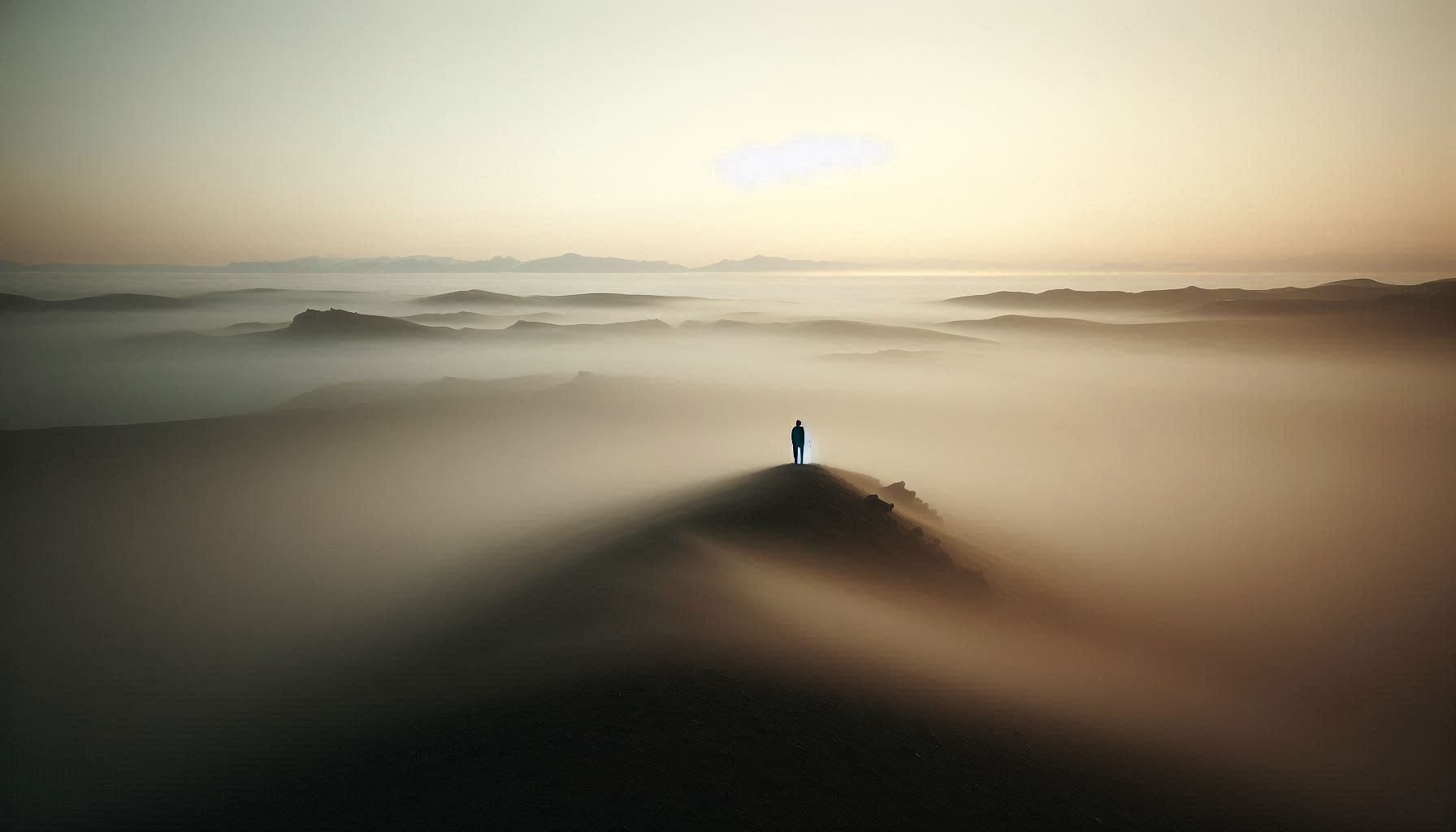
A contemplative essay exploring hope as a quiet form of resistance in a world shaped by crisis, exhaustion, and uncertainty. A slow, atmospheric reflection on rituals, memory, place, and the fragile thread that keeps us human at the edge of the abyss.
Hope at the Edge of the Abyss: The Anatomy of a Quiet Defiance
Hope is one of the oldest voices inside the human body. It does not shout. It does not demand attention, not break through the noise of the world with grand gestures or triumphant declarations. Instead, hope arrives as a whisper. Even in our darkest moments, there can be hope at the edge of the abyss. It is a subtle vibration beneath the ribs. A faint warmth that lingers even when everything else has grown cold. It is the quietest form of resistance, and the most enduring.
In a world that seems increasingly defined by crisis, exhaustion, and uncertainty, hope has become more than a feeling. It has become a practice. A discipline. A way of staying human when the world pushes us toward numbness or despair. And for many of us, hope is not a bright, blazing force. Instead, it is a fragile thread. We hold this thread with both hands as we navigate the narrow ledge between collapse and continuation.
This essay is an exploration of that thread. The rituals sustain it. The memories feed it. The places shelter it. It also symbolizes quiet defiance. Because hope, especially today, is not naïve. It is radical.

Hope as a Stance, Not an Emotion
We often confuse hope with optimism, but the two not be more different. Optimism is the belief that things will get better. Hope is the decision to continue even when we have no guarantee of improvement. Optimism is a prediction; hope is a posture.
Hope says:
“Even if the world does not change, I will not abandon myself.”
“Or if the path is unclear, I will take one more step.”
“Even if I am standing at the edge of the abyss, I will not let go of the thread.”
This is why hope is not a mood but a stance — a way of orienting oneself toward life. It is the quiet agreement we make with ourselves in the moments when no one is watching. A promise whispered in the dark: not yet, not now, not like this.
The Rituals That Sustain Hope
Hope does not survive on its own. It requires tending, like a small flame in a drafty room. And the tending happens through rituals — the small, repeated gestures that reconnect us to ourselves and to the world.
A cup of tea held between tired hands.
A window opened to let in the morning air.
A notebook waiting on a table.
A familiar street walked at dusk.
A song that returns us to a forgotten part of ourselves.
A place — a house, a room, a corner — where the air feels aligned with our inner rhythm.
These rituals are not trivial. They are the architecture of endurance. They remind us that life consists not only of crises and headlines. It is also made of textures, breaths, and moments of stillness. They anchor us when the world feels unmoored.
For some, hope is found in movement — walking, running, pacing, dancing. And others, found it in stillness — sitting in silence, listening to one’s own breath. For many, hope is found in returning to a place that holds memory. It is a place where the body remembers how to soften.
Hope is not abstract. It is embodied.
The Body Remembers Hope
We often speak of hope as something that happens in the mind, but the body is its true archive. The body remembers every time we stood up after falling. It remembers every instance we survived what we thought would break us. It recalls every time we found a way through the dark.
This is why hope can return suddenly — with a breath, a gesture, a familiar scent. The body recognizes the possibility of continuation even when the mind doubts it.
Hope is stored in the shoulders that have carried too much but still rise.
In the hands that tremble but do not let go.
In the spine that straightens even after nights of collapse.
In the lungs that keep expanding, again and again.
The body is the first witness of our resilience. And hope is the echo of that witness.
The Abyss and the Human Condition
Every human life holds an abyss. It is a moment when the ground seems to disappear beneath our feet. Be many moments like this. Loss, illness, betrayal, exhaustion, loneliness, the collapse of meaning. These experiences carve deep spaces inside us, spaces that feel bottomless.
Standing at the edge of the abyss is not a metaphor. It is a physical sensation. Your chest tightens, knees tremble. You feel that one more blow will be too much.
And yet, it is often at this edge that hope becomes most visible. Not as a bright light, but as a faint outline. A thin horizon. A breath that says: stay.
Hope does not deny the abyss. It acknowledges it fully — its depth, its danger, its pull. But it also insists that the abyss is not the whole story.
Hope is the narrow ledge on which we stand.
The fragile ground that holds us.
The possibility that the next step will not be a fall, but a return.
Memory as the Root of Hope
Hope is oriented toward the future, but it grows from the soil of the past. Our memories — especially the ones shaped by resilience, connection, and renewal — become the foundation on which hope stands.
We remember the times we thought we would not survive, but did.
We remember the people who held us when we not hold ourselves.
We remember the places that restored us. We recall the rituals that steadied us. We also hold dear the words that reached us at the right moment.
Memory is not a static archive. It is a living organism, constantly reshaping itself as we grow. Hope feeds on this living memory. It relies on the knowledge that we have been here before in different forms. Somehow, we found a way through.
Hope is not the denial of suffering. It is the recognition that suffering has not erased us.
The Places That Hold Hope
Some places carry a quiet power — a resonance that aligns with our inner landscape. These places become sanctuaries, not because they are perfect, but because they hold our stories.
A staircase worn by years of footsteps.
A courtyard where the air feels familiar.
A room where the light falls just right.
A house that breathes with the memory of those who passed through it.
These places do not save us, but they steady us. They remind us of who we were, who we are, and who we still become. They are the physical anchors of hope — the geography of our inner resilience.
Hope is not only emotional; it is spatial. It lives in the places where we have been capable of breathe.
Hope as a Form of Resistance
In a world that often rewards cynicism, hope is a radical act. Cynicism protects us from disappointment, but it also isolates us from possibility. It hardens the heart. It narrows the horizon.
Hope, on the other hand, requires vulnerability. It requires the willingness to be open, to care, to risk being hurt. This is why hope is not passive. It is a form of resistance — a refusal to let the world strip us of our humanity.
To hope is to insist that tenderness still matters.
That connection still matters.
That meaning can still be made.
That life, even in its brokenness, is worth returning to.
Hope is not loud, but it is powerful. It is the quiet rebellion of those who refuse to give up on themselves or on the world.
Hope as a Shared Space
Although hope is born inside the individual, it is sustained between people. It moves through gestures, words, presences. It grows in the spaces where we allow ourselves to be seen and where we witness others in their vulnerability.
A stranger’s smile.
A friend’s steady voice.
A hand placed gently on a shoulder.
A message sent at the right moment.
A silence shared without fear.
Hope is relational. It is a thread woven between lives. And when one person’s hope falters, another’s can hold the thread for a while.
This is why communities — even small, fragile ones — are essential. Hope is not a solitary flame. It is a constellation.
Living at the Edge
To live today is to live at the edge — of climate, of politics, of meaning, of personal endurance. The abyss feels closer than ever. And yet, this proximity makes hope even more vital.
Hope is not the belief that the abyss will disappear.
Hope is the belief that we can stand at its edge without losing ourselves.
It is the breath that steadies us.
The ritual that grounds us.
The memory that strengthens us.
The place that shelters us.
The connection that restores us.
Hope is the architecture of survival.
Conclusion: Hope as a Return
Hope is not a destination. It is a return — to ourselves, to our breath, to the places and rituals that hold us. It is the quiet decision to continue shaping meaning even when the world feels unmade.
Hope is fragile, but it is also persistent.
It bends, but it does not vanish.
It flickers, but it does not go out.
And its greatest power lies in this:
that even at the edge of the abyss, hope whispers the same simple invitation:
Come back, not yet, stay.




Leave a Reply