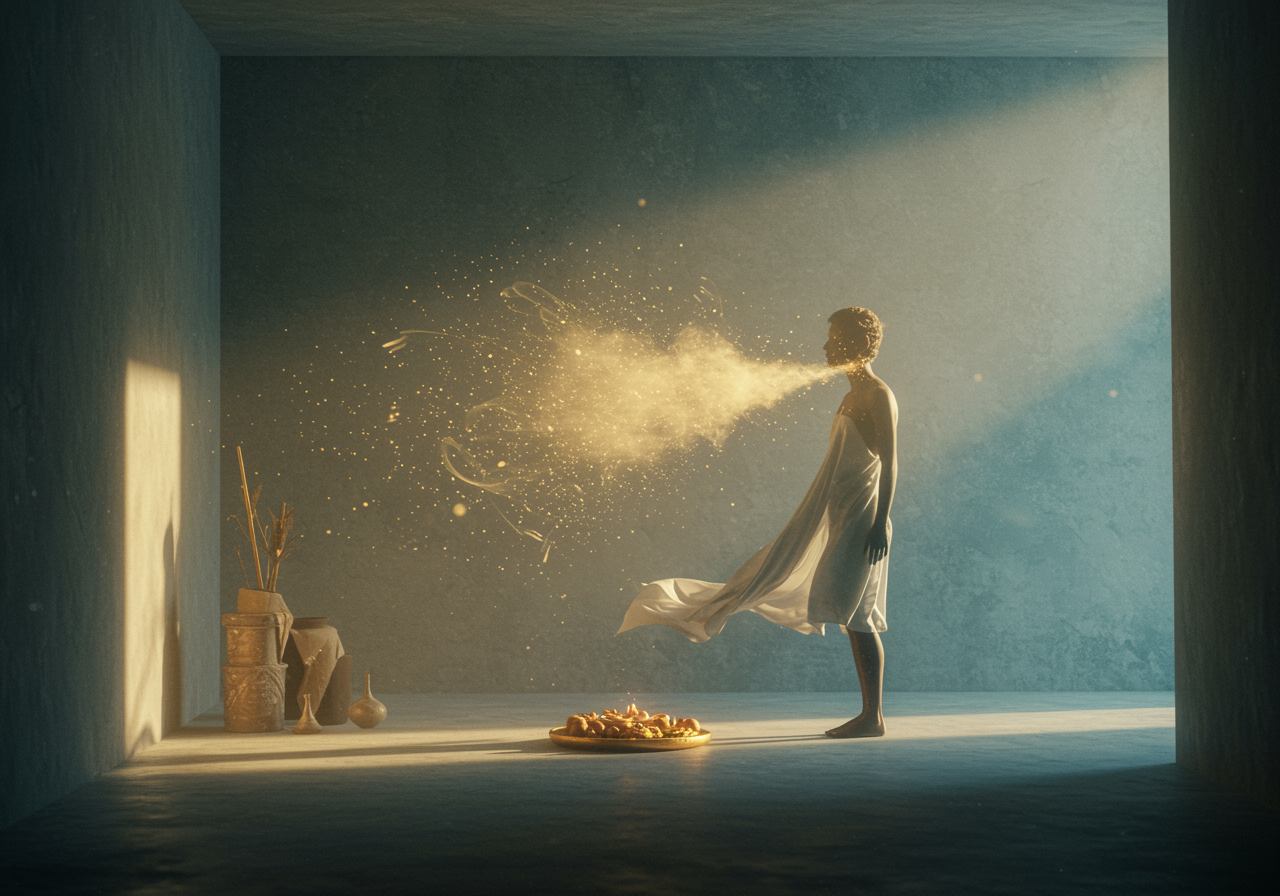
An essay exploring creativity as a way of breathing — a psychological, philosophical, and poetic reflection on the inner rhythm that shapes human experience. It examines why suppressing creative impulse leads to stagnation and how returning to one’s own creative flow becomes an act of renewal and self‑restoration.
Creativity as a Way of Breathing: On the Rhythm That Shapes Us
Some sentences do not merely pass through the mind. Instead, they settle into the body as if they were part of its hidden physiology. They return in moments of stillness, come back in the quiet just before dawn. They reappear in the fragile pause between one heartbeat and the next. One such sentence is this: “Creativity is not a talent but a way of breathing. Whoever holds it in, suffocates.”
It sounds like a metaphor, but it is closer to a psychological truth. Creativity is not a luxury, nor a privilege, nor a decorative addition to life. It is a rhythm. This rhythm is subtle, persistent, and necessary. It keeps the inner world from collapsing under its own weight. To suppress it is not to become disciplined. It is to become breathless.
Creativity as the Physiology of the Soul
When people speak of creativity, they often imagine artists: painters, writers, musicians, architects. But creativity predates art. It is older than culture, older than language, older than the first carved symbol on stone. It is the mechanism by which the human mind negotiates chaos.
A child invents stories to understand the world. An adult rearranges their life after loss. An elder shapes memories into a narrative to make sense of time.
These are not artistic gestures. They are survival strategies.
Creativity is the soul’s way of regulating pressure. It is the inner equivalent of breath: Inhale — experience. Exhale — meaning.
When this rhythm is interrupted, the psyche begins to tighten. What is unexpressed becomes heavy. What is heavy becomes stagnant. And what is stagnant becomes suffocating.
The Held Breath: On Self‑Censorship and Slow Collapse
Everyone has held their breath at some point — out of fear, tension, or the desire to stay unseen. Suppressing creativity works the same way.
Self‑censorship is not only the fear of criticism. It is the fear of one’s own voice. A suspicion that if we inhale too deeply, the exhale will reveal something irreversible. Something that can’t be taken back. Something that will change us.
But creativity held underwater does not dissolve. It thickens, it presses against the ribs. It becomes a silent weight that distorts the shape of one’s life.
A person who stops creating does not become neutral. They become an echo chamber for other people’s expectations. And that is a quiet form of suffocation.
The Rhythm That Shapes Us
Every person has a unique creative rhythm. Some create quickly, others slowly. Need noise, others silence. Some awaken at night, others at dawn.
But all creativity shares one structure: it is cyclical. Like breath.
Inhale: the world enters. Exhale: the world is transformed.
Inhale: chaos. Exhale: form.
Inhale: pain. Exhale: meaning.
We become ourselves not through stability but through rhythm. Not through permanence but through movement.
Creativity is not about producing masterpieces. It is about not becoming static.
The Psychology of Making: Why We Must Exhale
Psychology often describes creativity as the ability to connect distant ideas, break patterns, or generate novelty. But these are surface descriptions.
At its core, creativity is a method of emotional regulation. It is the act of giving shape to what would otherwise stay shapeless — and the shapeless is always dangerous.
Shapeless fear, shapeless grief, shapeless longing. Shapeless memory.
Creation gives these forces boundaries. It turns fog into contour. Chaos into structure. Pressure into movement.
This is why creativity is so closely tied to mental well‑being. Not because it is therapy, but because it is a natural mechanism of psychic ventilation.
The Philosophy of Breath: On Being That Creates Itself
Philosophers have long described being not as a state but as a process — something that unfolds, becomes, transforms. Creativity is one of the purest expressions of this becoming.
When a person creates, they do not merely produce something. They occur. They become a passage between the world and its interpretation. Between silence and language. Between raw experience and its symbolic form.
Creativity is not something we own. It is something that moves through us.
To block that movement is to interrupt the process of becoming.
Why We Fear Creating
The fear of creating has many faces, of not being good enough, of being misunderstood, of exposure. Fear of failure. Fear of success.
But beneath these fears lies a single truth: To create is to become visible.
And visibility is vulnerability. Yet invisibility is a slow death.
A person who fears creating often fears living. Because creation is life in motion.
How to Breathe Again
To return to creativity, one does not need grand gestures. A small movement is enough.
One breath. One sentence. One image. One thought allowed to surface. One moment of permission.
Creativity does not demand perfection. It does not require ideal conditions, not wait for approval.
It needs only space. And that space begins within.
Creativity as a Daily Ritual
Creativity is not a single act. It is a ritual — not religious, but existential. A ritual of returning to oneself.
A ritual of breath, of transformation a ritual that keeps the inner world alive.
Writing, designing, photographing, thinking, observing — these are all forms of breathing. Small, daily gestures that prevent the psyche from hardening.
Movement is life. And creativity is movement made visible.
Conclusion: On the Courage to Exhale
Creativity is not a talent. Not a luxury. Not a reward.
It is a way of breathing.
And whoever holds it in, suffocates — slowly, quietly, inevitably. A life that is not shaped from within collapses under the weight of external demands.
The greatest courage is not to create something monumental. The greatest courage is simply to exhale. To allow oneself to breathe in one’s own rhythm again.



Leave a Reply