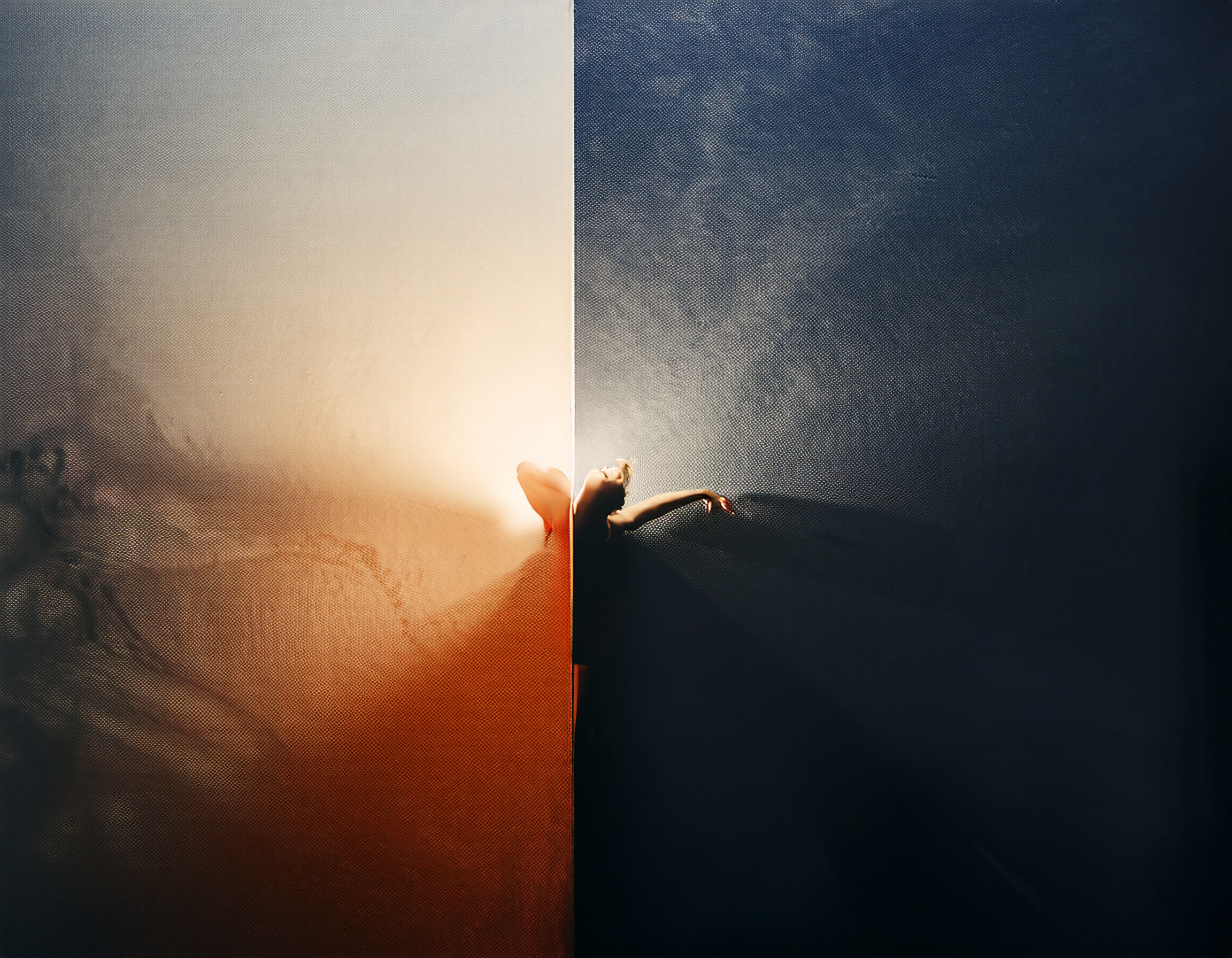
A reflective essay on how easily we disappear when we blend into the expectations of the world. A philosophical and psychological exploration of identity, visibility, roots, threshold existence, and the quiet creative resistance that keeps us present in our own lives.
Table of contents:
When You Blend In, You Disappear
Some sentences arrive uninvited, like a shadow sliding across the floor. They don’t ask for permission; they simply, as if whispered from a place just behind your shoulder. “When you blend in, you disappear.” It sounds like a warning, but it is something gentler — a reminder. It gently reminds that living among others is possible. Yet, a person can still become invisible if they surrender the outline that makes them who they are.
Blending in is easy. It is the path of least resistance. All it takes is adjusting to the rhythm of the surroundings. Release your questions. Silence the inner voice that questions why things must be done this way and not another. All it takes is drifting with the current, which is always stronger than the individual. And yet — or precisely because of that — there is danger in it. There is a danger not of punishment. The real danger is waking up one day. Then you realize that you have become a stranger to yourself.
The Thin Line Between Adaptation and Loss
Every person carries an inner geometry — a structure that is uniquely theirs. Some discover it early, others only when life begins to crack and the fractures reveal hidden shapes. And some never discover it at all, because they have learned to be what the world expects. But the world’s expectations are like sand: impossible to grasp, impossible to stabilize, impossible to satisfy.
To blend in is to stop being a source and become a reflection. And reflections vanish first.
Psychology calls it adaptation. Philosophy calls it the loss of the essential self. Literature calls it the silence between words. A human being calls it exhaustion. This type of exhaustion is the kind that sleep can’t cure. It does not come from lack of rest but from lack of oneself.
Visibility Is Not Noise
It is tempting to think that the opposite of blending in is loudness. That to be visible one must be dramatic, expressive, constantly present. But true visibility is quiet. It is a presence that does not need spotlights because it generates its own light.
Visibility is the ability to stand in your own axis even when the world shifts. It is the ability to say “I am here” without explaining why. It is the act of creating even when no one expects you to create. It is the fidelity to your own rhythm, even when the surrounding world dances to another beat.
And above all, it is the refusal to disappear from your own sight.
We Disappear to Ourselves First
Disappearance is not an event. It is a process. It begins subtly: a small compromise that seems harmless. Then another. And another. Until one day you find yourself in a space that resembles your life but is no longer yours.
Disappearance is quiet. No one notices. People still see you, still greet you by name, still speak to you as if nothing has changed. But a name is only a sound. Identity is the way you touch the world. And when you stop touching the world in your own way, the world stops touching you.
Not Blending In Does Not Mean Fighting
It is important to say this clearly: refusing to blend in does not mean opposing everything. It does not mean becoming a contrarian for the sake of being contrary. It does not mean isolating yourself or cultivating loneliness as a badge of honor.
Not blending in means being conscious. Conscious of what is yours and what is borrowed. What is alive and what is dead. What is true and what is merely convenient.
It is the ability to say yes and no without either becoming automatic.
Roots Instead of Masks
Identity is not a mask that we can change at will. This belief is one of the greatest illusions of modern life. People think that changing style, tone, or environment can transform us. But masks are not roots. Masks protect, but they do not nourish. Roots nourish, but they do not protect. And a human being needs both — only in a different order than we assume.
Roots hold us when the world trembles. Roots allow us to grow. Roots allow us to be ourselves without shouting.
And roots do not form when we blend in. They form when we choose to stand where we truly belong.
Threshold Existence
Every person carries a threshold within — a space where who they are meets who they be. It is neither inside nor outside. It is the place where creation begins, where change takes shape, where decisions are born.
To blend in is to abandon the threshold. To disappear is to forget it ever existed.
But to stay on the threshold — that is an art. It is a state in which one is neither fully adapted nor fully isolated. A state in which one sees the world from both sides and can move between them. A state that is demanding, but also the only one that feels truly alive.
To Not Disappear Is to Create
Creation is not limited to writing, painting, or building. Creation is the way one handles time. The way one arranges the world. The way one says: “I exist.”
Creation is a quiet resistance to disappearance. A daily decision that the inner world has value even when no one sees it. A commitment to cultivating what is within.
And creation is also the path back to oneself when one has begun to drift away.
Conclusion: Not Blending In, but Remaining
“When you blend in, you disappear.” Yes. But this sentence is not a threat. It is a compass. It points toward a way of living that does not dissolve before it ends.
Not blending in does not mean being different at any cost. It means being true. Here. Conscious. Rooted.
And above all, it means not disappearing from your own life.
Similar posts:



Leave a Reply