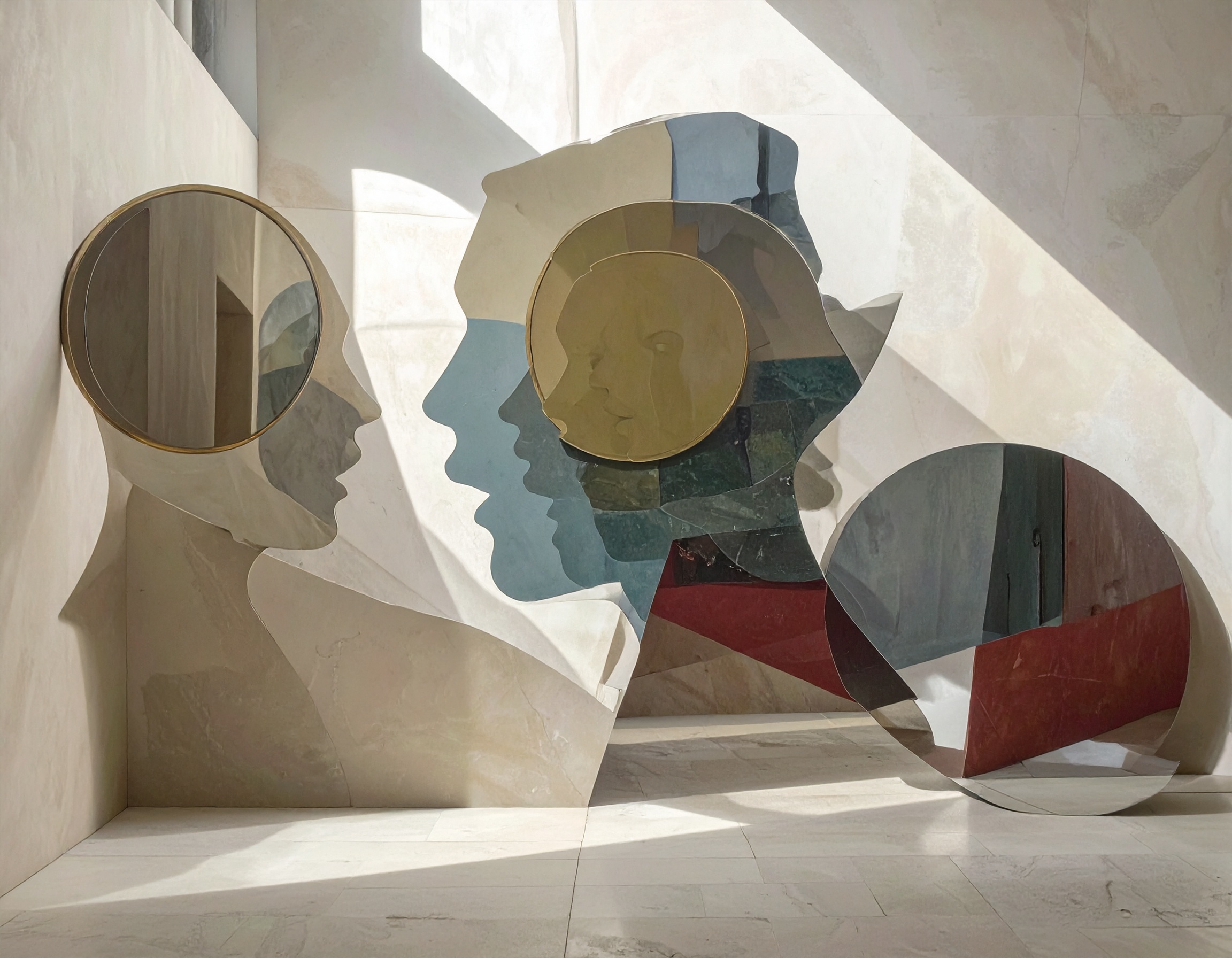
A reflective essay exploring the subtle interplay among truth, deception, and self-illusion, blending psychology, literature, and philosophy to reveal how inner narratives shape identity, relationships, and the architecture of the human soul.
Table of contents:
- Truth, Lies, and the Boundaries of the Soul: Deception as the Architecture of the Inner World
- The Alchemy of Deception: Psychological Portraits of Truth and Falsehood
- Literary Landscapes of Self‑Deception: Mirrors of the Soul and Figures of the Trickster
- Axioms of Being: Core Beliefs and the Tectonics of Reality
- The Silent Witness: Unseen Masks and the Inner Theatre
- The Path Through Mirrors: Discernment and Liberation
Truth, Lies, and the Boundaries of the Soul: Deception as the Architecture of the Inner World
There are thresholds in human existence where the light of understanding touches the shadows of illusion, and where the line between truth and falsehood dissolves into something fluid, almost invisible. It is precisely on these tectonic fractures of the soul—where objective reality collides with the intimacy of inner experience—that the drama of human deception unfolds. Not merely as a social phenomenon, but as a profound psychological mechanism shaping our perception, our identity, and the very structure of the stories we tell about ourselves.
Fernando Pessoa once wrote that life becomes whatever our imagination makes of it. And within that imagination, deception often acts as a quiet architect, arranging the contours of our inner landscape. This essay descends into the layered depths of that paradox, weaving together psychological insight and literary archetype to reveal how lies—conscious or unconscious—shape our world, our relationships, and above all, our relationship with ourselves.
The Alchemy of Deception: Psychological Portraits of Truth and Falsehood
The human psyche is a labyrinth of astonishing complexity, equipped with subtle mechanisms that help us navigate the chaos of existence. Among these mechanisms, deception occupies a peculiar and powerful place. It can be a tool of adaptation or a seed of self-destruction, a shield or a trap.
In everyday life, small lies—polite phrases, softened truths, omissions—act as the lubricant of social interaction. They protect fragile egos, prevent unnecessary conflict, and maintain a fragile sense of harmony. We rarely question them because they make the world easier to bear.
More potent still is self‑deception. It allows us to survive trauma, to preserve hope where realism would crush us, or to construct a self‑image that enables us to function. These “positive illusions” can even foster growth, as long as they do not sever their last threads to reality.
Even the concept of the “psychopath” becomes less rigid under the lens of modern psychology. Rather than a fixed category, it is increasingly understood as a spectrum of traits: diminished empathy, manipulative tendencies, and an instrumental view of human relationships. In this sense, the psychopath becomes an archetype—an extreme manifestation of cold, utilitarian deception, where the boundaries of the soul dissolve and only the hunger for control remains.
Literary Landscapes of Self‑Deception: Mirrors of the Soul and Figures of the Trickster
Literature has always been a grand stage for the interplay of truth and deception. Fictional characters often reveal the intricacies of the human psyche more vividly than psychological theory because they embody archetypes that resonate across centuries.
Othello is one of the most striking examples. His downfall is not merely the result of Iago’s manipulation, but of his own insecurities. Iago’s deception is a mirror reflecting Othello’s inner fractures.
Dostoevsky’s “Crime and Punishment” offers another labyrinth of self-deception. Raskolnikov constructs elaborate philosophical justifications for an act that violates his deepest moral core. His internal lies form a maze from which he cannot escape without confronting the truth he has tried so hard to silence.
There are also the conscious deceivers: Iago, who treats manipulation as an art form, or Jay Gatsby, who builds an entire identity out of longing and illusion. Gatsby’s deception is monumental yet tender in its tragic naiveté—a cathedral erected in the hope of resurrecting a lost dream.
And then there is the unreliable narrator, a figure who forces us to question the very nature of truth. Pessoa, with his heteronyms, elevated this concept to a metaphysical level. “The Book of Disquiet” is an archive of voices, each carrying its own truth and its own lie, each revealing a different facet of the self.
Literature teaches us that the deceiver and the deceived are often the same person.
Axioms of Being: Core Beliefs and the Tectonics of Reality
Deep within the psyche lie core beliefs—invisible axioms that shape how we see ourselves, the world, and others. They form the foundation of our emotional and cognitive architecture. Often forged in childhood and reinforced by experience, they become remarkably resistant to change.
These beliefs resemble tectonic plates. Any information that threatens to shift them triggers an internal earthquake: anxiety, cognitive dissonance, and existential tremors. This is why people cling to familiar lies—they offer stability, while truth can be destabilizing, even painful.
If someone’s core belief is “I am not good enough,” they will dismiss praise and amplify criticism. If their belief is “the world is dangerous,” they will interpret kindness as a trap. In both cases, reality is filtered through the architecture of the inner world.
Literary characters often embody these struggles. The figure who clings to an illusion of importance even as their life collapses is an archetype that resonates because we recognize the same impulse in ourselves: the desire to protect the fragile structures that hold our identity together.
Truth, in this sense, becomes an act of courage—a demolition of old architecture to make space for something more authentic.
The Silent Witness: Unseen Masks and the Inner Theatre
Every human being wears masks—for parents, partners, colleagues, society. These masks are not inherently false; they are functional. They allow us to move through the world without exposing our most vulnerable layers.
But the deepest deception does not occur on the public stage; it unfolds in the quiet theater of the inner self.
Who would we be if no one were watching?
This question opens the hidden chambers of our being. Some people need an audience even for their private thoughts—they perform a narrative for themselves, sustaining a version of identity that comforts them, even if it is untrue. Others reveal their truest face only in solitude, a face they would never show to the world.
This inner space is where the “book of peculiarities” is written — an archive of intuitions, rituals, anxieties, and desires that shape our deepest self. Self-deception can be a refuge, but it can also be the place where truth slowly emerges, stripped of social expectations.
Pessoa created an entire universe for his hidden self. Each of us carries a similar universe within.
The Path Through Mirrors: Discernment and Liberation
Understanding the dance between truth and deception is not a destination but a lifelong journey. It requires observation, subtlety, courage, and the ability to read between the lines. Psychology and literature offer mirrors in which we can glimpse our own reflections—sometimes distorted, sometimes painfully accurate.
Liberation does not mean eliminating all illusions. Some illusions are necessary for balance, for survival, for meaning. What matters is the ability to choose which illusions serve us and which imprison us. This is the essence of maturity—transforming the shadow from a cage into a landscape we can walk through without fear.
Truth and falsehood are not always opposites. Often, they are two ends of the same axis, defining the contours of our humanity. In the tension between them, self-knowledge is born. Every lie we recognize and every truth we accept becomes a building block in the architecture of a more authentic soul.
Deception reveals the boundaries of the soul—but also its capacity for transformation, depth, and renewal.
Similar posts:



Leave a Reply