An essay exploring architecture as a sanctuary of the soul. A reflection on how light, space and materials shape our emotions, support mental well‑being and create environments where we can breathe, slow down and return to ourselves.
Table of contents:
Architecture as a Sanctuary of the Soul: On Spaces That Hold, Protect, and Transform Us
There are moments when a person pauses in the middle of a room. They suddenly realize that the space around them is not merely a backdrop. The walls, the light, the silence, the textures—they create an invisible architecture of presence. This forms a subtle scaffolding. It keeps the mind from scattering into the noise of the world. We live in an age of acceleration. Our inner landscapes grow fragile and porous. In these times, we rediscover an ancient truth: architecture is not only the art of building. It is the art of sheltering the soul.
Home, studio, library, café—every space we enter shapes us. Architecture quietly acts as a therapist. It accompanies us through our anxieties, our exhaustion, and our moments of clarity and renewal. In its proportions, we sense our longing for calm. In its materials, we feel our need for touch. In its shadows, we realize our vulnerability. In its openings, we find our wish to breathe.
This essay is a try to trace how architecture influences our psychological well‑being. It does not treat it as a technical discipline. Instead, it sees it as a living organism, breathing with us. It resonates with our moods, and sometimes, it heals us without announcing itself.
Light: The First Language of Space
Light is the oldest architect. Long before walls existed, before the first shelter was raised, light shaped human rhythms. It defined the safety of night, the clarity of day, the threshold between waking and dreaming. Today, in contemporary interiors, light becomes a subtle regulator of emotion.
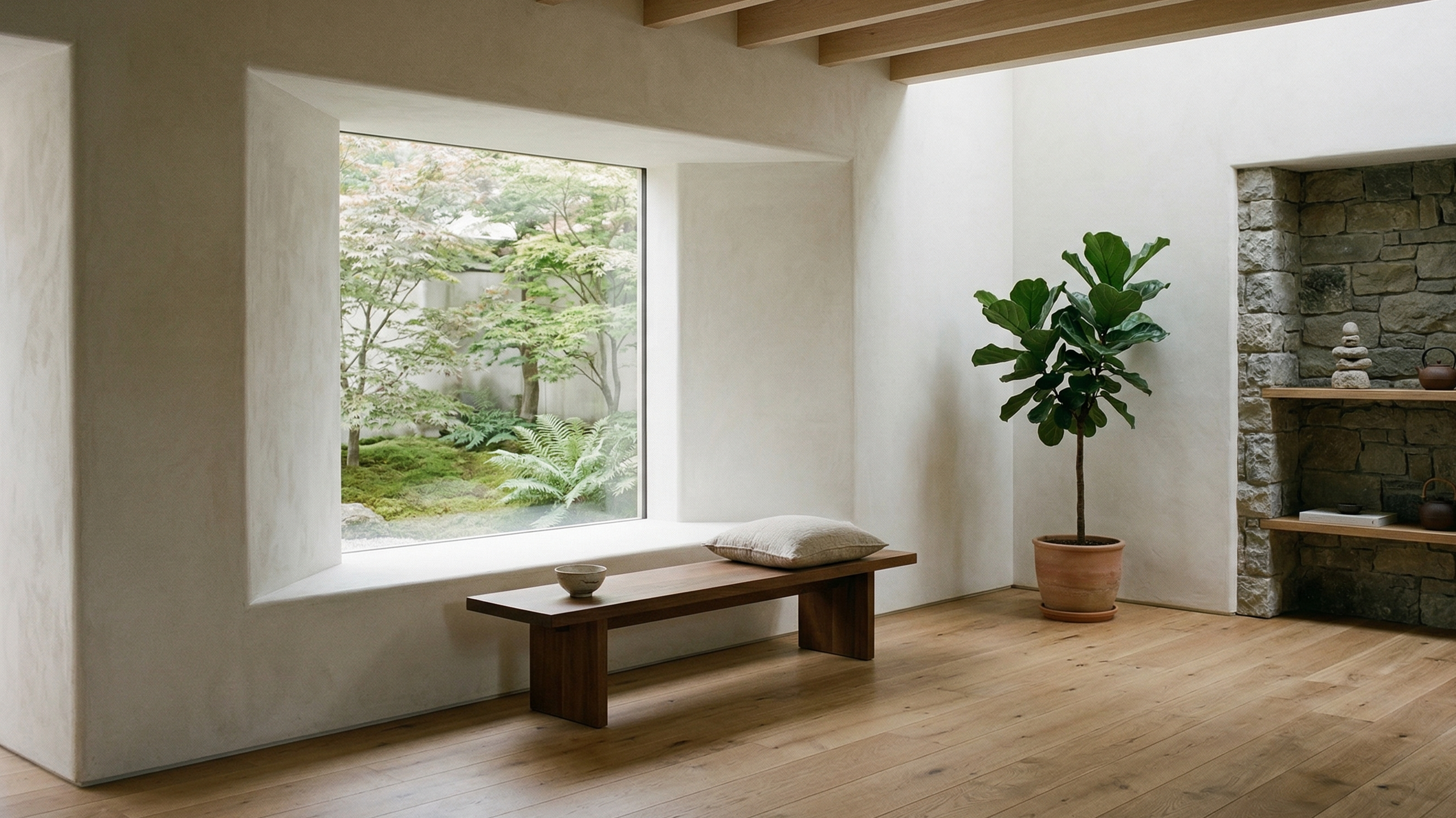
Natural light entering through a deep window recess creates a sense of protection. It does not attack; it invites. It touches surfaces the way water touches the shore—softly, rhythmically, with a quiet insistence. Such light calms the nervous system, slows the breath, and returns the body to the current moment.
Harsh, relentless light—the kind found in office corridors, supermarkets, and twenty‑four‑hour spaces—pulls us out of ourselves. It is a light without mercy, a light that exposes rather than embraces. Under such illumination, a person becomes an object, not a being.
Architecture that works consciously with light creates psychological refuge. Skylights, perforated facades, translucent curtains, light wells—these are not decorative gestures but therapeutic instruments. They allow light to become a companion, a guide, a gentle reminder that the world can be soft.
Space as a Map of Inner States
Every space has its own psychology. Low ceilings protect; high ceilings liberate. Narrow corridors direct; wide halls disperse. Open plans can feel freeing, yet they can also overwhelm, exposing us to too many stimuli at once.
Human beings need spatial hierarchy—places to withdraw and places to expand. A corner that belongs only to us, and a view that reminds us the world is larger than our fears. A threshold that slows us down, and a window that opens us up.
Contemporary architecture often forgets this simple truth. In the pursuit of minimalism, efficiency, and openness, intimacy is lost. Yet intimacy is what shields the psyche from overstimulation. Without it, we become restless, unanchored, unable to settle into ourselves.
A space that is too open exhausts. A space that is too closed suffocates. Ideal architecture breathes—expansion and contraction, like the lungs of a living being.
Materials as Tactile Memory
We touch the world before we understand it. Touch is the first sense to awaken and the last to fade. This is why materials in architecture carry such deep psychological resonance.
Wood soothes. It is warm, irregular, alive.
Stone stabilizes. Its weight and permanence offer grounding.
Textiles soften both acoustics and perception.
Concrete, when used with sensitivity, becomes a protective shell—quiet, steady, unwavering.
Materials are not merely aesthetic choices. They are psychological languages. In their textures lies the memory of landscapes, the rhythm of seasons, the echo of human hands. In an era of digital abstraction, tactile experience becomes one of the last bridges between the self and the world.
Touching a wooden railing is a small act of grounding. Feeling the coolness of stone under bare feet is a ritual of presence. Resting one’s hand on a wall that carries the warmth of the sun embodies these grounding acts.
Architecture as Protective Skin: Between Shelter and Openness
Modern life overwhelms us. Too much information, too much noise, too many expectations. It is no surprise that architecture is beginning to respond to this collective fatigue.
We see houses with inward‑facing courtyards, partially sunken structures, buildings with thick walls, minimalist retreats in nature. These are not gestures of isolation but acts of filtering reality.
A sanctuary is not a bunker.
A sanctuary is a space that allows vulnerability without danger.
A place where masks can be set aside, where the body can soften, where the mind can rest.
A place where silence is not emptiness but nourishment.
Psychological literature often speaks of the paradox of protection. The more we defend ourselves, the more we risk closing off from life. Architecture can soften this paradox by offering layered environments—transitional zones, half‑shadows, acoustic gentleness, visual calm.
Such spaces do not shut the world out; they modulate it.
Home as a Personal Sanctuary
Home is no longer merely the place where we sleep. It is the place where we heal. The place where we return to ourselves. The place where we learn to be whole again.
A psychologically safe home is not defined by luxury. It is defined by rhythm, light, silence, and materiality. Objects rest in their places. The air moves. Morning enters the room.
A home nurtures the soul in several ways. It reduces visual noise. It embraces warm materials. It offers zones for different states of mind. It allows rituals to unfold. It supports regeneration.
Such a home is not an escape from the world.
It is a bridge—a way to re‑enter the world without fear.
The Workspace as a Tool of Mental Hygiene
Work has migrated into our homes, cafés, coworking spaces. With it comes the need for environments that support focus without draining the psyche.
A healthy workspace offers several features. It invites natural light and controls noise. It breathes with plants and offers the possibility of isolation. It respects the body’s ergonomics and maintains visual clarity.
This is not a luxury.
It is a prerequisite for long‑term psychological well‑being.
A workspace that respects the mind does not push for productivity at all costs. It creates conditions in which thinking becomes fluid, attention becomes gentle, and creativity becomes possible.
Architecture as a Silent Therapist
Architecture can be healing even when it does not announce itself as therapeutic. Its healing power is often invisible, woven into the proportions, the textures, the light.
A space that heals is predictable without being rigid. It offers refuge without isolation. It connects with nature without romanticizing it. This space treats silence as a resource. It allows rituals to anchor the day. It brings the body back into the now.
Such a space does not demand improvement.
It simply allows being.
Conclusion: The Space That Carries Us
Architecture as a sanctuary of the soul is not a trend. It is the contemporary expression of an ancient need—the need for protection, breath, and return.
The world is loud.
But architecture can be a doorway into inner quiet.
Today we ask not only, “What house do we want to live in.”
We ask something deeper:
What inner state do we want to inhabit.
And the deepest question of all:
What space does our soul need in order to remain whole.
Inspiration:
- ArchDaily Global (jakýkoli projekt, např. “The OCULUS”)
- Psychology Today (“Greetings From My Bomb Shelter”, “From River to Stream: How Vulnerability Becomes Illness”)


Leave a Reply