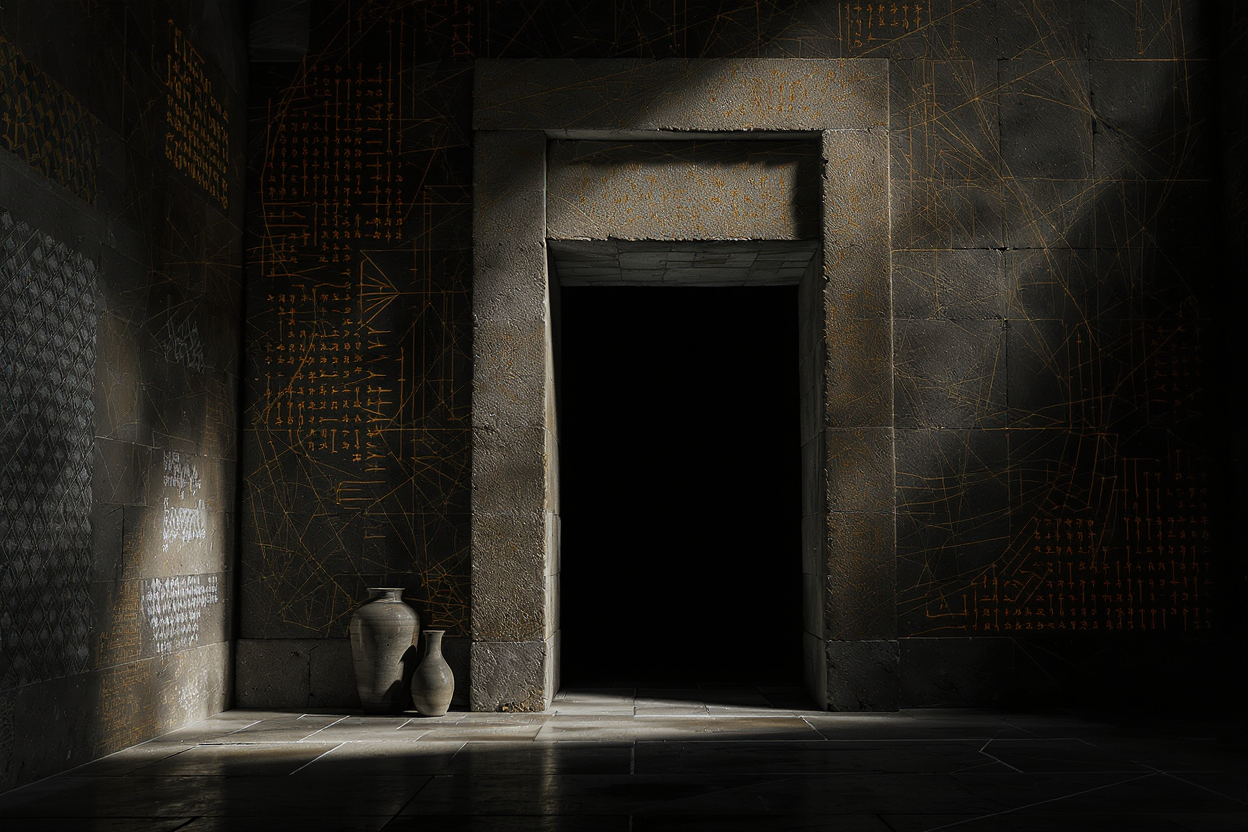
An essay exploring exclusivity as an inner architecture of being: a reflection on sensitivity, language, ritual, cities, and the psychology of living with rare precision.
Table of contents:
Silent Norms and the Unmoving Core of the Human Self
There are moments when a person pauses in the middle of an ordinary day—between two breaths, between two sentences, between two obligations—and suddenly senses that the world around them is built from invisible lines. From rules no one signed yet everyone follows. From expectations that masquerade as inevitabilities. From norms that arise not from truth but from repetition.
And in such moments, an ancient question stirs within the human mind: If what we call “normal” is merely the habit of the majority, and I stand outside that habit, then who is truly the one out of place?
This question is not an act of rebellion. It is a subtle, almost meditative gesture: touching the boundary we never consciously drew, yet which surrounds us like unseen architecture.
Norms as Quiet Agreements
Norms are not laws. They have no paragraphs, no judges, no official punishments. And yet they bind us more tightly than many legal systems ever could. They are quiet agreements born from repetition: when enough people do the same thing, it becomes “normal.”
But this normality is fragile. Change the place, the time, the culture—and the entire structure dissolves. What is obvious in one country is strange in another. What is natural in one century becomes unacceptable in the next.
Norms are like sand: they appear solid until a different wind begins to blow.
Still, we cling to them. Perhaps because they offer the illusion of safety, perhaps because humans fear chaos, or perhaps because most people would rather adapt than risk the glances, the questions, and the subtle distancing of others.
When One Finds Themselves Outside the Circle
But what happens when a person realizes that their way of thinking, their sensitivity, or their rhythm of life diverges from the mainstream? When their inner compass points in a direction the collective compass does not acknowledge?
A peculiar feeling emerges: not quite loneliness, not quite defiance—more a quiet awareness of standing on a threshold, on the border between the shared world and the intimately personal one.
And on that border, a paradox appears: From the perspective of someone outside the norm, the majority itself can seem like the anomaly.
Not because it is wrong, but because its logic, its rhythm, its values no longer feel self-evident. They are simply different.
The Psychology of Difference
Psychology knows this state well. A person who differs from the majority is not necessarily a rebel. Often, they are simply someone who hears nuances others overlook, someone who perceives the world in additional layers, someone who does not follow automatic patterns but follows questions.
Such a person may appear “abnormal” only because their sensitivity vibrates at another frequency. And yet, throughout history, it is precisely these individuals—those who deviate—who bring change. They shift boundaries, introduce new perspectives, and disrupt stagnation.
Difference is not a disorder. It is a variation, a possibility, a reminder that the human mind is not uniform.
The Philosophy of Perspective
Philosophy offers a simple yet profound tool: perspective. What is normal from one angle becomes incomprehensible from another. What is ordinary in one context becomes extraordinary in another.
Thus, “normal” is not an objective category. It is merely the point around which the majority has gathered. Nothing more, nothing less.
From this viewpoint, the question “Who is abnormal?” loses its meaning. A more fitting question would be: Who defines the center? And why should I accept their center as my own?
The Quiet Courage of Being Different
To be different does not mean to be against. It does not mean rejecting the world. It means remaining faithful to one’s own axis, one’s own rhythm, one’s own way of seeing.
Difference can be a source of strength. It can open the door to creativity. It can lead to deeper authenticity.
But it can also bring vulnerability, for the world often rewards conformity more readily than originality.
And yet there is a particular, quiet courage in staying loyal to one’s own norm—even if it is a minority, even if it is misunderstood, even if it has no name.
When Norms Begin to Dissolve
Perhaps the most important realization is this: Norms are not eternal. They shift. They crumble. They are rebuilt and undone again.
What seems like a solid structure today may become a historical curiosity tomorrow.
And so one begins to ask: Why struggle to fit into a shape that will soon change anyway?
Perhaps it is wiser to remain faithful to what is lasting within us: our inner compass, our way of perceiving, our quiet conviction.
The Final Light
And so we return to the original question: If “normal” is merely the sum of the majority’s habits, and I think differently, does that mean the majority is “abnormal” from my perspective?
Perhaps yes. Perhaps no. Perhaps the question itself leads us astray.
Maybe the truth is this: Every person is the center of their own world, and norms are only maps we draw so we do not lose ourselves in these worlds.
Some maps are shared. Some are personal. And some are so unique that one carries them only within.
And this is the beauty of human existence: that no norm is final, no difference is definitive, and no person is truly “abnormal.” We are simply different variations of the same mystery.
Similar posts:



Leave a Reply