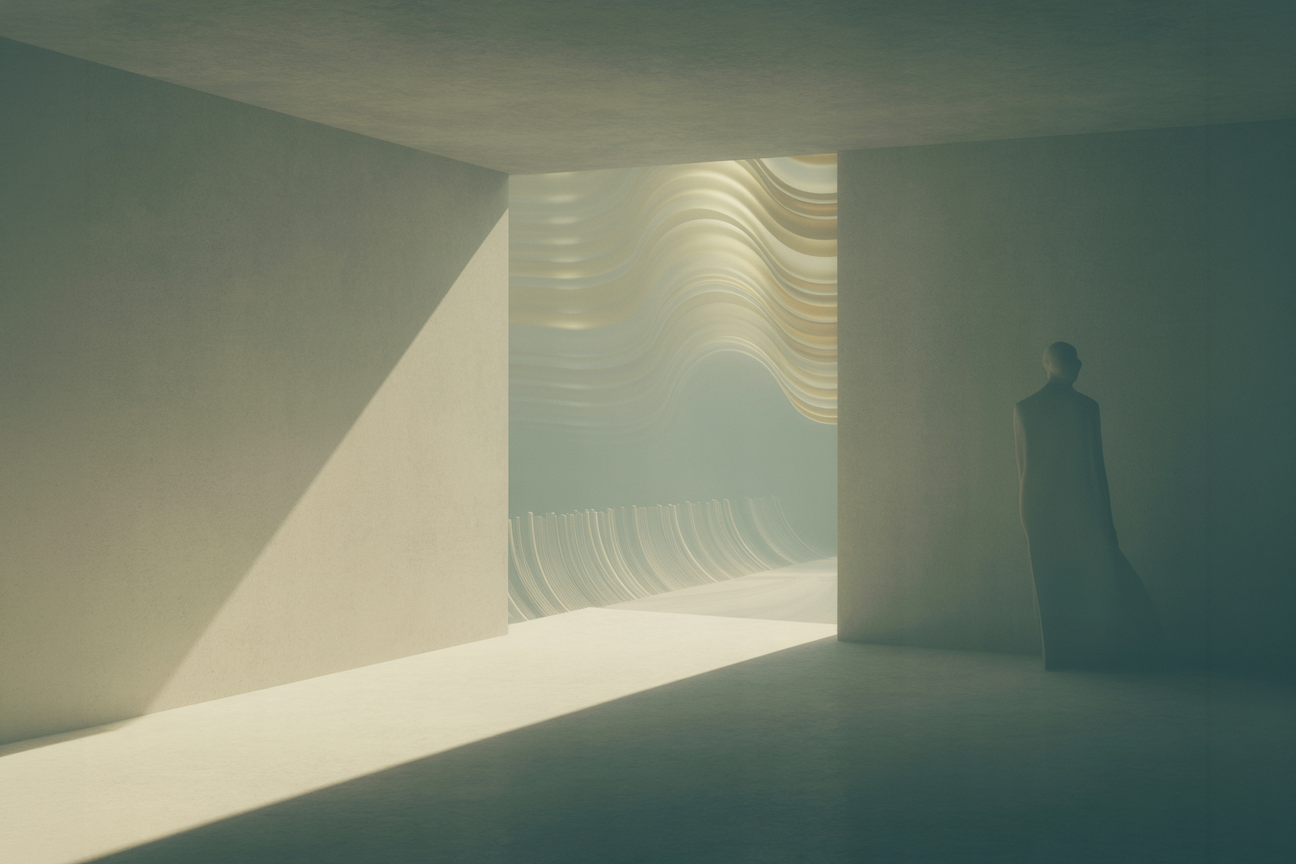
A contemplative essay on the quiet act of returning to oneself, on dissolving old layers, on light that finds new paths, and on human fragility that transforms into strength. A reflective text about silence, inner change, presence, and the subtle movements of the inner life.
Table of contents:
The Quiet Reflection of Returning
There are moments when a person pauses in the middle of an ordinary day and senses that the world has shifted ever so slightly. It hasn’t vanished, it hasn’t collapsed—it has simply changed the angle of its light. In those moments, questions begin to rise. In a way, these are The Quiet Reflections that gently settle into our awareness. They are not urgent, not practical, not even clearly formed, yet they insist on being felt. They do not intrude; they gather around you, like a thin layer of dust settling on the surface of things until you finally notice it.
Perhaps this is where the true return to oneself begins, not in dramatic gestures or sudden decisions, but in the quiet realization that something inside is rearranging itself, and that this movement is not a sign of weakness but a natural rhythm of being.
On the Slow Dissolving of Old Layers
Every person carries layers that have accumulated over the years—some consciously chosen, others added without our permission. Layers of expectations, old fears, unspoken sentences, small disappointments, and large, silent hopes. Even when we try to live in the present, the past returns in subtle imprints that appear in our reactions, our choices, and the way we look at the world.
Sometimes we try to shed these layers quickly, as if they were an old coat. But the human psyche is not a wardrobe. Layers do not fall away with a single gesture. They dissolve — slowly, almost imperceptibly, like snow disappearing under the first warm light of spring.
And maybe that is how it should be. Because if we stripped everything away at once, we might lose the very threads that hold us together.
On Returns That Are Not Really Returns
We often imagine that returning means going back to where we once were. But a true return is more like arriving in a place that feels familiar and yet undeniably new. It is like stepping into an old house that someone has quietly rebuilt. The walls stand where they always stood, but the light falls differently. And suddenly you realize that it is not only the house that has changed—you have changed as well.
Returns are not circles. They are spirals.
We revisit themes we believed were long resolved, but this time we see them from a different height, a different angle. And sometimes the surprise comes not from pain, but from truth.
On Silence That Is Not Empty
In the modern world, silence is often treated as a lack—something to be filled with sound, images, activity, words. But there is a kind of silence that is not empty, a silence that does not drain you but carries you, a silence that is not an escape but a return.
In this silence, a person meets themselves without decoration, without the roles they perform for others, and without the masks they wear so the world will not be startled by their real face.
And it is precisely there—in that delicate space between inhale and exhale—that the most important decisions are born. Not the ones that change the world, but the ones that change us.
On the Courage to Be Slow
We live in a time that worships speed: quick responses, quick results, quick transformations.
But some processes cannot be rushed: healing, understanding oneself, grief, joy that is learning to walk again.
The courage to be slow is one of the purest forms of strength. It is the ability to say, “I am not hurrying, not because I cannot, but because I choose not to.”
Slowness is not laziness; slowness is precision. It is a way of touching life without letting it slip through your fingers.
On Light That Returns by Another Path
Sometimes it feels as though the light has disappeared, as if it has withdrawn from our days, our relationships, our plans.
But light never vanishes completely. It simply changes direction.
Perhaps it no longer enters through the window we were used to. Perhaps it appears in details we once overlooked—the slight movement of a curtain, the distant hum of the city, the unexpected brush of wind against the skin.
And then you understand that light is not a reward. It is a reminder.
A reminder that even when things change, something in the world still knows how to return—not out of obligation, but out of its nature.
On Fragility That Is Not Weakness
Fragility is often seen as something to hide, but true fragility is not weakness. It is the ability to remain open to the world even when you know it can hurt you.
Fragility is transparency. It is the courage to say, “I am here. Not perfect, not finished, but real.”
And perhaps this realness is what connects us: not our achievements, not our roles, not our masks, but that delicate, human vulnerability that touches others without needing to be spoken aloud.
On the Return That Happens Within
A return is not a journey backward. It is a journey inward.
It is the process of gathering your pieces again—not as they were, but as they can be. It is the quiet acknowledgment that life is not linear, that we are constantly rewriting ourselves, reshaping ourselves, being born again in small, almost invisible ways.
And maybe this is the beauty of human existence: that we are never finished. That we can return, change, lose ourselves, and find ourselves again.
On What Remains
When all the layers dissolve, when silence settles, when light returns by another path, something remains that cannot be named. Something that is not a thought, not a feeling, not a memory.
It is presence, not the kind described in books, but the kind that fits between two heartbeats.
And then you understand that a return is not a destination. It is a way of being.
Conclusion
Perhaps the whole of life is simply learning how to return—to ourselves, to others, to what is real. And perhaps every return is different because we, too, are different each time.
But one thing remains unchanged: even if the world shifts a millimeter to the side, a person will always find within themselves a path back to the light.
Similar posts:



Leave a Reply