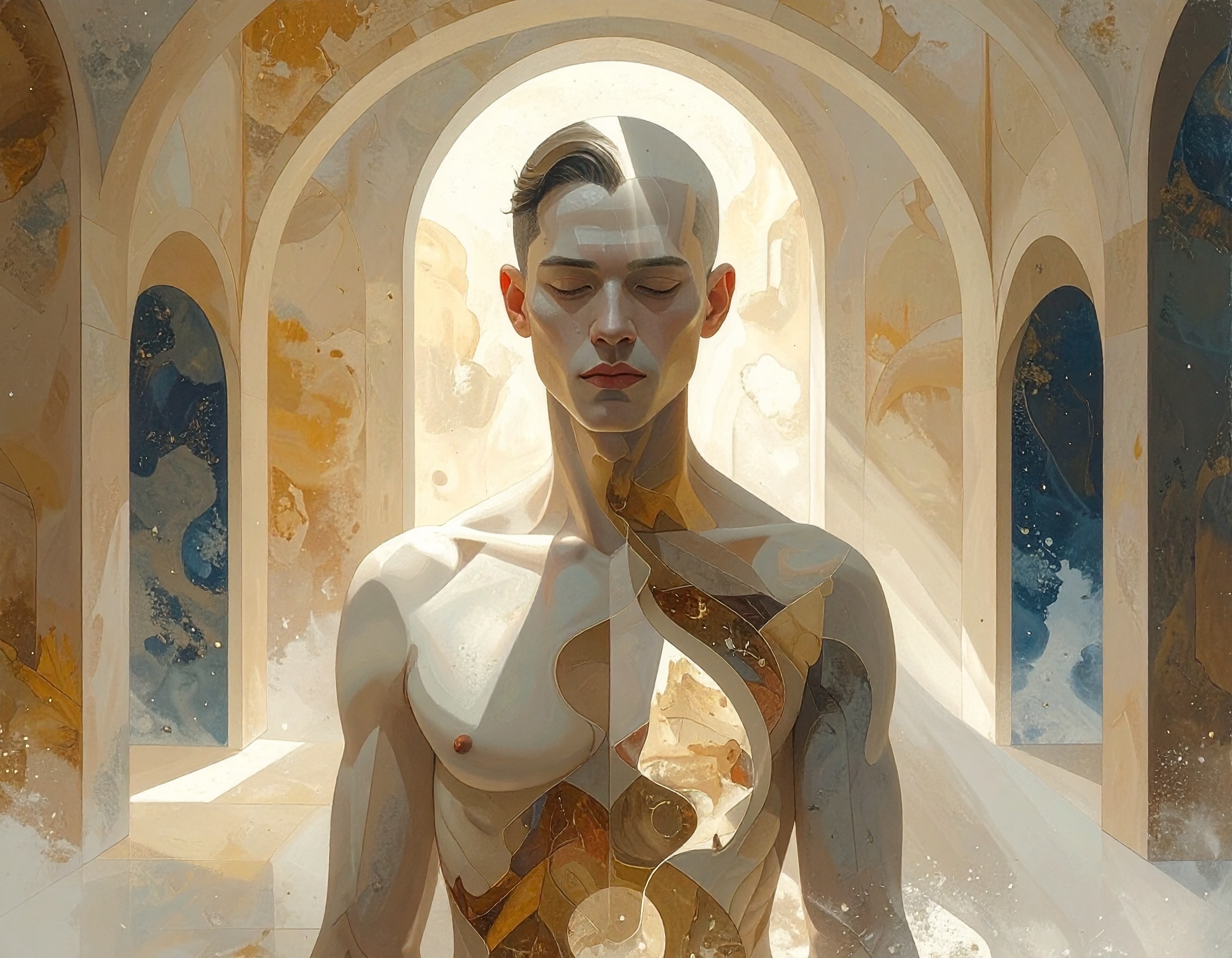
A reflective essay on the inner architecture of the human being, on returning to oneself in a fragmented world, on the light that withdraws and returns, and on the healing power of slowing down.
Table of contents:
Between Light and Dust: On the Inner Space That Teaches Us How to Live
There are days when the world feels too fast, too loud, too fragmented, as if reality were breaking into thousands of tiny shards drifting through the air without ever touching. On such days, a person may find themselves standing in the middle of their own life like someone lingering on the threshold of a stranger’s house—aware that they should step inside, yet unsure whether the room beyond holds light or only another form of emptiness.
Perhaps this is why we return to stories—not to escape, but to come back. Back to ourselves, back to something older than our name, older than our fears, older than the crises that crash over us like relentless waves. Stories create a space where the world slows down just enough for us to hear our own breath again. And sometimes, in that slowed-down moment, we rediscover layers we had ignored for far too long.
The Weight of Days and the Fragility of a Moment
Every day carries its own weight. Sometimes it is the weight of obligations; sometimes the weight of expectations we have draped over ourselves like a coat that is far too heavy. And sometimes it is the weight of the world—the constant stream of news, the images that cling to the mind, the sense that too much is happening at once and that our inner architecture was never designed for such intensity.
Yet there are moments that break through this heaviness. They arrive quietly, without warning, like a thin line of light slipping through a half-open door. It might be the smell of coffee in the late afternoon. It might be the expression on the face of someone who suddenly pauses in the middle of the street, as if remembering something essential. It might be a sentence from a book that settles inside us like a seed.
These moments are not grand, but they are true. And truth, even in its smallest form, has the power to carry us forward. It reminds us that even in the midst of chaos, there are points of return—small anchors that guide us back to what matters.
A Space That Is Not Empty
In the modern world, stillness is often mistaken for a void—something to be filled immediately with sound, with images, with activity. Yet there is another kind of stillness: one that is not empty but full, one that is not an escape but a return.
It is the state in which a person stops trying to be someone they are not, stops chasing a rhythm that does not belong to them, and stops explaining the world only through logic and begins to feel it again.
In this space, questions we have postponed for years begin to surface, and with them, answers we may not have been seeking but somehow needed. It is a space where a person regains their place—not as a distant observer, but as an active participant in their own life.
The Inner Architecture of a Human Being
Each of us carries a certain architecture within. For some, it is intricate, full of hidden corridors and unexpected passages. For others, it is simple, open, like a house by the sea. But all of us have places that are fragile and places that are strong, rooms we fear to open and rooms we fear to lose.
The outer world often pushes us to build new walls, out of caution, out of exhaustion, out of the instinct to survive. But literature, art, the stories that move us, do the opposite. They open windows. They carve small openings where we least expect them. They remind us that even if the world can be harsh, our inner landscape can remain flexible, alive.
Perhaps our strength lies precisely here: in the ability to rebuild ourselves without betraying our essence, to reshape our inner structure while remaining faithful to what is most authentic within us.
On the Light That Returns
There are periods when it seems that the light has disappeared. Not the physical light, but the inner one—the light that gives shape and meaning to things. In such times, a person may feel like a vessel that was once full but now carries only an echo.
Yet light has a peculiar nature. It does not vanish. It simply withdraws into deeper layers, waiting to be found again. And often it returns in forms we do not expect: in a brief conversation with a stranger, in a sentence overheard by accident, in a glance at an old photograph, in the return to a place we once loved.
Sometimes it returns through pain—reminding us that even loss has its own shape, and that cracks can become openings through which a new beginning enters. Light returns because its source is something we carry within.
The Healing Power of Slowness
In an age where everything accelerates, slowness becomes almost an act of resistance. Yet it is slowness that allows us to see again, to feel again, to think again. Slowness is not laziness; it is a way of returning to ourselves.
When we slow down, details we once overlooked begin to appear: subtle shifts within us, signals from the body and mind that are drowned out by the noise of the day. Slowness is a way of relearning how to be human.
And perhaps even more, it is a way of rediscovering gratitude for the small things that vanish in haste, for the moments that crumble into dust when we rush past them.
A Return That Is Not an Escape
The most important thing may be this: returning to oneself is not an escape from the world. It is a way of being more present within it, a way of not being swallowed by chaos while still remaining sensitive, a way of living in difficult times without hardening.
Each of us carries our own story. And every story has its light, its fractures, its foundations. When we learn to listen to what resonates deepest within us, we discover a compass we have been searching for all along.
And perhaps then we understand: even if the world is demanding, our capacity to create, to feel, to transform remains. And it is precisely in this capacity that our humanity finds its strongest expression.
Similar posts:


Leave a Reply