A deep literary essay exploring Marcel Pagnol’s Souvenirs d’enfance. Childhood as a living landscape, Provence as an organ of memory, and the act of returning as a creative ritual.
Table of contents:
Marcel Pagnol: Childhood as a Landscape That Never Disappears
There are books we do not read only with our eyes. We read them with our bodies, with memory, with a quiet inner light that has survived the years. They do not unfold in chronological time but in the layered, spiraling space of remembrance. Marcel Pagnol’s Souvenirs d’enfance — his Childhood Memories — creates exactly such a space. It is alive and breathing and washed in the light of Provence. It is shaped by the fragile yet enduring rhythm of childhood.
The cycle has four parts. They are The Glory of My Father, The Castle of My Mother, The Time of Secrets, and The Time of Love. It is more than an autobiography, it is an exploration of life. It surpasses simple narration. It delves deeper into life. The cycle serves as a ritual of return. It is a deliberate movement back toward the small moments. These formative moments quietly build a human life. Pagnol writes childhood not as a period. He sees it as a landscape. It is one that can be walked again. It can be inhaled again and heard again. And that is why his work continues to resonate: because each of us carries a similar landscape within us.
Dětství jako světlo, které se neztrácí
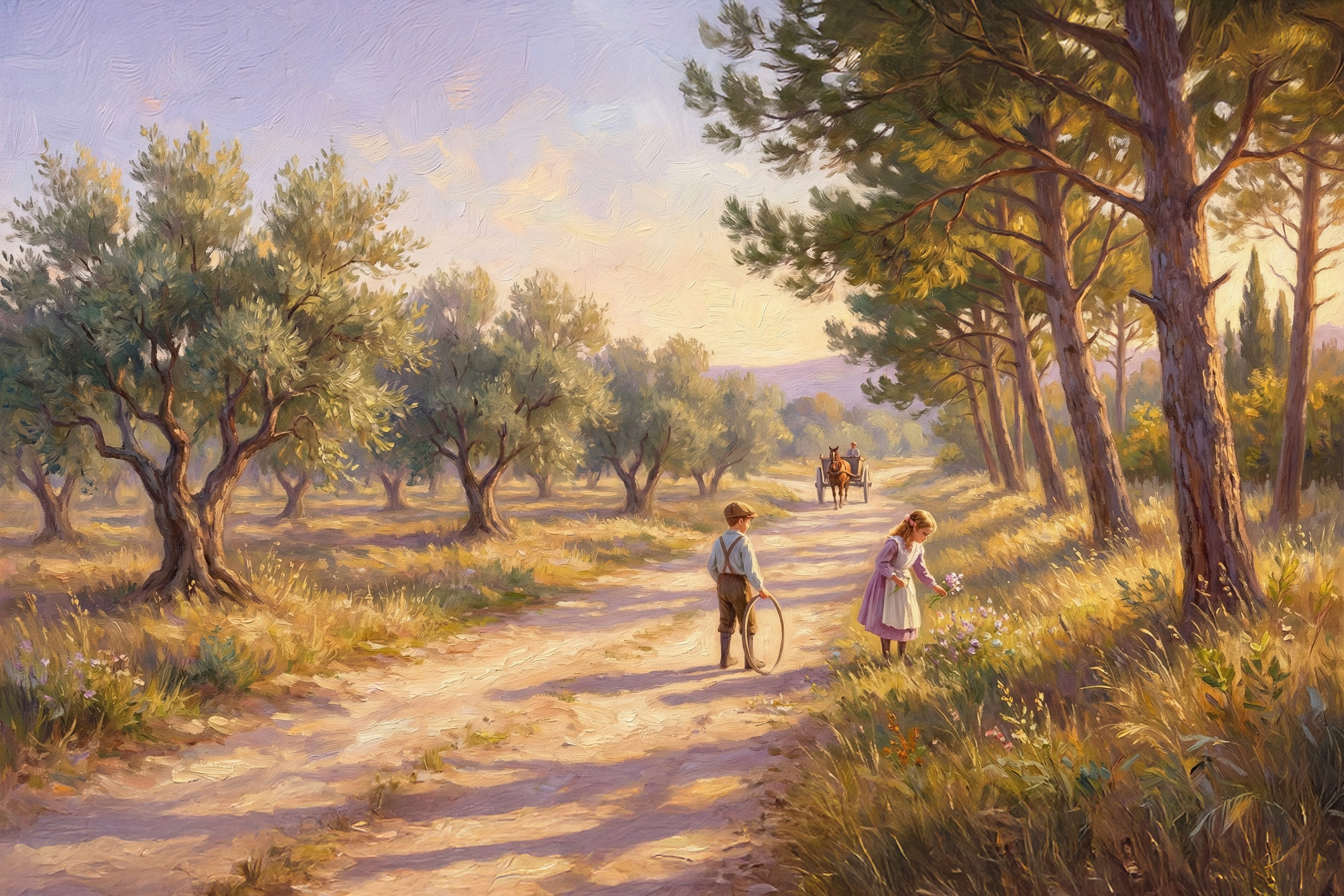
Pagnol grew up in Marseille. Still, his deepest memories belong to Provence. It is the countryside where time slowed down and the world still felt unbroken. In his writing, light becomes almost a character. Not a backdrop, but an active presence. Sun on stone. Light breaks across dusty paths. Shadows stretch across long summer afternoons. These are not descriptions. They are memory itself.

The Glory of My Father is an ode to paternal presence. Joseph Pagnol is not a heroic figure in the traditional sense; his greatness lies in his ordinariness. Through a child’s eyes, the father becomes the axis of the world. Pagnol reminds us that childhood is not shaped by grand events. It is shaped by intensity: a voice, a scent, a path, a summer day. These are the building blocks of identity.

The Mother as the Quiet Center of the Universe
If the father is light, the mother is warmth. The Castle of My Mother is written with a tenderness that slows the reader’s breath. Pagnol’s mother is gentle, fragile, yet strong — the invisible pillar of the family. He does not idealize her, but he writes with profound respect.
One of the most moving scenes in the entire cycle is the mother’s exhaustion. Her silent sacrifices foreshadow a loss that the reader senses long before it arrives. Pagnol writes about his mother. He describes a world that is slowly slipping away. It is a world that can’t be fully recovered.

Landscape as an Organ of Memory
Provence is not merely a setting. It is a memory-organ, a living archive. The paths between Marseille and La Treille are not simple routes. They are thresholds between two worlds. These paths connect the city and countryside. They bridge duty and freedom, school and summer.

Every path, every stone, every hill becomes symbolic. A road is never just a road. It is a line connecting past and now. A place where secrets, friendships, and first loves are born.

The Time of Secrets and the Time of Love
In the third and fourth volumes — The Time of Secrets and The Time of Love — Pagnol makes a transition. He moves from childhood into adolescence. He moves into adolescence. The tone shifts. The world becomes more complex, less safe. The first disappointments, the first sense of solitude, the first inner conflicts.

And then comes first love. Pagnol neither romanticizes nor trivializes it. He understands that its importance lies not in perfection but in its newness. This sensitivity gives the later volumes a quiet emotional depth.
Why Pagnol Still Speaks to Us
Because his writing is not nostalgic in the escapist sense. He does not return to the past to flee the now, but to understand it. Childhood is not a lost paradise but the soil from which we grow. Sometimes fertile, sometimes rocky — but always ours.
His language is simple yet profound. It guides the reader gently toward their own inner landscape. Everyone carries a Provence — a world that once felt larger, brighter, slower.

Pagnol as a Guide of Return
Reading Childhood Memories is not simply reading a story; it is undertaking a pilgrimage. The reader walks through Pagnol’s Provence while simultaneously returning to the quiet rooms of their own childhood. His books are like an old house: familiar, yet offering new details with every visit.


Leave a Reply