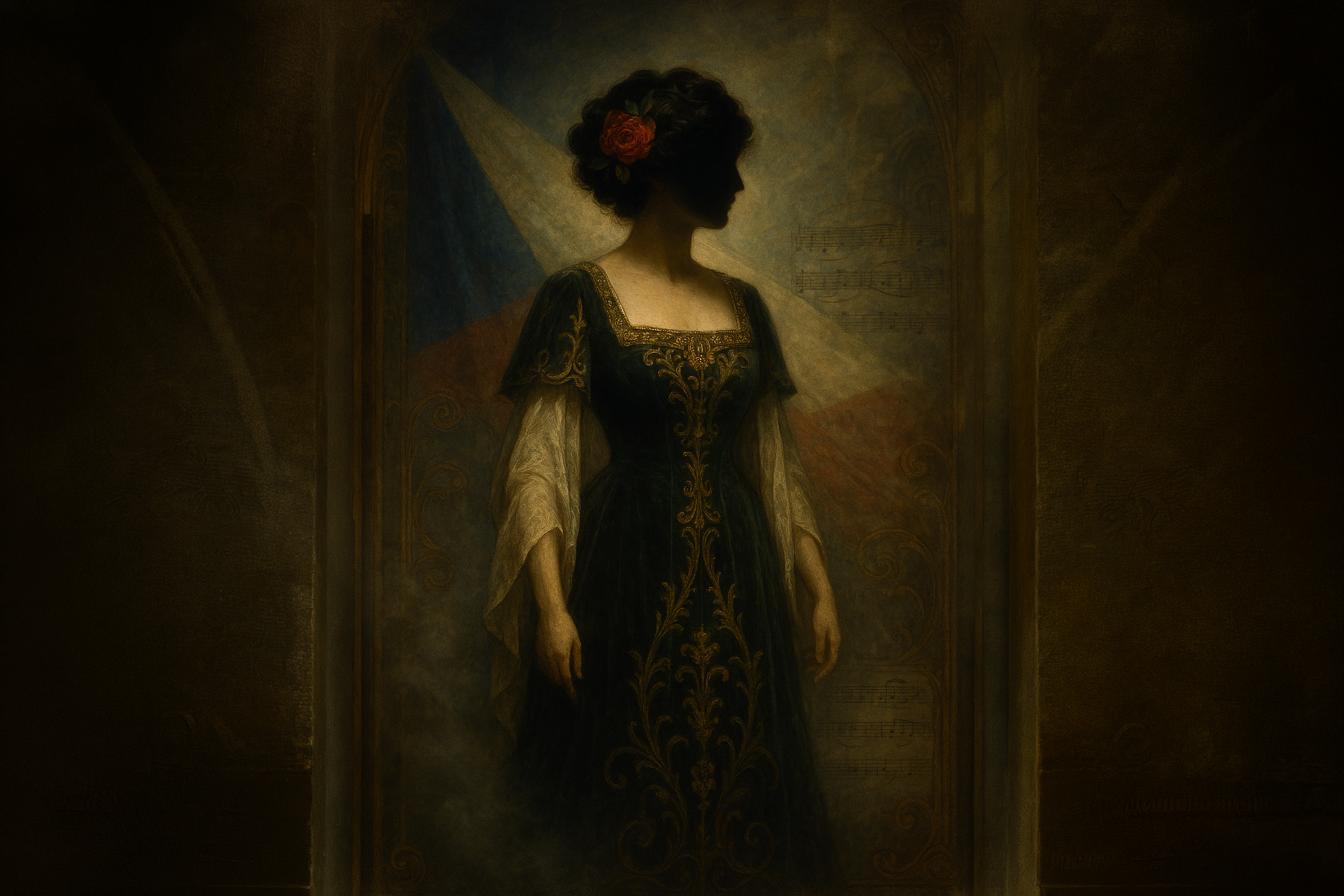
The extraordinary life of Ema Destinn — world‑renowned soprano, patriot, and artist whose voice shaped cultural identity. A commemorative essay on the anniversary of her death.
Ema Destinn: A Voice That Became the Homeland of a Nation
Some artists have lives that transcend the boundaries of their own era. It is as if they were born not just to act but to remind humanity of something essential. Ema Destinn—born Emilie Pavlína Věnceslava Kittlová—was one of those rare figures. Her story is not only the story of a great soprano. It is not merely the chronicle of a woman who conquered the world’s most prestigious stages. It is the story of a soul. This soul carried within itself a fierce devotion to truth and beauty. It also held to the fragile yet unbreakable idea of a homeland.
Today, on the anniversary of her death, we return to her with a sense of quiet reverence. We do not return with nostalgia. Her life still speaks to us about courage. It speaks about sacrifice. It speaks about the strange and luminous burden of having a gift that can shake the world.
A Childhood Tuned to the Frequency of Destiny
Ema Destinn was born in Prague in 1878. She grew up in a family where art was not an ornament but a way of breathing. Music filled the rooms of her childhood home; books, instruments, and conversations shaped her early world. Even as a child, she possessed a voice that seemed older than she was—rich, resonant, and strangely knowing.
Her teachers recognized her potential instantly. But what set her apart was not only her natural talent; it was her hunger. She studied with a devotion that bordered on spiritual discipline. She was not content to learn technique. She wanted to understand the emotional architecture of music. She explored the invisible currents that make a phrase tremble or soar.
This intensity would become her signature.
Berlin: The Crucible of a New Identity
When she left for Berlin as a young woman, she stepped into a world that was both exhilarating and unforgiving. It was there that she chose her stage name—Ema Destinnová, later simplified abroad to Ema Destinn. The name was not a mask; it was a declaration. She was shaping her own destiny.
Berlin embraced her, but only after she proved herself. She worked relentlessly, rehearsing until her voice and body were exhausted. Yet she carried within her a fire that not be extinguished. Soon, she became one of the brightest stars of the Berlin Court Opera. Critics praised her for her dramatic intelligence. They admired her emotional depth. She had the ability to inhabit a role so completely that audiences forgot they were watching a performance.
She was not merely singing; she was revealing something essential about the human condition.
The Metropolitan Opera: A Triumph Written in Light
Her arrival at the Metropolitan Opera in New York marked the beginning of a new chapter. This new chapter would secure her place among the immortals. When she stepped onto the stage for the first time, the audience sensed instantly that something extraordinary was unfolding.
And then came her legendary partnership with Enrico Caruso.
Their voices—his golden tenor, her powerful, velvety soprano—created a chemistry that critics struggled to describe. It was not simply harmony; it was a cosmic alignment. Together, they performed roles that became the stuff of operatic mythology. Their duets were said to make even the most stoic listeners weep.
Destinn was not just a star; she was a phenomenon.
A Patriot in an Age of Silence
But her greatness was not confined to the stage. When the First World War erupted, she made a choice that would change her life forever. She openly supported the Czech independence movement, aided resistance groups. She used her resources to help those fighting for national freedom.
For this, she paid a heavy price.
The Austro-Hungarian authorities confiscated her passport, placed her under surveillance, and restricted her movements. She was effectively silenced at the height of her career. The world’s stages continued without her, and the momentum she had built began to fade.
Yet she never regretted her decision.
For her, art and homeland were inseparable.
A voice that move millions had to stand for something.
Return to a New Country, Return to Herself
After the war, she returned to the newly formed Czechoslovakia. But the world she came back to was different, and so was she. Years of stress, isolation, and political pressure had taken their toll. Her voice, once limitless, now carried the weight of everything she had endured.
She settled at her estate in Stráž nad Nežárkou, where she sought peace in writing, composing, and teaching. The stage no longer defined her. She had entered a quieter chapter of her life—one marked by introspection rather than applause.
These years were not a decline; they were a transformation.
She had given her voice to the world. Now she was learning to listen.
Death as a Threshold, Not an Ending
Ema Destinn died on January 28, 1930. But her story did not end with her final breath. Her recordings, though limited by the technology of her time, still carry the unmistakable timbre of her spirit. Her legacy lives in the memories of those who study her. It is also preserved in the history of opera. Furthermore, it exists in the cultural consciousness of her homeland.
She remains a symbol of artistic integrity. She exemplifies courage. Her voice has the mysterious power to shape the destiny of a nation.
Why Her Story Still Matters
In an age obsessed with speed, efficiency, and instant success, her life reminds us that true greatness is slow. It is demanding, and often painful. She teaches us that art is not entertainment—it is a form of truth-telling. And she shows us that loyalty to one’s principles can cost everything, yet still be worth it.
Her story resonates because it is not only about music.
It is about identity.
About belonging.
It is about the courage to stand alone.
Ema Destinn was a woman who refused to be small.
And in doing so, she became vast.




Leave a Reply