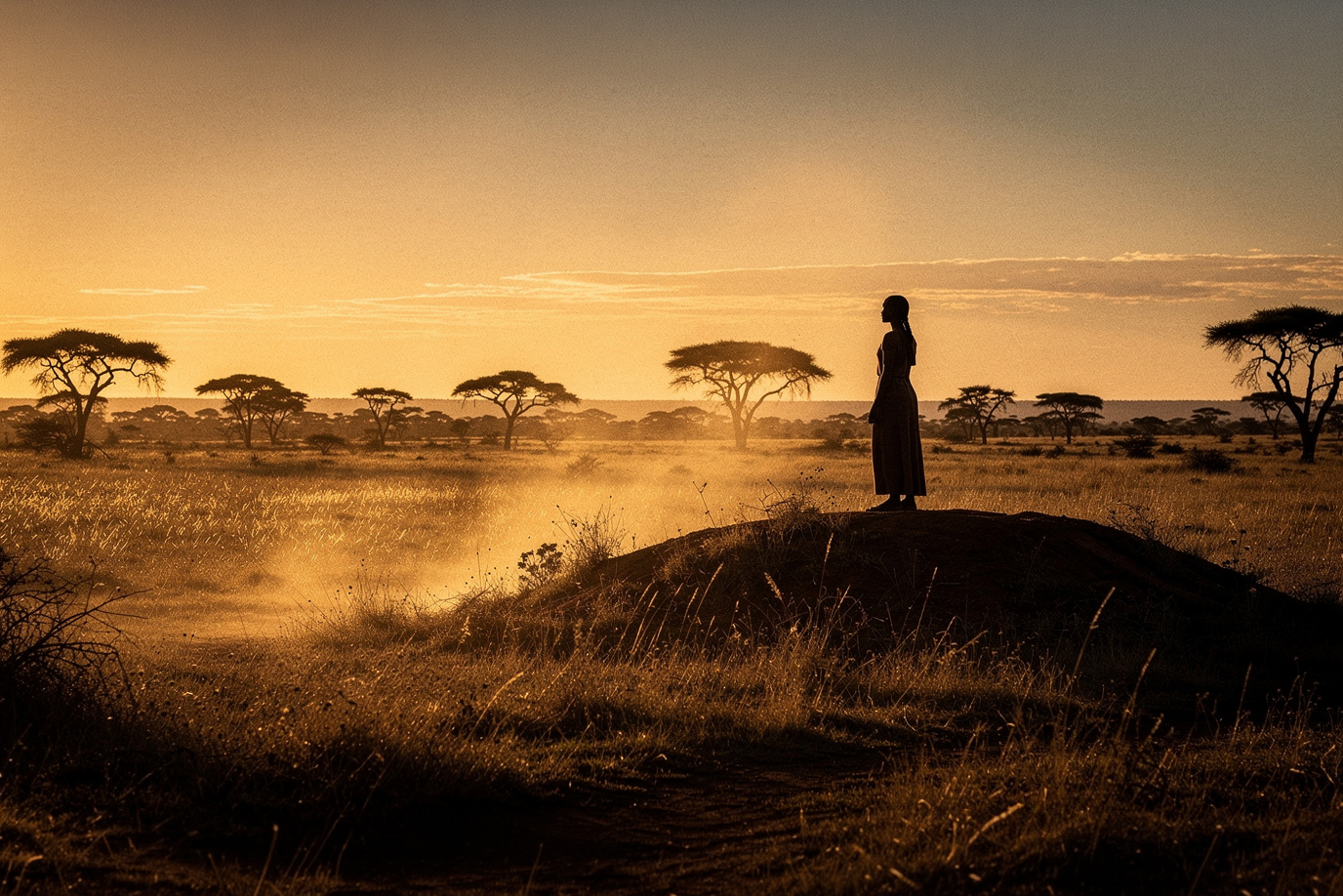
A contemplative essay on Barbara Wood’s The Green City in the Sun: Africa as a living presence, memory as landscape, and the quiet journey back to oneself.
Table of contents:
The Green City in the Sun: On the Returns That Shape Us
There are books we do not simply read — we return to them. Not because we have forgotten the plot, but because something of ourselves remained within their pages. Some stories become places we revisit when we need to find our voice again, our breath, our memory. Among Barbara Wood’s novels, there are many that invite such returns. Yet, The Green City in the Sun is more than just a novel for many readers. It is also more than a novel for me. It is a place lived.
When I picked it up again after years, I realized something. This book is not merely about a woman searching for her place in the world. It is a story about a landscape that transforms a person. It tells of foreign soil reaching into the roots of one’s identity. It also describes memory unfolding like terrain. We return, for a reason. Each of us carries a landscape within us. This landscape, real or internal, once changed us and never let go.
Africa as a Living Being
Wood never writes Africa as an outlandish backdrop. In her hands, Africa is a living presence — breathing, watching, accepting or rejecting. It is a land that tests a person. Yet, it offers a space found nowhere else. It is a space where masks fall away, expectations dissolve, and one stands face to face with oneself.
In The Green City in the Sun, Africa is not scenery. It is a force that enters the characters’ decisions, relationships, fears, and hopes. It is a light that burns and heals. A silence that forces one to hear one’s own thoughts. A vastness where the past can’t hide.
This unrelenting openness is why we return to the book. Because Africa, in this story, is not a dream — it is a truth. And truth demands honesty, even toward oneself.
The Power of a Woman’s Journey
Wood’s female characters are written with such depth that the reader feels they know them personally. They are not perfect; they are not heroes in the traditional sense. They are women learning to live in a space larger than themselves.
And their strength lies precisely there.
The protagonist of The Green City in the Sun stands between two worlds. One is the world she came from. The other is the one calling her. Her journey is not merely geographical. It is a descent into the depths of her identity. Africa forces her to breathe again, to question again, to feel again.
That is why this novel resonates so strongly with readers who have stood at the threshold of change. Those who know that returning home is sometimes impossible — because either the home has changed, or they have.

Memory as Landscape
One of the novel’s most powerful themes is memory. Not nostalgic memory, but memory that behaves like a landscape: sometimes fertile, sometimes barren, sometimes shadowed, sometimes bright. Wood shows that memory is not carried in the mind alone. It is written into the body, into gestures, into the way one sees the world.
Africa becomes a catalyst of memory. Its silence brings long-buried things to the surface. Its light reveals truths one did not want to see. Its rhythm gives birth to a new understanding of self.
Each time I reread the book, I realize that the return is actually a return to myself. One finds something different each time because one has walked a different path in the meantime. And that is the definition of true literature: it changes with us.
A Landscape That Heals
One of the most beautiful aspects of the novel is Wood’s portrayal of the healing power of landscape. Not as romantic escape, but as a process — sometimes painful, sometimes liberating, always true.
The Green City in the Sun is not merely light. It is purification. A force that burns away old layers so that new growth can emerge. A reminder that life is not only what happens to us, but what we do with it.
That is why we return to this book in moments of disorientation. Because it whispers that transformation is possible. That pain can be a beginning. That foreign land can become home if one opens to it.
Why We Return
Every reader has their own reason. Some love the atmosphere. Some the story. Some the characters. But I think there is a deeper reason. The Green City in the Sun is a novel about returning to oneself.
And that theme never ages.
We return because the book reminds us of something missing in everyday life: a space to breathe. A space to be. A space where one’s own voice can be heard without noise.
We return because each of us has an Africa. It is a place that once transformed us. It continues to live within us.
We return because Wood writes with such texture that her words are not merely words. They are images, touches, light.
A Ritual of Return
For me, The Green City in the Sun has become a ritual. It is not just a reading ritual but an existential one. I return not because I have forgotten the plot. I return because I need to step again into a space where things slow down. It is where memory opens and where breath deepens.
Each reading is different. Each reveals a new layer. And each brings me back to the question one asks throughout life: Who am I becoming?
Wood does not offer answers. She offers a landscape in which answers be found.
Conclusion: The Sun That Remains
When I close the book, Africa remains within me. Not as a place, but as a feeling. As a light that returns when needed. It serves as a reminder. Even as the world changes, some stories endure rooted within us. They are like trees that have survived storms.
The Green City in the Sun is not a book I read. It is a book I live. And that is why one returns to it again and again. It holds something that can’t be explained, only experienced.
And so I return. I open the pages. I let the African sun illuminate me once more. Because some books are not merely stories. They are places that shape us.




Leave a Reply