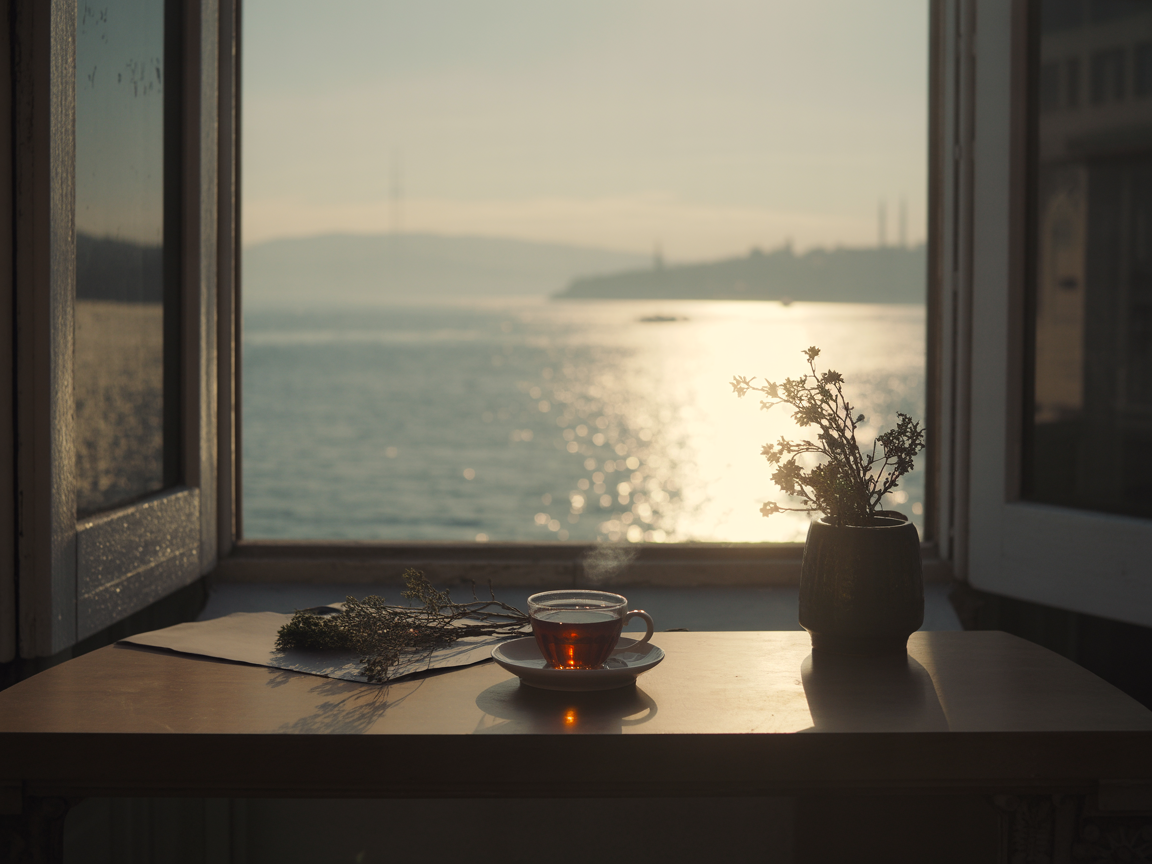
A reflective essay exploring Easter Sunday as the quiet center of the year — a moment of renewal, psychological turning, ritual meaning, and threshold experience in Istanbul. A poetic, philosophical, and introspective meditation on time, change, and inner transformation.
Table of contents:
Easter Sunday as the Quiet Center of the Year
There are days that do not announce themselves. They do not arrive with triumph, they do not demand attention, they do not insist on celebration. And yet something shifts within them — something breaks open, something turns, something is quietly reborn. Easter Sunday is one of these rare days. It’s a threshold day in which light returns. A person can look at their own life from a different angle. Not as a sequence of obligations, but as a landscape in constant transformation.
This day becomes even more intense when experienced outside one’s original cultural frame. Istanbul is a city that serves as a threshold between continents, religions, and eras. Here, Easter becomes an intimate ritual. It is not a public holiday, it does not fill the streets, it does not echo from shop windows. It is silent, private, almost hidden. And in this hiddenness, its true meaning becomes visible.
Spring as a Psychological Turning Point
Easter Sunday is often linked to the story of resurrection. Nevertheless, long before that, it was tied to the return of spring. To the moment when daylight stretches just enough for a person to believe that winter has truly ended. Psychologists call it an archetypal moment of renewal. It is a time when inner energy rises. The body and mind awaken from winter’s muted stillness.
It is no coincidence that people often reconsider their plans, relationships, and direction during this season. Spring is the time of questions: What do I truly want to achieve this year? What should be planted? What should be left behind? These are not trivial questions — they shape the rhythm of the entire year.
Easter Sunday is thus not only a religious symbol but also a psychological pivot. A day when one can say: Yes, something new begins now. Even if the new is not yet visible, it is already here in the air.
Silence Between Two Worlds
In Istanbul, this day has a particular flavor. The city is loud, vibrant, and endlessly in motion. Yet, it holds pockets of silence. These pockets open when one stops rushing. In such an environment, Easter Sunday does not need church bells or processions. Morning light on a balcony. A cup of tea. The shimmering surface of the Bosphorus — a thin line between two worlds — suffices.
This silence is not empty. It is a silence in which one can hear their own thoughts. And sometimes even what lies beneath them: the subtle tension between who one has been and who one is becoming.
Easter Sunday is a bridge. Not only between winter and spring, but also between past and future. It is a day to pause our busy lives. It is a moment to realize that each year brings a small cycle of death and rebirth. Something ends, something begins, and in between the world stands still for a moment.
Ritual as a Way of Giving Shape to Time
Rituals are not merely religious acts. They are ways of giving time a shape, of making it comprehensible. Without rituals, days would blur into one another, and years would disappear without leaving a trace. Easter Sunday is one of those rituals that remind us that time is not only linear but also cyclical. That we return to certain points to breathe again.
For someone who works with archives, heteronyms, and personal mythology, this day has yet another layer. It is an opportunity to inscribe something into the inner calendar. It does not have to be a grand declaration — a short, precise note is enough: Here something changed. Here I chose a different direction. Here I returned to myself.
A ritual does not need to be spectacular. It can be a single sentence, a new paragraph in a personal archive, a symbolic gesture meaningful only to you. What matters is that you give time a form.
A Threshold City, a Threshold Day
Istanbul is a city that lives on the edge. A place where Europe meets Asia, Christianity meets Islam, the old meets the new. In such a city, Easter Sunday becomes a reminder that boundaries are not only geographical. Every person carries their own thresholds: between past and future, fear and courage, the known and the yet‑to‑be‑discovered.
This is why the day feels so powerful. Not because it is loud or ceremonial, but because it is quiet. And in quietness, boundaries become clearer.
Easter Sunday is a moment when one can decide which side of the threshold to step onto. Not as a dramatic gesture, but as a subtle, internal shift. And sometimes the smallest shift can change the entire year.
Renewal as a Daily Practice
Rebirth is not a single event. It is a process that unfolds in small, almost invisible steps. Easter Sunday reminds us that renewal is not something that happens outside of us, but something we create ourselves. With every decision, every gesture, every word.
This quietness is what makes the day so strong. It is not about grand promises or radical transformations. It is about gentle movements that gradually become a new rhythm of life.
And so one ask: What am I renewing today? What am I leaving behind? What is awakening within me? These questions are not mandatory, but they open space. For a new beginning.
A Final Note
Easter Sunday is not just a date on the calendar. It is a state of mind. A moment when light returns but has not yet become blinding. It is a moment to breathe. One can realize that, although the world changes, the inner rhythm can remain steady.
In threshold cities, in threshold years, in threshold moments, this day gains a special force. This day is the quiet center of the year. It is a place where one can pause and say: Yes, I am here. And I continue.



Leave a Reply