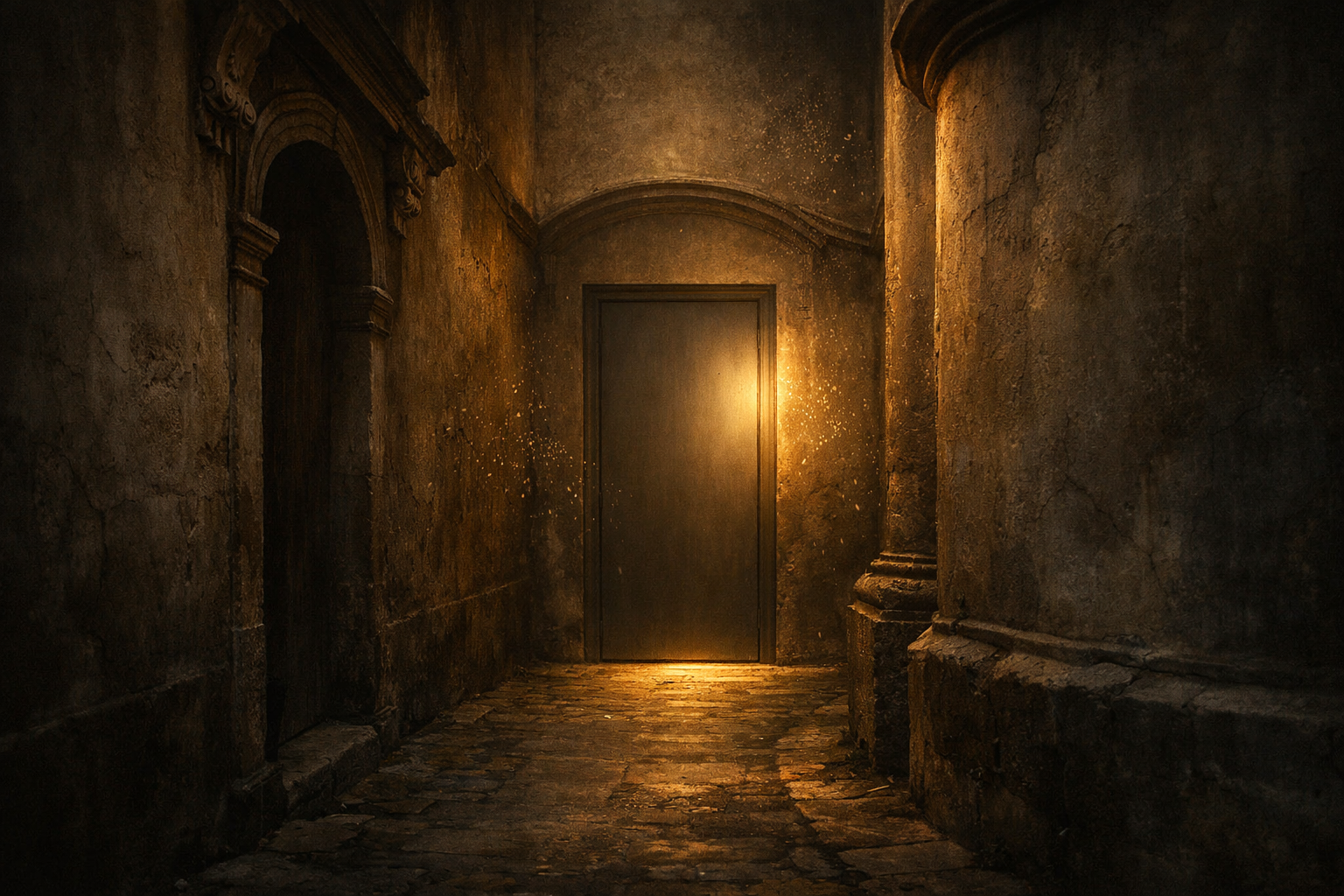
A reflective essay on a symbolic threshold that opens only through an unspoken story: a meditation on courage, inner transformation, creative alchemy, and the room where dreams take shape as images of the soul.
Table of contents:
The Door Without a Key: On the Threshold That Opens Only to an Unspoken Story
There are places that escape the ordinary geography of the world, yet feel more real than anything we can touch. They do not appear on maps, nor do they catch the hurried glance of passersby. They exist as quiet points of rupture, as numinous thresholds in the landscape of the inner self. One such place is a narrow alley hidden from noise and haste, where a door waits—one without a keyhole. It bears no heavy lock, no ornate hinges. Stands instead as a calm, unassuming portal that asks a question simply by being there. It does not open to touch. Does not respond to any mechanical gesture. It yields only when someone dares to speak a story that has never been spoken before. And behind it, in the room beyond the threshold, dreams—once fleeting and formless—begin to take shape, becoming the tangible substance of the soul.
This essay, inspired by the mystery of that door, is a meditation on the quiet mechanisms of transformation, on the architecture of inner passages, and on the alchemy that turns the unspoken into the embodied. In an age saturated with noise and information, the ability to find and articulate our deepest hidden stories becomes an act of rare courage and creativity. It is a process the Polyphonic Archivist knows intimately: arranging the invisible, giving voice to the unheard, shaping form out of the ungraspable.
The Door as an Archetypal Threshold: Guardian of Quiet Secrets
A door, as C. G. Jung once suggested in his reflections on threshold archetypes, is never merely a functional object. It is a symbol of transition, of crossing from the known into the unknown. But a door without a keyhole elevates this symbol to something more demanding. It does not test strength or technical skill. It tests inner readiness. Asks whether we are willing to face our own shadow. It becomes a kind of via negationis—a path that strips away everything external so that we may reach the core.
Its placement in a “quiet alley” is no accident. Much like the hidden chapels of the Baroque imagination, placed deliberately off the main roads to require pilgrimage and focus, this door demands stillness. It refuses the spectacle of central avenues. Echoes that “quiet whisper” I once wrote about in *When Staying Becomes Riskier Than Leaving*—the subtle signal that true transformation rarely announces itself loudly. It is not dramatic. It is felt rather than seen.
The Phenomenology of the Unspoken Threshold
What does it mean for a door to have no keyhole? It means that conventional access fails. The material key—symbol of logic, learned procedures, external authority—has no power here. Some passages in life, some layers of self-knowledge or creativity, cannot be unlocked mechanically. They require a ritual sacrifice: the sacrifice of silence, of concealment. And this is where the story enters.
The Story as Key: The Alchemy of Articulation
“A story that has never been spoken” is the heart of the entire concept.
How many such stories do we carry within us? Stories too painful, too misunderstood, too controversial, or simply too intimate to entrust to the world. They are fragments of the soul, isolated in our inner archive, waiting for their archivist, waiting for the moment of birth.
In “Paper as the Most Honest Friend“, I wrote that paper is “the most honest friend, the one that carries truths people do not want to hear.” Here the shift is deeper: it is not about truths others refuse to hear, but truths we ourselves have not dared to speak—our own suppressed narratives, our hidden oddities, as I called them in “The Book of My Oddities“.
Silence as Prison, Storytelling as Liberation
An unspoken story is not merely an absence of words. It is an entire dimension of existence trapped in silence. Silence can protect, yes—but it can also imprison. It is the way we retreat from ourselves when we fear exposure, when we hesitate to “step out of the shadow”—not the shadow of parents or society, but the shadow of our own fear.
To speak such a story is an act of purification. It releases energy that was previously bound to maintaining silence. It requires a quiet, deep courage—the kind I described in “When Staying Becomes Riskier Than Leaving“: the courage to take the first step into the unknown, to admit vulnerability.
When the story enters language, it leaves the shadows. It becomes a key. Rearranges the inner space. It opens the door.
The Room Where Dreams Become Images: The Creative Alchemy of the Soul
Beyond the door lies a room that is itself a mystery: a space where dreams turn into images. This is not merely a metaphor for artistic creation; it is a metaphor for the embodiment of our deepest, often unconscious desires and intuitions. Dreams are fluid, elusive, and difficult to hold. Images, by contrast, offer solidity, clarity, and the possibility of contemplation.
Think of Santini, whose architectural visions transformed from sketches into breathing spaces of stone and light. Think of Tchaikovsky, whose music turned abstract emotions into landscapes of sound. Here, the same transformation occurs—but on a more intimate plane.
From Fluid Dreams to Solid Images
These “images” need not be visual. They may be poems that articulate feelings once impossible to name. May be melodies that carry the weight of moods long suppressed. They may be sudden insights that carve themselves into the mind and reshape our perception.
They are manifestations of a soul that has found its language—a language stronger than words, as I once wrote in “The Silent Art of Thinking“.
The Image as the Embodied Soul
This process is a ritual. The door tests readiness. The story acts as a catalyst. The image is both a result and a beginning.
This room is not a gallery of finished works. It is a laboratory, an atelier where the psyche is constantly being shaped and reshaped. Every newly spoken story opens the way to new dreams waiting to be embodied. It is a cycle of continuous creation, a perpetual return to oneself—much like the Polyphonic Archivist, the eternal wanderer and maker of inner worlds.
Returning to Oneself Through the Quiet Door
Ultimately, the “Door Without a Key” is a metaphor for the journey toward authenticity. It is not only about creativity; it is about becoming whole. Every unspoken story is a fragment of the self waiting to be released. Every embodied dream is a step toward integration.
In a life that often unfolds “Life Between Choices – Chance – Sacrifice and Regret” as I once wrote, these doors offer the possibility of entering a space where choices become rituals and chance becomes intention. They speak of quiet revolutions that occur within, of overcoming regret through truth, and of building an “archive of longing” that is alive and ever-evolving.
A person is defined not only by what they say but by what they dare to say. And sometimes the deepest conversation is the one we have with ourselves, standing before a door without a key, holding a story that has never before found its way out. When the door opens, we step into a room where our boldest dreams become visible, where the soul takes shape. And in that moment, we become the architects of our own inner universe.
Similar posts:


Leave a Reply