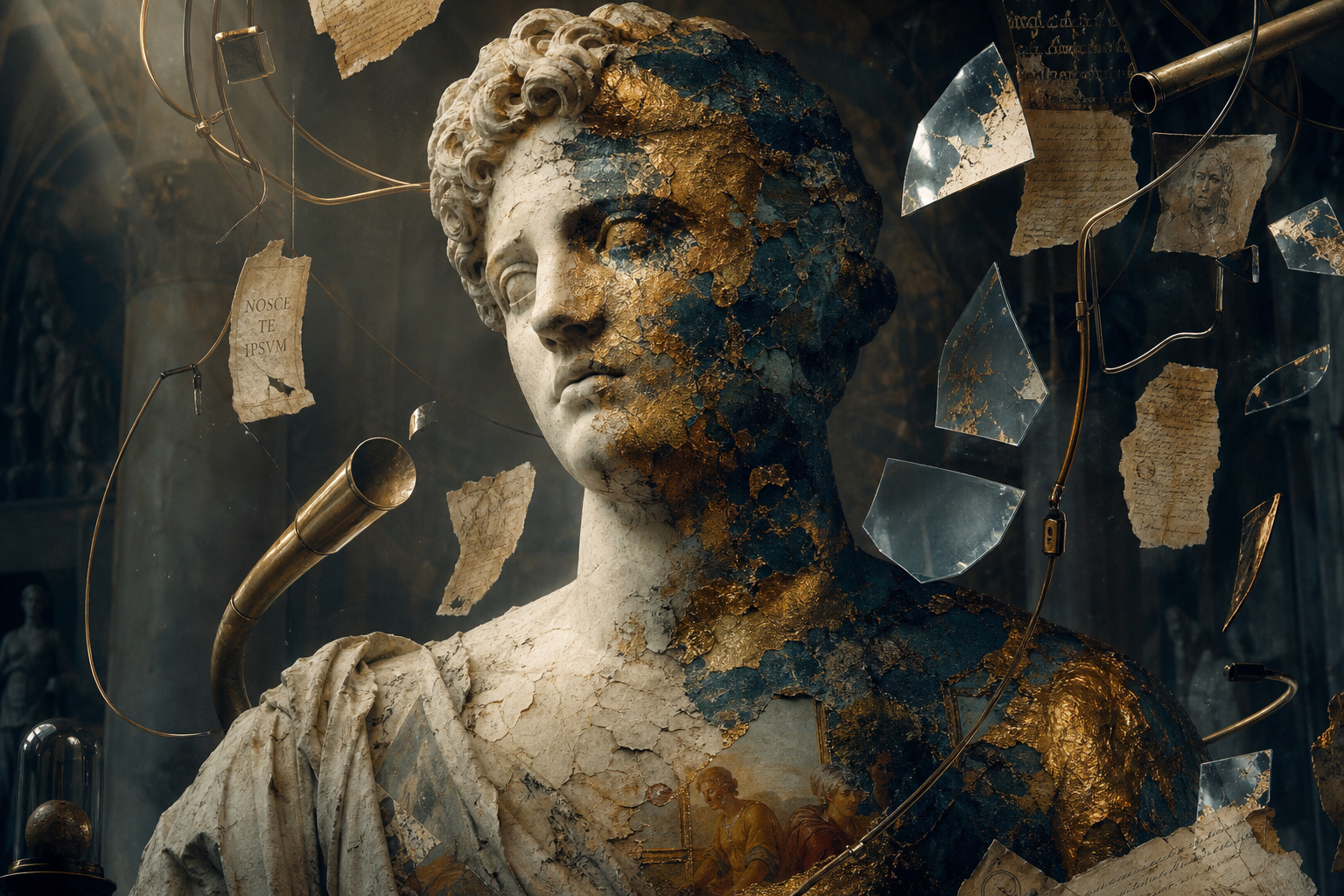
An essay exploring the shifting nature of authenticity in art—from ancient copies to contemporary reinterpretations. A reflection on originality, cultural memory, and the dialogue between the master’s voice and the echo of later generations.
Table of contents:
- Authenticity Through Time: On Changing Masks of Truth and the Echoes of Masters
Authenticity Through Time: On Changing Masks of Truth and the Echoes of Masters
There are moments when our perception of the world—and especially of art—begins to resemble a palimpsest: an ancient parchment where each new layer of truth is written over the previous one without fully erasing it. The question of authenticity, essential to the nature of creation itself, has never been a simple binary between truth and falsehood. It is an endless labyrinth of mirrors, where the reflections of masters blend with the echoes of their followers, and originality becomes a shifting threshold—fluid as liquid silver.
From the quiet temples of antiquity, through the layered workshops of the Renaissance, to contemporary galleries where minimalism—once so pure and untouchable—is now bent and reimagined with bold elegance, the story of authenticity is a story of searching, losing, and constant reinterpretation. This text enters those layers, exploring how our understanding of originality has evolved across epochs and how this dynamic shapes the way we look at contemporary creation—at the very edge of which a new discourse on truth is unfolding.
The Ancient Dilemma: Between the Original and the Echo
Ancient art offers modern viewers one of the most elusive lessons about authenticity. When we stand before a marble sculpture from the Hellenistic era, we rarely consider the complexity of its origins. Most of the works we admire in museums are not “originals” in the sense defined by post-Renaissance Europe. They are Roman copies of Greek masterpieces—created centuries later, adapted to different tastes and functions.
So what, in this context, is truly authentic? The lost Greek bronze we know only from descriptions and fragments? Or the Roman copy that survived the fall of empires and carried the aesthetic ideal across centuries?
Fragments of Stone and the Weight of Time
In Roman workshops, copying was not a source of anxiety. It was an act of homage, a cultural enrichment. Entire studios specialized in producing replicas — not forgeries, but legitimate interpretations of canonical works. This is why today we encounter dozens of versions of Polykleitos’ Doryphoros: none may be the original, yet each bears the imprint of its own era.
In antiquity, authenticity was not tied to the singular hand of a creator. What mattered was the ideal form, mimesis, and the function of the work within ritual and culture. The silence surrounding the names of many masters—and many copyists—is a profound lesson in humility. It reminds us that the value of art can exist beyond the anxious fixation on one
author.
Baroque Shadows and a Vatican Revelation: The Case of El Greco
While antiquity blurred the lines between originals and copies, the Baroque era began to define forgery as deliberate deception. The recent discovery of an El Greco painting in the Vatican—hidden beneath a later overpainting—is a striking example of this shift.
Imagine a painting hanging for centuries in a respected space, believed to be the work of a lesser artist, perhaps a study or a mere copy. Then, under the cracked surface and old retouching, conservators uncover the signature and unmistakable hand of Domenikos Theotokopoulos. “The Crucifixion” emerges from the shadows like a voice breaking through layers of silence.
When the Mask Falls
The paradox is powerful: the layer considered false protected the original, yet condemned it to centuries of invisibility. What becomes of the value of the “fake” when it turns out to have shielded a masterpiece? And how does the fate of a painting change when it is suddenly lifted from anonymity into the center of attention?
Walter Benjamin wrote about the aura of the original—intangible yet potent. A forgery may attempt to imitate it, but can never fully reproduce it. Revealing the truth beneath the false layer is an act of archaeology—literal and metaphorical. The entire perception of the work shifts: from decoration to treasure, from shadow to the gesture of a master. It is like listening to Tchaikovsky’s orchestra and suddenly hearing a solitary violin carrying an unspoken melody.
Modern Metamorphoses: Minimalism in the Hands of Carol Bove
If antiquity questioned mimesis, and the Renaissance questioned authorship, modern and postmodern art push authenticity into new territory. Contemporary artists often bend established forms, reinterpret them, and challenge the very idea of originality in an age of mass reproduction.
Carol Bove, an American sculptor, takes minimalism—one of the most purist movements of the twentieth century—and reshapes it into a dialogue, a critique, and a tribute all at once. She bends metal tubes, colors them, gives them new textures, and disrupts their strict geometry. Her sculptures are industrial and organic, strong and fragile, cool and emotional.
The Aesthetics of Bending: A Dialogue with the Canon
Bove returns to the core principles of minimalism—simplicity, repetition, material truth—but adds elements foreign to the minimalist ethos:
- Visual complexity — layers, textures, subtle shifts of color.
- Historical allusion — echoes of modernism, art deco, and brutalism.
- Emotional undertone — where minimalists sought objectivity, she introduces a lyrical vibration.
This is not imitation but reinterpretation — like Pessoa’s heteronyms, each with its own voice though born from the same source. Bove’s authenticity lies not in new material, but in new meaning.
The Philosophy of Originality: Market, Criticism, and Perception
The definition of “truth” in art evolves with society, technology, and economics. Once, art served ritual purposes, and the author’s name was secondary. Today, the artist’s signature can outweigh the work itself.
In the Baroque and Classical periods, the virtuosity of copyists was valued; studios produced works created by many hands without diminishing their worth. Today’s art market, however, fetishizes the unique—the single, recognizable hand. Provenance has become almost sacred.
Aura, Simulacrum, and Silent Contracts
Benjamin predicted that the age of reproduction would weaken the aura of the original. Paradoxically, it strengthened it. In the digital era, NFTs and blockchain attempt to certify digital originality — a reminder of our longing for unquestionable truth, even when that truth is abstract.
The art market and critical discourse function as invisible contracts, constantly redrawing the boundary between the real and the imitation. The forger does not merely mimic style — they attempt to deceive an entire system. It is an intellectual game with truth, mirroring our own anxieties about authenticity in life. Not all of us are Santini, whose architecture carries an unmistakable signature. Most of us move through a world where truth is sought, yet always subjective.
Conclusion: The Architecture of Quiet Truth
The story of authenticity in art is the story of our own search for meaning. Ancient sculptures remind us that art transcends the individual creator. Baroque paintings, reborn from beneath layers of falsehood, show how time acts as an archaeologist. Contemporary artists bend the canons of the past to reveal new possibilities.
Authenticity is not fixed. It is fluid, evolving with each era, each technology, each gaze. What we consider true today may shift tomorrow. What was once hidden may rise into the light.
And perhaps it is precisely in this uncertainty—in the open, ongoing dialogue between origin and interpretation, between the master’s voice and the follower’s echo—that art finds its deepest authenticity.
Polyphonic Archivist does not seek a final definition, but an endless conversation stretching from the earliest clay tablets to the most delicate digital traces.
Similar posts:


Leave a Reply